For centuries, travelers crossing the rugged hills of southern Africa stumbled upon something they could hardly believe. Rising from the landscape were enormous stone walls, graceful towers, narrow passageways, and massive enclosures—all built without mortar. The ruins looked so impressive that many early visitors simply refused to believe they had been created by African builders.
Instead, they invented stories.
Some claimed the city had been built by ancient Egyptians. Others argued it was the legendary kingdom of the Queen of Sheba. Some even suggested that Phoenician sailors, Arabs, or biblical figures had constructed the remarkable stone complex.
These theories spread widely, not because there was strong evidence for them, but because many people during the colonial era carried deep racial prejudices. They believed that Africans could not have created a sophisticated stone city or managed a powerful kingdom.
Modern archaeology has completely overturned those assumptions.
Today, researchers know that Great Zimbabwe was built by the ancestors of the Shona people between the eleventh and fifteenth centuries. It was the political, economic, and spiritual heart of a flourishing African kingdom whose influence stretched across southern Africa and reached trading ports along the Indian Ocean.
Yet despite this remarkable achievement, Great Zimbabwe still carries an air of mystery. Many questions remain unanswered. Why was the city built where it was? How were its enormous stone walls constructed without mortar? Why was it eventually abandoned? And how did one of Africa’s greatest medieval cities become forgotten by much of the world?
The story of Great Zimbabwe is not only the story of a lost city. It is also the story of forgotten history, scientific discovery, and the determination to uncover the truth behind one of Africa’s greatest archaeological treasures.
Discovering the Stone City
Imagine walking across rolling grasslands dotted with granite hills. The landscape appears peaceful, interrupted only by scattered trees and towering rock formations shaped by millions of years of weathering.
Then, almost unexpectedly, immense stone walls emerge from the earth.
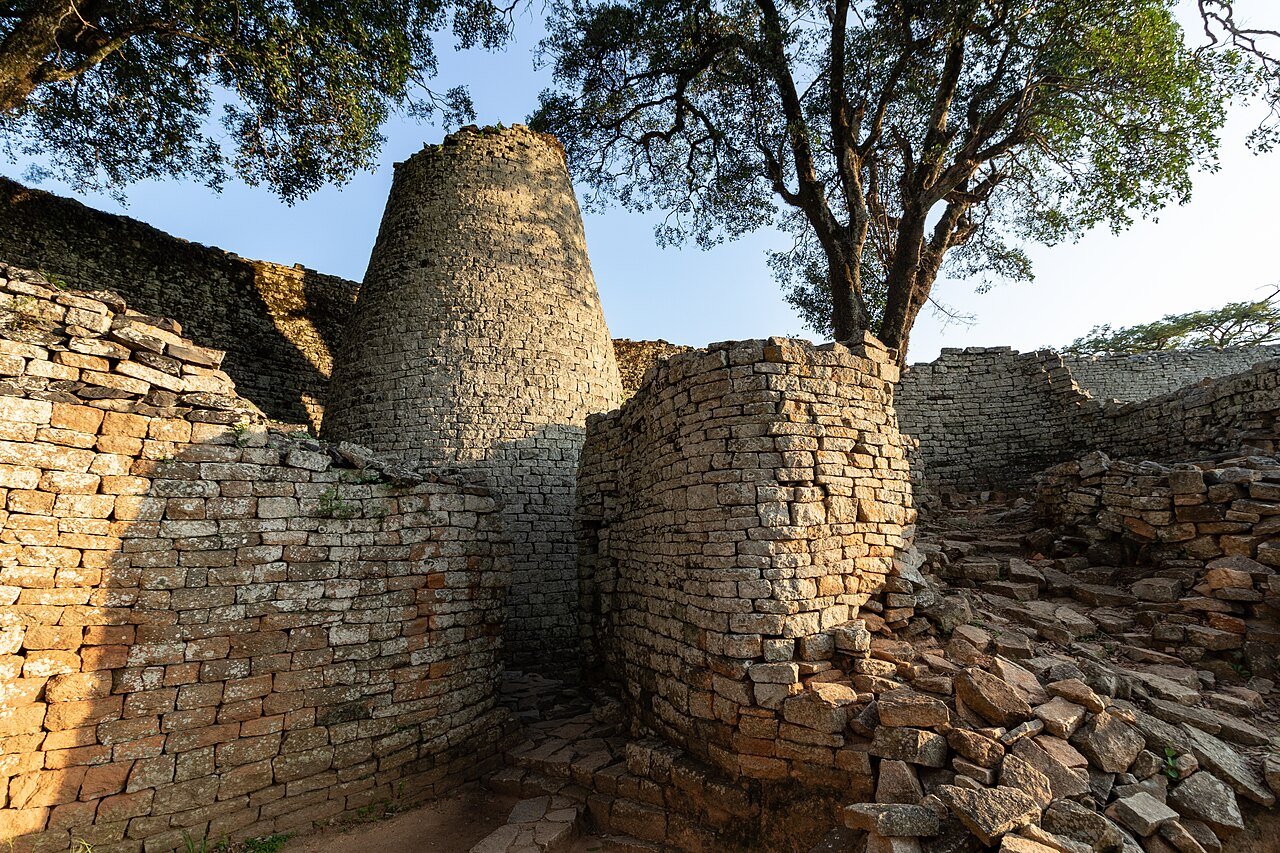
Some rise over eleven meters, or about thirty-six feet, into the air. Others curve gracefully around hilltops or enclose vast courtyards. Every stone has been carefully selected, shaped, and placed without a single drop of mortar.
The walls have stood for more than six hundred years.
Even today, they inspire awe.
The ruins of Great Zimbabwe cover nearly seven square kilometers, making them the largest ancient stone-built settlement south of the Sahara Desert.
Unlike castles in Europe, these structures were not built primarily for warfare. Their elegant curves, impressive gateways, and decorative stone patterns suggest they served political, ceremonial, and residential purposes.
The city reflects extraordinary planning, engineering, and craftsmanship.
Its builders possessed remarkable architectural knowledge that continues to impress modern archaeologists.
What Does “Zimbabwe” Mean?
The name “Zimbabwe” comes from the Shona language.
Most scholars interpret it as meaning “houses of stone” or “venerated houses.”
The name perfectly describes the site.
Stone was far more than a building material.
It represented permanence, authority, and prestige.
Most ordinary people in the kingdom lived in homes made from wood, clay, and thatch. Stone architecture was reserved for rulers, elites, and important ceremonial spaces.
Building in stone communicated power.
The enormous walls announced that this was the center of an influential kingdom capable of organizing thousands of workers over many generations.
The Natural Landscape
Great Zimbabwe occupies a remarkable setting in what is now southeastern Zimbabwe.
The region enjoys seasonal rainfall, fertile valleys, and nearby rivers.
Granite dominates the landscape.
Over millions of years, weathering fractured the granite into flat slabs that could easily be collected and shaped into building stones.
This natural abundance of stone partly explains why the builders chose dry-stone construction.
The surrounding environment also supported agriculture.
Farmers cultivated crops while herding cattle across nearby grasslands.
The area contained valuable mineral resources, particularly gold.
These natural advantages helped transform Great Zimbabwe into a prosperous regional center.
The Rise of a Kingdom
Great Zimbabwe did not appear overnight.
Its origins stretch back to farming communities that gradually settled the region centuries before the city’s construction.
These early societies raised cattle, cultivated sorghum and millet, produced iron tools, and developed extensive trade networks.
Over time, population increased.
Communities became wealthier.
Political leadership became more centralized.
By around the eleventh century, construction of monumental stone buildings began.
Generation after generation expanded the settlement.
Each ruler added new walls, enclosures, and ceremonial areas.
The city reached its greatest size between the thirteenth and fifteenth centuries.
At its peak, Great Zimbabwe may have supported between ten thousand and twenty thousand inhabitants, making it one of medieval Africa’s largest urban centers.
Building Without Mortar
One of Great Zimbabwe’s greatest mysteries lies in its construction.
The walls were built entirely without mortar.
Instead, builders carefully selected granite blocks and shaped them into remarkably uniform sizes.
Each stone rested securely upon the next.
Weight, balance, and careful craftsmanship held everything together.
This technique is known as dry-stone masonry.
It required tremendous skill.
Builders had to understand how different stones fit together, how walls distributed weight, and how slight adjustments could improve stability.
Many walls curve gracefully rather than forming sharp angles.
These curves were not accidental.
Rounded structures distribute stress more evenly, increasing long-term stability.
Remarkably, many of these walls remain standing after hundreds of years despite earthquakes, storms, and changing weather.
Their durability demonstrates an advanced understanding of architecture developed through experience rather than written engineering manuals.
The Hill Complex
The oldest section of Great Zimbabwe occupies a granite hill rising above the surrounding landscape.
Known today as the Hill Complex, it likely served both political and religious functions.
Stone stairways wind through narrow passages leading toward elevated enclosures.
The position offered commanding views across the surrounding countryside.
Height often symbolized authority.
Living or conducting ceremonies above ordinary settlements reinforced the ruler’s special status.
Archaeologists believe important rituals probably occurred here.
Some researchers suggest the Hill Complex served as the residence of early rulers before later expansion into the valley below.
Its maze-like design continues to puzzle visitors.
The arrangement may have reflected ceremonial traditions whose meanings have long been forgotten.
The Great Enclosure
Perhaps the most famous structure at Great Zimbabwe is the Great Enclosure.
This enormous circular complex contains one of the largest ancient dry-stone walls in the world.
The outer wall reaches more than five meters in thickness in some places.
Inside stands the mysterious Conical Tower.
Unlike defensive towers elsewhere in the world, this structure contains no rooms, windows, or staircases.
It is completely solid.
Its purpose remains uncertain.
Some archaeologists believe it symbolized royal authority.
Others suggest it represented grain storage, fertility, or political power.
Whatever its original meaning, the Conical Tower remains one of Africa’s most iconic archaeological monuments.
A City of Symbols
Great Zimbabwe was more than an impressive collection of buildings.
Every structure likely carried symbolic meaning.
Stone walls separated social groups.
Gateways controlled movement.
Elevated platforms emphasized hierarchy.
Large open courtyards provided space for ceremonies and public gatherings.
Architecture communicated authority without written language.
Visitors approaching the city would immediately recognize they were entering the center of a powerful kingdom.
The careful organization of space reflected an equally organized society.
The Zimbabwe Birds
Among the site’s most famous discoveries are the Zimbabwe Birds.
These remarkable soapstone sculptures depict stylized birds perched upon tall columns.
Eight such sculptures have been found.
Their exact meaning remains debated.
Many researchers believe they represented royal authority or spiritual guardians.
Others connect them with ancestral beliefs central to Shona culture.
Today, the Zimbabwe Bird has become one of the country’s most important national symbols.
It appears on the national flag, coins, and official emblems.
Although their original purpose remains uncertain, the birds connect modern Zimbabwe with its remarkable past.
Life Inside the City
Great Zimbabwe was a thriving urban center filled with activity.
Families lived in circular houses constructed from clay, wood, and thatch.
Children played among courtyards.
Craftspeople shaped pottery, forged iron tools, carved soapstone, and produced jewelry.
Farmers brought grain into the city.
Herders managed large cattle herds.
Merchants exchanged goods arriving from distant regions.
The city bustled with conversation, trade, religious ceremonies, and political meetings.
Smoke rose from cooking fires.
Music echoed through ceremonial gatherings.
The smell of livestock mixed with fresh crops harvested from nearby fields.
Far from being an isolated monument, Great Zimbabwe was once alive with thousands of people pursuing ordinary lives beneath extraordinary stone walls.
Cattle and Wealth
In Great Zimbabwe, wealth was measured not only in gold but also in cattle.
Cattle provided milk, meat, leather, and social prestige.
They played essential roles in marriage arrangements, ceremonies, and political relationships.
Owning large herds demonstrated prosperity.
Archaeological excavations have uncovered abundant cattle bones, confirming their importance.
Control of cattle strengthened political leadership.
Rulers who managed large herds could reward supporters, organize labor, and reinforce their authority.
The economy rested upon both agriculture and livestock.
Gold and Long-Distance Trade
Perhaps the greatest source of Great Zimbabwe’s wealth came from trade.
The surrounding region contained rich gold deposits.
Local miners extracted gold, which entered trade networks extending hundreds and even thousands of kilometers.
Merchants transported gold toward ports along the East African coast.
From there, traders connected with merchants from Arabia, Persia, India, and China.
Archaeologists have discovered imported ceramics from China, glass beads from Asia, and other foreign goods at Great Zimbabwe.
These discoveries reveal that the city participated in an international trading system stretching across the Indian Ocean.
Although Great Zimbabwe lay far inland, it was connected to a global medieval economy.
The Indian Ocean World
Trade transformed Great Zimbabwe into a prosperous kingdom.
Along Africa’s eastern coastline, wealthy Swahili city-states linked African kingdoms with overseas merchants.
Ships followed seasonal monsoon winds across the Indian Ocean.
They carried gold, ivory, animal skins, and other African products outward.
They returned with textiles, ceramics, beads, spices, and luxury goods.
Great Zimbabwe occupied a strategic position within this network.
Its rulers controlled valuable resources while maintaining political authority over surrounding territories.
Trade enriched the kingdom and supported monumental construction.
Religion and Spiritual Life
Religion formed an essential part of Great Zimbabwe’s society.
Like many African cultures, the ancestors of the Shona people emphasized relationships between the living and their ancestors.
Spiritual leaders likely conducted ceremonies seeking guidance, protection, and blessings.
Certain areas within the city may have served ceremonial purposes.
The elevated Hill Complex may have possessed particular religious significance.
The Zimbabwe Birds probably held symbolic importance connected with leadership or spirituality.
Although many details remain uncertain, archaeology suggests that political authority and religious belief were closely connected.
The ruler was likely both a political leader and an important spiritual figure.
Who Truly Built Great Zimbabwe?
For modern scholars, this question has been answered through decades of archaeological research.
The builders were African.
More specifically, they were ancestors of today’s Shona-speaking peoples.
Evidence comes from pottery styles, ironworking traditions, settlement patterns, oral history, radiocarbon dating, and cultural continuity.
Excavations consistently demonstrate local development over several centuries.
There is no archaeological evidence supporting claims that Egyptians, Phoenicians, Israelites, or Europeans constructed the city.
Great Zimbabwe represents an extraordinary achievement of indigenous African engineering and statecraft.
This conclusion rests upon overwhelming scientific evidence.
Colonial Myths and Misunderstandings
Yet accepting this truth was not always easy.
During the nineteenth century, European colonizers encountered Great Zimbabwe with preconceived beliefs about Africa.
Many simply refused to believe African societies could have created such sophisticated architecture.
As a result, they proposed increasingly imaginative alternatives.
Some blamed the Phoenicians.
Others credited Arabs.
Still others connected the ruins with biblical stories.
These theories reflected racial prejudice rather than archaeological evidence.
Excavations that supported African origins were sometimes ignored or suppressed because they challenged colonial ideology.
The history of Great Zimbabwe therefore became entangled with politics as well as archaeology.
Archaeology Changes the Story
Scientific archaeology gradually dismantled these myths.
Careful excavations documented continuous local occupation.
Radiocarbon dating established construction periods centuries after the Phoenician civilization had declined.
Artifacts matched regional African traditions rather than Mediterranean cultures.
Linguistic evidence supported connections with Shona-speaking communities.
Every new discovery strengthened the same conclusion.
Great Zimbabwe was built by Africans.
Today, this conclusion enjoys overwhelming support among archaeologists worldwide.
The mystery no longer concerns who built the city.
Instead, researchers focus on understanding how its society functioned and why it eventually declined.
Why Was Great Zimbabwe Abandoned?
Perhaps the greatest remaining mystery concerns the city’s decline.
By the fifteenth century, Great Zimbabwe gradually lost political importance.
Several explanations have been proposed.
Environmental pressures may have affected agriculture.
Growing populations could have strained local resources.
Trade routes shifted over time.
Political centers often move as new kingdoms emerge.
Rather than experiencing sudden destruction, Great Zimbabwe appears to have declined gradually.
Its population dispersed.
Political leadership shifted elsewhere.
New regional powers developed.
The stone walls remained, silently watching as centuries passed.
Rediscovery by the Modern World
European travelers began describing the ruins during the nineteenth century.
Their reports astonished readers.
Many could hardly imagine such architecture existing deep within southern Africa.
Unfortunately, early excavations often caused damage.
Treasure hunters disturbed archaeological layers searching for gold and artifacts.
Valuable information disappeared before proper scientific methods became standard.
Later archaeological work adopted far more careful techniques, preserving evidence for future generations.
Today, Great Zimbabwe stands as one of Africa’s most important archaeological sites.
Great Zimbabwe Today
Visitors walking through Great Zimbabwe experience a profound sense of history.
The stone walls still curve elegantly across the landscape.
Birdsong echoes among ancient passageways.
Massive granite hills overlook valleys much as they did centuries ago.
The city has become a symbol of national pride.
Its name inspired the modern nation of Zimbabwe when the country gained independence in 1980.
The ruins remind both citizens and visitors that southern Africa possessed powerful kingdoms long before European colonial expansion.
They stand as enduring evidence of African creativity, leadership, and engineering.
Lessons from Great Zimbabwe
The story of Great Zimbabwe teaches important lessons extending beyond archaeology.
It reminds us that history can be misunderstood when prejudice shapes interpretation.
For decades, overwhelming evidence was ignored because it conflicted with colonial assumptions.
Only careful scientific investigation corrected these misconceptions.
The city also demonstrates the remarkable complexity of medieval African civilizations.
Too often, global history has overlooked Africa’s achievements.
Great Zimbabwe challenges outdated narratives by revealing sophisticated architecture, extensive trade networks, political organization, and cultural richness.
It encourages a broader understanding of human history.
Why the Mystery Endures
Even though archaeologists know who built Great Zimbabwe, the site retains an undeniable sense of mystery.
Questions remain about ceremonial practices, political succession, architectural symbolism, and everyday life.
Many meanings embedded within the stone walls may never be fully recovered.
Unlike civilizations that left extensive written records, Great Zimbabwe communicated primarily through architecture, material culture, and oral traditions.
These sources provide valuable information but also leave room for interpretation.
Each new excavation reveals another small piece of a much larger puzzle.
Conclusion
Great Zimbabwe is one of humanity’s greatest archaeological achievements and one of Africa’s most inspiring historical monuments. Rising from the granite hills of southern Africa, its towering dry-stone walls testify to centuries of ingenuity, organization, and cultural achievement. Built by the ancestors of the Shona people between the eleventh and fifteenth centuries, the city served as the heart of a powerful kingdom connected to trade networks stretching across the Indian Ocean.
For many years, colonial myths obscured this remarkable truth. Unable or unwilling to recognize African accomplishments, early writers attributed the city to distant civilizations despite a lack of evidence. Modern archaeology has firmly corrected that narrative. Pottery, architecture, radiocarbon dating, metallurgy, settlement patterns, and oral traditions all point to indigenous African builders whose skills rivaled those of many medieval societies around the world.
Yet Great Zimbabwe continues to inspire wonder. The elegant curves of its mortarless walls, the mysterious Conical Tower, the symbolic Zimbabwe Birds, and the silent passageways of the Hill Complex invite endless curiosity. The city reminds us that not every mystery lies in discovering who built a monument. Sometimes the deeper mystery is understanding the lives, beliefs, ambitions, and dreams of the people who once filled those stones with laughter, ceremony, commerce, and hope.
Today, Great Zimbabwe stands not as the ruin of a forgotten people but as enduring proof of Africa’s rich and sophisticated past. Its stones continue to speak across the centuries, telling a story of resilience, innovation, and cultural brilliance. They remind us that history is most powerful when guided by evidence rather than assumption and that humanity’s greatest achievements belong to no single civilization, but to the shared story of our species.