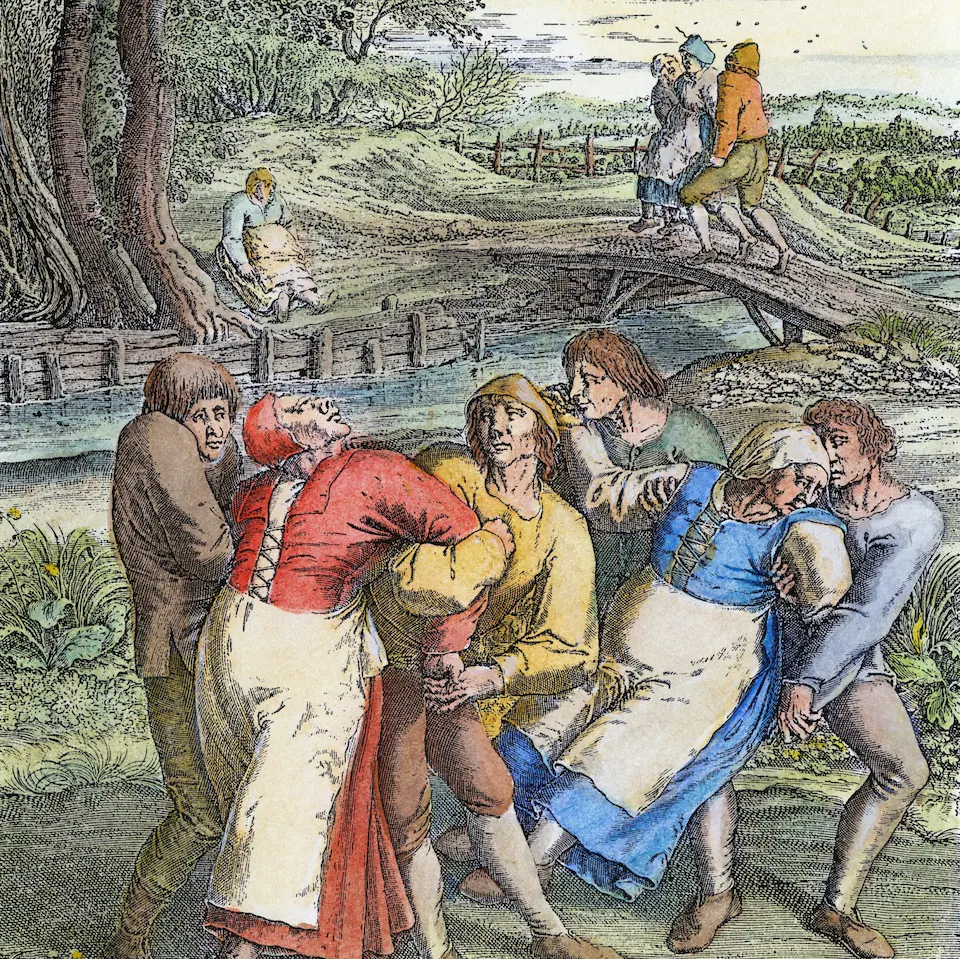
In the summer of 1518, something extraordinary happened in the city of Strasbourg, a thriving community within the Holy Roman Empire that is now part of modern-day France. It began with a single woman dancing alone in the street. At first, her behavior seemed strange but not necessarily alarming. People stopped to stare. Some laughed. Others assumed she was celebrating something or had simply lost her senses.
But then she kept dancing.
Hours passed. Then days.
Soon, others joined her.
Within weeks, dozens of people were dancing uncontrollably. Eventually, hundreds became caught up in the strange phenomenon. Witnesses reported people leaping, twirling, and convulsing in the streets despite obvious exhaustion. Many appeared unable to stop. Some collapsed from fatigue, dehydration, or physical injury. Contemporary accounts even claimed that a number of participants died.
The event became known as the Dancing Plague of 1518, one of the most bizarre episodes in recorded history.
More than five hundred years later, historians, doctors, psychologists, and scientists still debate what truly happened. Was it a medical condition? A psychological epidemic? Religious hysteria? Poisoning? Or something else entirely?
The mystery remains one of history’s most fascinating puzzles because it challenges our understanding of human behavior. The people who danced in Strasbourg were not pretending. Contemporary records suggest that they genuinely experienced something powerful and frightening. Yet modern science struggles to fully explain how such an event could occur.
The Dancing Plague reminds us that history is often stranger than fiction.
A Summer Day That Changed Everything
The story begins in July 1518.
According to historical records, a woman known as Frau Troffea stepped into a street in Strasbourg and began dancing.
There was no music.
There was no festival.
There was no celebration.
She simply started moving.
At first, people likely viewed the incident as odd but harmless. Yet what made the situation remarkable was that she did not stop.
She danced throughout the day.
Then she continued the next day.
And the day after that.
Witnesses reportedly observed her dancing almost continuously for several days. Her movements were not graceful performances intended to entertain spectators. They appeared compulsive, exhausting, and beyond her control.
Soon, other individuals began exhibiting the same behavior.
The number of dancers steadily increased.
What started with a single person gradually transformed into a public crisis.
Strasbourg in 1518
To understand the Dancing Plague, it is important to understand the world in which it occurred.
Life in sixteenth-century Europe was incredibly difficult.
Most people lived close to poverty. Crop failures were common. Disease outbreaks frequently devastated communities. Medical knowledge was limited. Religious beliefs shaped nearly every aspect of daily life.
Strasbourg itself was an important city, but its residents had recently endured years of hardship.
Poor harvests had caused food shortages.
Many people struggled with hunger.
Diseases regularly threatened the population.
Economic instability created constant uncertainty.
In such an environment, stress was not merely an occasional experience. It was a permanent feature of life.
Modern people often underestimate the psychological burden faced by medieval communities. Imagine living in a world where a bad harvest could mean starvation, where disease could wipe out entire families, and where natural disasters seemed like signs of divine punishment.
Fear was everywhere.
This atmosphere would later become central to many explanations of the Dancing Plague.
The Crowd Begins to Grow
As days passed, more people joined the strange dance.
Contemporary reports suggest that dozens of individuals became affected.
Some accounts indicate that eventually hundreds participated, though historians debate the exact number.
Regardless of the precise figures, the outbreak clearly expanded beyond a single individual.
The dancers reportedly moved continuously for hours or even days.
Witnesses described people sweating heavily, collapsing from exhaustion, and then resuming their movements.
Some cried out in pain.
Others appeared dazed or disconnected from reality.
The scene must have been deeply unsettling.
Imagine walking through the streets of your city and seeing neighbors, friends, and family members dancing without control, unable to stop despite visible suffering.
To the people of Strasbourg, it may have seemed as though some supernatural force had taken hold of the community.
The Authorities Become Involved
As the number of dancers increased, city officials grew concerned.
The situation was no longer a curiosity.
It had become a public emergency.
Unfortunately, the authorities misunderstood the nature of the problem.
According to historical records, local leaders consulted physicians.
These doctors concluded that the dancers suffered from what they called “hot blood.”
Their diagnosis reflected the medical beliefs of the time rather than modern scientific understanding.
The physicians believed the dancers needed to continue moving until the condition naturally resolved itself.
As a result, officials made a decision that seems astonishing today.
Instead of stopping the dancing, they encouraged it.
They arranged spaces where people could dance.
Musicians were hired.
Stages were constructed.
The idea was that allowing the dancers to move freely would help them recover.
In reality, if the participants were already exhausted, this response likely made the situation worse.
The Human Cost
One reason the Dancing Plague remains so famous is the claim that people died from dancing.
Several historical sources suggest that some participants collapsed due to exhaustion, heart problems, strokes, or dehydration.
The exact death toll remains uncertain.
Some later accounts claimed that fifteen people died each day at the height of the outbreak.
Most modern historians believe these figures may be exaggerated.
The evidence does not clearly support such precise numbers.
However, even if the death toll was lower than reported, the event was undoubtedly dangerous.
Human bodies are not designed for prolonged, intense physical activity without adequate rest.
Continuous dancing under summer heat could lead to severe physical stress.
Participants likely suffered muscle injuries, dehydration, and extreme fatigue.
For observers, the spectacle must have been terrifying.
The dancers were not celebrating.
They were trapped.
Religion and Fear
Religion played a central role in how people interpreted the outbreak.
In medieval Europe, unusual events were often viewed through a spiritual lens.
Many residents believed supernatural forces influenced daily life.
Saints, demons, curses, and divine punishment were accepted realities for many people.
One figure became especially important during the Dancing Plague: Saint Vitus.
Saint Vitus was a Christian saint associated with neurological disorders and involuntary movements.
A widespread belief held that Saint Vitus could either inflict or cure certain afflictions involving uncontrollable dancing.
As the crisis worsened, many people concluded that the dancers had been cursed by the saint.
This explanation may seem strange today, but it made sense within the cultural framework of the time.
When people cannot understand an event scientifically, they often seek explanations that fit their existing worldview.
For sixteenth-century Europeans, religion provided that framework.
The Pilgrimage to Saint Vitus
Eventually, authorities abandoned their strategy of encouraging dancing.
Instead, they turned toward religious solutions.
The afflicted were reportedly transported to a shrine associated with Saint Vitus.
There, priests performed rituals intended to remove the curse.
Some accounts describe special ceremonies involving prayers, blessings, and religious symbols.
Interestingly, historical records suggest that the outbreak gradually subsided after these measures were implemented.
To modern observers, this raises an intriguing question.
Did the religious intervention actually cure the dancers?
Or did the participants recover because the social and psychological conditions fueling the outbreak began to change?
The answer remains uncertain.
What is clear is that belief itself may have played an important role.
If people sincerely believed that Saint Vitus could heal them, the rituals may have had a powerful psychological effect.
Was It Really a Plague?
The term “Dancing Plague” can be misleading.
Unlike diseases caused by bacteria or viruses, the Strasbourg outbreak does not appear to have involved a contagious pathogen.
No evidence suggests that an infectious organism spread from person to person.
Instead, historians use the word “plague” because the behavior spread through the community in a manner resembling an epidemic.
The dancers influenced one another.
As more people became affected, the phenomenon gained momentum.
This pattern resembles what modern researchers call mass psychogenic illness.
Understanding this concept is crucial to understanding the most widely accepted explanation for the event.
The Theory of Mass Psychogenic Illness
Today, many historians and psychologists believe the Dancing Plague was an example of mass psychogenic illness.
This condition occurs when psychological stress manifests as physical symptoms within a group of people.
The symptoms are real.
They are not faked.
Participants genuinely experience them.
Mass psychogenic illness has been documented throughout history.
People have suddenly developed unexplained tremors, fainting episodes, paralysis, nausea, and other symptoms without an identifiable physical cause.
These outbreaks often occur in communities experiencing intense stress or fear.
The affected individuals are not pretending.
Their bodies respond to psychological pressures in powerful ways.
The Strasbourg outbreak fits many characteristics associated with this phenomenon.
The population was under enormous stress.
Religious beliefs provided a framework for interpreting unusual behavior.
The symptoms spread socially.
The outbreak eventually ended without leaving evidence of a conventional disease.
For many experts, this explanation remains the strongest.
Why Stress Can Affect the Body
Modern neuroscience has shown that the mind and body are deeply connected.
Stress does not exist only in our thoughts.
It produces physical effects throughout the body.
Heart rate increases.
Hormone levels change.
Muscles tense.
Sleep patterns are disrupted.
Immune function can be affected.
In extreme circumstances, psychological distress can contribute to dramatic physical symptoms.
People experiencing severe emotional strain sometimes develop blindness, paralysis, seizures, or involuntary movements despite having no structural damage to the affected organs.
These conditions demonstrate the extraordinary power of the human brain.
The dancers of Strasbourg may have been experiencing an extreme manifestation of this mind-body connection.
Their suffering was real.
Their movements were real.
But the source may have been psychological rather than infectious.
The Ergot Poisoning Theory
Not everyone accepts the mass psychogenic illness explanation.
One alternative theory involves a fungus known as ergot.
Ergot can grow on rye and other grains.
When consumed, it produces toxic compounds that affect the nervous system.
In some cases, ergot poisoning can cause hallucinations, muscle spasms, and unusual behavior.
Because medieval Europeans often relied on rye bread, some researchers proposed that contaminated grain triggered the outbreak.
At first glance, the theory appears plausible.
However, most modern experts reject it.
Ergot poisoning typically causes symptoms that differ significantly from those described during the Dancing Plague.
Victims often experience severe illness, pain, gangrene, and neurological problems that would make prolonged dancing nearly impossible.
Furthermore, ergot poisoning would not easily explain why so many people engaged in similar movements over an extended period.
As a result, historians generally view the ergot hypothesis as less convincing than psychological explanations.
Could It Have Been a Neurological Disease?
Another possibility is that the dancers suffered from an unknown neurological disorder.
Certain medical conditions can produce involuntary movements.
Diseases affecting the nervous system sometimes cause tremors, spasms, or repetitive behaviors.
Yet this explanation faces significant challenges.
Neurological diseases rarely spread through communities in the pattern observed in Strasbourg.
The social contagion aspect of the outbreak remains difficult to explain through purely biological causes.
Moreover, no evidence suggests the presence of a previously unknown neurological epidemic.
While medical factors may have contributed to individual cases, they do not appear sufficient to explain the event as a whole.
Earlier Dancing Epidemics
One fascinating aspect of the Strasbourg outbreak is that it was not unique.
Similar incidents occurred elsewhere in Europe during the Middle Ages.
Historical records describe outbreaks of uncontrollable dancing dating back centuries before 1518.
Some involved large groups of people moving frantically through towns and villages.
Others included strange convulsions and ecstatic behavior.
These recurring episodes suggest that the Dancing Plague was part of a broader historical phenomenon rather than an isolated event.
The repetition strengthens arguments for cultural and psychological explanations.
Communities sharing similar beliefs, fears, and social pressures may have been vulnerable to comparable outbreaks.
The Strasbourg incident was simply one of the best-documented examples.
The Power of Belief
Belief can profoundly influence human behavior.
Throughout history, people have experienced visions, miracles, possessions, and other extraordinary events shaped by cultural expectations.
This does not necessarily mean such experiences are imaginary.
Rather, it highlights how human perception interacts with belief systems.
In sixteenth-century Strasbourg, many people believed Saint Vitus could cause uncontrollable dancing.
They lived in a deeply religious society.
They faced enormous stress.
When one person began dancing, others may have interpreted the event through familiar cultural narratives.
This interpretation could have made similar symptoms more likely to appear in susceptible individuals.
The result was a self-reinforcing cycle.
Fear generated symptoms.
Symptoms increased fear.
The outbreak grew.
What Witnesses Actually Saw
One challenge in studying the Dancing Plague is the reliability of historical sources.
The event occurred more than five centuries ago.
Many records were written after the fact.
Some accounts may contain exaggerations.
Others reflect the biases of their authors.
Historians must carefully evaluate each source.
Despite these challenges, certain details appear consistently.
People danced.
The behavior lasted for weeks.
Authorities became involved.
Religious explanations played a major role.
The outbreak eventually ended.
These core facts are well supported.
The precise number of participants, the exact death toll, and the specific symptoms remain less certain.
Historical mysteries often involve balancing evidence with uncertainty.
The Dancing Plague is no exception.
The Psychological Reality of Collective Behavior
Modern psychology offers numerous examples of collective behavior that may seem irrational from the outside.
Crowds can influence emotions, perceptions, and actions.
People often unconsciously imitate those around them.
Social environments shape individual experiences more than many realize.
Under certain conditions, entire groups can become caught up in powerful shared beliefs and behaviors.
The Strasbourg outbreak demonstrates how social forces can amplify individual experiences into community-wide events.
What happened there was not simply about dancing.
It was about human beings responding to fear, uncertainty, and cultural expectations together.
Why the Mystery Endures
More than five hundred years later, the Dancing Plague continues to capture imaginations.
Part of its appeal lies in its sheer strangeness.
History contains wars, revolutions, and disasters.
But hundreds of people dancing uncontrollably through city streets feels almost surreal.
The event challenges assumptions about human behavior.
It reminds us that people in the past were not fundamentally different from us.
They experienced stress, fear, hope, and confusion just as we do.
Yet they lived within cultural frameworks that shaped those experiences differently.
The Dancing Plague offers a rare glimpse into the intersection of psychology, culture, religion, and history.
Lessons From the Dancing Plague
The Strasbourg outbreak teaches several important lessons.
It demonstrates the powerful connection between mind and body.
It highlights the influence of cultural beliefs on human experience.
It reveals how communities respond to crises when explanations are uncertain.
Most importantly, it reminds us that people are deeply social creatures.
Our emotions, perceptions, and behaviors do not exist in isolation.
They are influenced by the people around us and the stories we tell ourselves about the world.
The Dancing Plague was not simply a medical mystery.
It was a human mystery.
And that may be why it continues to fascinate researchers today.
Conclusion
The Dancing Plague of 1518 remains one of history’s most extraordinary and puzzling events. What began with a single woman dancing in the streets of Strasbourg evolved into a community-wide crisis that baffled witnesses and continues to challenge scholars centuries later.
Although no explanation can account for every detail with complete certainty, the most convincing evidence points toward mass psychogenic illness fueled by extreme stress, religious beliefs, and social contagion. The people who danced were not pretending or participating in a festival. They appear to have been experiencing a genuine and deeply distressing condition shaped by the psychological and cultural realities of their time.
Alternative theories, including ergot poisoning and neurological disease, have been proposed but generally fail to explain the full scope of the outbreak. The mystery persists partly because historical evidence is incomplete and partly because human behavior is often more complex than simple explanations allow.
In the end, the Dancing Plague is more than a historical curiosity. It is a reminder of the extraordinary ways in which the human mind, body, and society interact. It shows how fear, belief, and collective experience can shape reality in ways that seem almost impossible to modern observers.
Five hundred years after the dancers finally stopped moving, their story still echoes through history. It remains a haunting reminder that sometimes the greatest mysteries are not hidden in distant places or ancient ruins. Sometimes they are found within the human mind itself.