For centuries, the ancient Maya have fascinated the world. Their towering pyramids rise above tropical forests, their cities reveal remarkable engineering, and their inscriptions preserve stories from a civilization that flourished long before European contact with the Americas. Yet among all their achievements, few subjects have generated as much intrigue as the Mayan calendars.
For many people, the phrase “Mayan calendar” immediately brings to mind prophecies about the end of the world. In the years leading up to 2012, books, documentaries, websites, and television programs warned that the Maya had predicted a global catastrophe. Some expected earthquakes, others anticipated planetary alignments, and still others imagined dramatic spiritual transformations. As December 21, 2012 approached, excitement and anxiety spread across the globe.
Then the day arrived.
And nothing extraordinary happened.
The world continued turning.
The Sun rose the next morning.
Life went on.
Yet the real story of the Mayan calendars is far more fascinating than the myths that surrounded 2012. Far from being a system designed to predict the apocalypse, the Mayan calendars represent one of humanity’s greatest achievements in astronomy, mathematics, and timekeeping. They reveal a civilization that carefully observed the movements of celestial bodies and developed an extraordinarily sophisticated understanding of cycles in nature.
The question remains: were the Mayan calendars prophetic tools predicting future events, or were they masterpieces of astronomical precision?
The answer lies in understanding who the Maya were, how they viewed time, and why their calendar system continues to amaze scholars today.
Who Were the Maya?
The Maya were one of the most advanced civilizations of the ancient Americas.
Their civilization developed across regions that today include southern Mexico, Guatemala, Belize, Honduras, and El Salvador. For thousands of years, Maya societies built cities, created monumental architecture, developed complex political systems, and produced remarkable works of art and literature.
The height of Maya civilization occurred during what historians call the Classic Period, roughly between AD 250 and AD 900. During this era, cities such as Tikal, Palenque, and Copán became centers of power, learning, and culture.
The Maya developed one of the few fully functional writing systems in the ancient world. They recorded historical events, royal lineages, religious ceremonies, and astronomical observations on monuments, pottery, and books.
Unlike many ancient civilizations, the Maya left behind an enormous amount of information about how they understood time.
Their calendars were not simple tools for marking days. They were deeply woven into religion, politics, agriculture, and daily life.
To understand the calendars, we first need to understand how the Maya viewed the universe itself.
The Maya and Their View of Time
Modern societies often think of time as a straight line.
Yesterday is behind us.
Tomorrow is ahead.
History moves forward from one event to the next.
The Maya viewed time somewhat differently.
For them, time was often cyclical.
Events repeated in patterns.
The movements of the Sun, Moon, planets, and stars created recurring rhythms.
Seasons returned year after year.
Religious ceremonies followed established cycles.
Historical events were frequently interpreted through the lens of previous cycles.
This cyclical understanding of time influenced every aspect of Mayan life.
Rather than seeing time as a road stretching endlessly forward, the Maya often saw it as a series of interconnected wheels turning within larger wheels.
The calendar systems they developed reflected this worldview.
Why Calendars Were So Important
Today, most people use calendars simply to organize schedules.
We check dates, plan appointments, and celebrate holidays.
For the Maya, calendars had far greater significance.
Calendars helped determine when crops should be planted and harvested.
They guided religious rituals.
They influenced political decisions.
They helped rulers legitimize their authority.
They connected earthly events with cosmic cycles.
In many ways, understanding time was considered essential for maintaining harmony between humans, nature, and the gods.
As a result, Mayan astronomers and priests devoted enormous effort to studying celestial movements.
The calendars they created became among the most sophisticated in human history.
The Myth of a Single Mayan Calendar
One of the most common misconceptions is that the Maya used a single calendar.
In reality, they used several interconnected calendar systems simultaneously.
Each served a different purpose.
Some tracked religious cycles.
Others followed solar years.
Still others measured vast spans of historical time.
These systems worked together like gears in a complex machine.
Their interaction allowed the Maya to record dates with remarkable precision.
This complexity is one reason the calendar system continues to fascinate researchers.
It demonstrates a deep understanding of mathematics and astronomy.
The Sacred Tzolk’in Calendar
One of the most important Mayan calendars was the Tzolk’in.
This sacred calendar consisted of 260 days.
Unlike modern calendars, it was not based directly on the solar year.
Instead, it combined a sequence of twenty day names with numbers from one to thirteen.
As these cycles rotated together, each day received a unique combination.
After 260 days, the pattern repeated.
The exact reason for the 260-day cycle remains debated.
Some scholars suggest it may relate to agricultural rhythms.
Others believe it may reflect human gestation periods.
Still others argue that astronomical observations influenced its development.
Whatever its origin, the Tzolk’in played a central role in religious life.
Priests used it to determine auspicious dates for ceremonies, rituals, and important decisions.
Each day carried symbolic meanings and associations.
The calendar helped guide interactions between humans and the spiritual world.
The Haab’: The Solar Calendar
Alongside the Tzolk’in, the Maya used a solar calendar known as the Haab’.
This calendar consisted of 365 days, remarkably close to the length of the solar year.
The Haab’ was divided into eighteen months of twenty days each.
An additional five-day period completed the year.
These final days were often viewed as spiritually dangerous or uncertain.
The Haab’ served practical purposes.
It helped coordinate agricultural activities.
It tracked seasonal changes.
It organized civic and political events.
The existence of a 365-day calendar demonstrates that the Maya carefully observed the annual cycle of the Sun.
Their measurements were impressively accurate given the tools available to them.
The Calendar Round
The Tzolk’in and Haab’ did not operate independently.
Instead, they worked together in a system known as the Calendar Round.
Each day could be identified by combining dates from both calendars.
Because the cycles differed in length, a particular combination would not repeat for approximately 52 years.
This created a larger cycle that played an important role in Mayan culture.
For many individuals, a complete Calendar Round roughly corresponded to a human lifetime.
The interaction between these calendars reflects the sophistication of Mayan mathematical thinking.
It allowed them to identify dates with considerable precision while maintaining connections between religious and solar cycles.
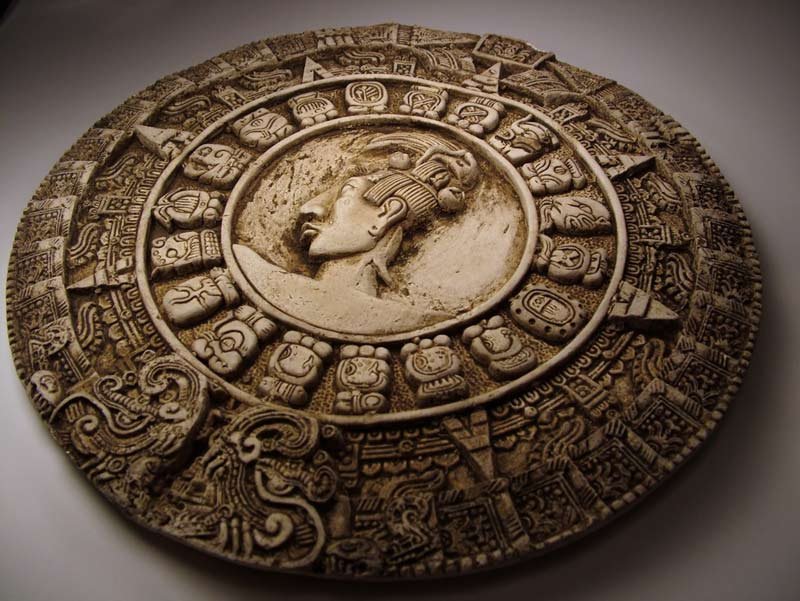
The Long Count Calendar
The calendar most associated with the 2012 controversy is the Long Count.
Unlike the Tzolk’in and Haab’, which repeated continuously, the Long Count tracked the passage of time over enormous periods.
The system counted days from a mythological starting point corresponding to 3114 BC in modern calculations.
Instead of months and years, the Long Count used units based on multiples of days.
This structure allowed the Maya to record dates spanning thousands of years.
Monuments often included Long Count dates to commemorate historical events, royal accessions, and important ceremonies.
The Long Count was essentially a chronological framework.
It enabled the Maya to place events within vast cycles of time.
This capability was extraordinary for an ancient civilization.
The Maya and Mathematics
The success of the Mayan calendars depended upon mathematics.
The Maya developed one of the most advanced mathematical systems in the ancient world.
They used a base-20 numbering system.
Even more impressively, they employed a symbol representing zero.
The concept of zero is one of humanity’s greatest mathematical inventions.
Many civilizations struggled to develop it.
The Maya used zero centuries before it became widespread in Europe.
This innovation made complex calculations possible.
Without it, their calendar systems would have been far less sophisticated.
The connection between mathematics and astronomy formed the foundation of Mayan timekeeping.
Astronomy and the Maya
The Maya were extraordinary observers of the sky.
Night after night, generation after generation, they tracked celestial movements with remarkable dedication.
Without telescopes or modern instruments, they recorded the positions of the Sun, Moon, planets, and stars.
These observations accumulated over centuries.
Patterns emerged.
Cycles became predictable.
Astronomical knowledge grew increasingly precise.
The Maya understood that celestial events followed regular rhythms.
Their calendars reflected these rhythms.
Far from being mystical guesswork, much of their system was rooted in careful observation.
This is one reason modern researchers continue to admire Mayan astronomy.
Tracking the Movements of Venus
Among all celestial bodies, Venus held special significance for the Maya.
The planet was associated with important religious and political meanings.
Mayan astronomers carefully tracked its movements.
They recorded when Venus appeared as the Morning Star and when it became the Evening Star.
The accuracy of these observations is astonishing.
Mayan records preserved in surviving manuscripts demonstrate a sophisticated understanding of Venus’s cycle.
They were able to predict appearances of the planet with impressive precision.
This achievement required long-term observation and mathematical analysis.
It highlights the scientific capabilities of Mayan astronomers.
Observing the Moon
The Maya also paid close attention to the Moon.
Lunar cycles influenced rituals, ceremonies, and calendar calculations.
Astronomers recorded patterns in the Moon’s phases and movements.
Some Mayan records reveal calculations related to eclipses.
Although eclipse prediction was challenging, the Maya recognized recurring patterns.
Their observations helped integrate lunar cycles into broader systems of timekeeping.
This combination of solar, lunar, and planetary observations created a remarkably comprehensive understanding of celestial rhythms.
Architecture Aligned with the Sky
Evidence of Mayan astronomical knowledge appears not only in calendars but also in architecture.
Many buildings were carefully aligned with celestial events.
At several sites, structures appear positioned to mark solstices, equinoxes, or planetary observations.
When sunlight strikes certain buildings during specific times of year, dramatic visual effects occur.
These alignments suggest deliberate planning.
They indicate that astronomy was deeply integrated into religious and political life.
The sky served as both a scientific laboratory and a sacred realm.
Architecture became a bridge connecting the two.
Understanding the 2012 Phenomenon
No discussion of Mayan calendars is complete without addressing 2012.
In popular culture, the date became associated with predictions of apocalypse.
Books warned of global destruction.
Television programs speculated about catastrophic events.
Internet rumors spread rapidly.
Many people believed the Maya had predicted the end of the world.
The reality was very different.
The Long Count calendar included large cycles.
One of these cycles ended on December 21, 2012.
For the Maya, this marked the completion of a significant period of time.
But ending a cycle does not necessarily mean ending the world.
To understand this, consider a modern calendar.
When December 31 arrives, one year ends.
The next year begins.
No one expects the world to disappear simply because a calendar cycle concludes.
The same principle applies to the Long Count.
What the Maya Actually Believed
The surviving evidence does not support claims that the Maya predicted a global apocalypse in 2012.
Ancient inscriptions discussing future dates generally treat them as continuations of time rather than endings.
Some inscriptions even reference dates far beyond 2012.
If the Maya expected the world to end, it would be strange for them to discuss events occurring afterward.
The misconception arose largely from modern interpretations rather than ancient texts.
Popular media often exaggerated the significance of the date.
The actual evidence paints a much less dramatic picture.
For the Maya, the completion of a cycle was meaningful, but it was not necessarily catastrophic.
Why the Apocalypse Myth Spread
The popularity of the 2012 prophecy reveals something interesting about modern society.
Humans are naturally attracted to dramatic predictions.
End-of-the-world stories capture attention.
They evoke fear, curiosity, and excitement.
The mystery surrounding the Maya made the narrative even more appealing.
Because relatively few people understood the complexities of the calendar system, misinformation spread easily.
Ancient wisdom appeared to confirm modern anxieties.
The result was one of the most famous misunderstandings in archaeological history.
Ironically, the obsession with apocalypse often overshadowed the genuine achievements of Mayan science.
The Real Achievement of the Mayan Calendars
The true wonder of the Mayan calendars is not prophecy.
It is precision.
The Maya created systems capable of tracking multiple cycles simultaneously.
They integrated astronomy, mathematics, religion, and history into a coherent framework.
They monitored celestial movements over generations.
They developed methods for recording dates spanning thousands of years.
These accomplishments required intellectual sophistication and sustained observation.
Modern scholars continue to study Mayan records because they reveal extraordinary achievements in scientific thinking.
The calendars represent centuries of accumulated knowledge.
Deciphering Ancient Maya Texts
For many years, scholars struggled to understand Mayan inscriptions.
The writing system remained largely undeciphered.
As a result, much of Mayan history remained hidden.
During the twentieth century, major breakthroughs transformed the field.
Researchers gradually learned how to read the inscriptions.
Historical events, royal biographies, and astronomical records began to emerge.
These discoveries revolutionized understanding of Maya civilization.
The calendars became clearer.
Their purpose became easier to interpret.
The evidence increasingly pointed toward sophisticated timekeeping rather than apocalyptic prediction.
The Emotional Power of Time
One reason the Mayan calendars continue to captivate people is that they deal with something deeply human: time itself.
Every person experiences the passage of days, months, and years.
We celebrate birthdays.
We mark anniversaries.
We remember the past and anticipate the future.
The Maya elevated this experience into something cosmic.
Their calendars connected individual lives to celestial cycles.
They suggested that human existence was part of a much larger pattern.
This perspective remains emotionally powerful.
Even today, many people find comfort in the idea that life participates in rhythms greater than ourselves.
Lessons from the Maya
The story of the Mayan calendars offers valuable lessons.
It reminds us that ancient civilizations were capable of remarkable intellectual achievements.
It demonstrates the importance of careful observation.
It highlights the power of mathematics to reveal patterns in nature.
It also warns against misunderstanding the past.
Modern assumptions can sometimes distort ancient ideas.
The 2012 phenomenon illustrates how easily myths can overshadow evidence.
Yet it also shows how deeply people remain fascinated by ancient knowledge.
The challenge is to separate fact from fiction while preserving a sense of wonder.
Prophecy or Astronomical Precision?
So were the Mayan calendars prophetic tools or products of astronomical precision?
The evidence strongly favors astronomical precision.
The calendars were rooted in centuries of observation.
They tracked celestial cycles with impressive accuracy.
They reflected mathematical sophistication and systematic thinking.
This does not mean the Maya lacked spiritual beliefs.
On the contrary, religion permeated their understanding of time.
Astronomy and spirituality were deeply interconnected.
But the calendars themselves functioned primarily as systems for organizing and understanding temporal cycles.
Their purpose was not to predict a specific apocalypse.
Their purpose was to measure time and connect human life to the rhythms of the cosmos.
The Enduring Legacy of the Mayan Calendars
More than a thousand years after many great Maya cities declined, their calendars continue to inspire fascination.
Archaeologists study them.
Historians analyze them.
Astronomers admire their precision.
Visitors marvel at monuments bearing ancient dates.
The calendars stand as a testament to human curiosity.
They remind us that people everywhere have looked toward the sky and wondered about their place in the universe.
The Maya answered those questions with extraordinary creativity and intelligence.
Their achievement was not a prediction of the world’s end.
It was the creation of one of the most sophisticated systems of timekeeping ever developed.
Conclusion
The Mayan calendars are among the greatest intellectual achievements of the ancient world. Although popular culture often portrays them as prophetic instruments that predicted the end of civilization, the historical evidence tells a different story. The calendars were primarily tools of astronomical observation, mathematical calculation, religious organization, and historical record-keeping.
The Maya carefully tracked the movements of the Sun, Moon, Venus, and other celestial bodies. They developed interconnected calendar systems capable of measuring both everyday life and vast spans of time. Their understanding of cycles allowed them to create a framework that was astonishingly sophisticated for its era.
The famous 2012 prediction was largely a modern misunderstanding. For the Maya, the end of a calendar cycle represented renewal rather than destruction. Time continued beyond the cycle, just as it always had.
In the end, the real wonder of the Mayan calendars is not that they foretold the future. It is that they reveal the brilliance of a civilization determined to understand the rhythms of the universe. Their legacy reminds us that long before modern science, people were already observing the heavens with patience, intelligence, and awe.
The Mayan calendars remain a powerful symbol of humanity’s enduring desire to find order, meaning, and beauty in the passage of time.