Few lost treasures have captured the human imagination as powerfully as the treasures of King Solomon. For nearly three thousand years, stories of unimaginable wealth, sacred artifacts, hidden vaults, and secret chambers have surrounded the legendary ruler of ancient Israel. His name has become almost synonymous with wisdom and riches. Across continents and centuries, explorers, treasure hunters, archaeologists, religious scholars, and adventurers have wondered the same thing: What happened to Solomon’s treasures?
Were they stolen during invasions? Were they hidden beneath Jerusalem before enemy armies arrived? Did they travel to distant lands? Could they still be buried somewhere beneath ancient ruins, waiting to be discovered?
The mystery is fascinating because it sits at the intersection of history, religion, archaeology, and legend. Unlike fictional treasure tales, the story begins with a real historical kingdom that existed in the ancient Near East. Yet over time, historical facts became intertwined with legends so extraordinary that separating truth from myth became increasingly difficult.
Today, the treasures of King Solomon remain among history’s greatest unsolved mysteries. Their story is one of glory, faith, conquest, loss, and a centuries-long search for answers.
The Man Behind the Legend
To understand the mystery of Solomon’s treasures, we must first understand the man himself.
According to the Hebrew Bible, Solomon was the son of King David and the third king of the united Kingdom of Israel. He is traditionally believed to have ruled during the tenth century BCE.
Solomon became famous not only for his wealth but also for his wisdom. Stories describing his intelligence became legendary. Even people who know little about ancient history often recognize the famous tale in which Solomon proposed dividing a disputed baby to reveal the child’s true mother.
Under Solomon’s rule, Israel was said to experience peace, prosperity, and international influence. Trade expanded, alliances flourished, and enormous building projects transformed the kingdom.
The most famous of these projects was the construction of the First Temple in Jerusalem, often called Solomon’s Temple.
This magnificent structure would become central to the treasure mystery.
Solomon’s Astonishing Wealth
Biblical descriptions portray Solomon as one of the wealthiest rulers in history.
Gold appears repeatedly throughout accounts of his reign. Vast amounts reportedly flowed into the kingdom through trade, tribute, and commerce. Precious stones, exotic animals, rare woods, silver, ivory, and luxury goods arrived from distant lands.
The biblical narrative describes a royal court overflowing with riches.
Gold drinking vessels supposedly replaced ordinary containers. Decorative shields were made of gold. The king’s throne itself was described as an extraordinary masterpiece adorned with ivory and precious materials.
Ancient visitors were said to be overwhelmed by the splendor they witnessed.
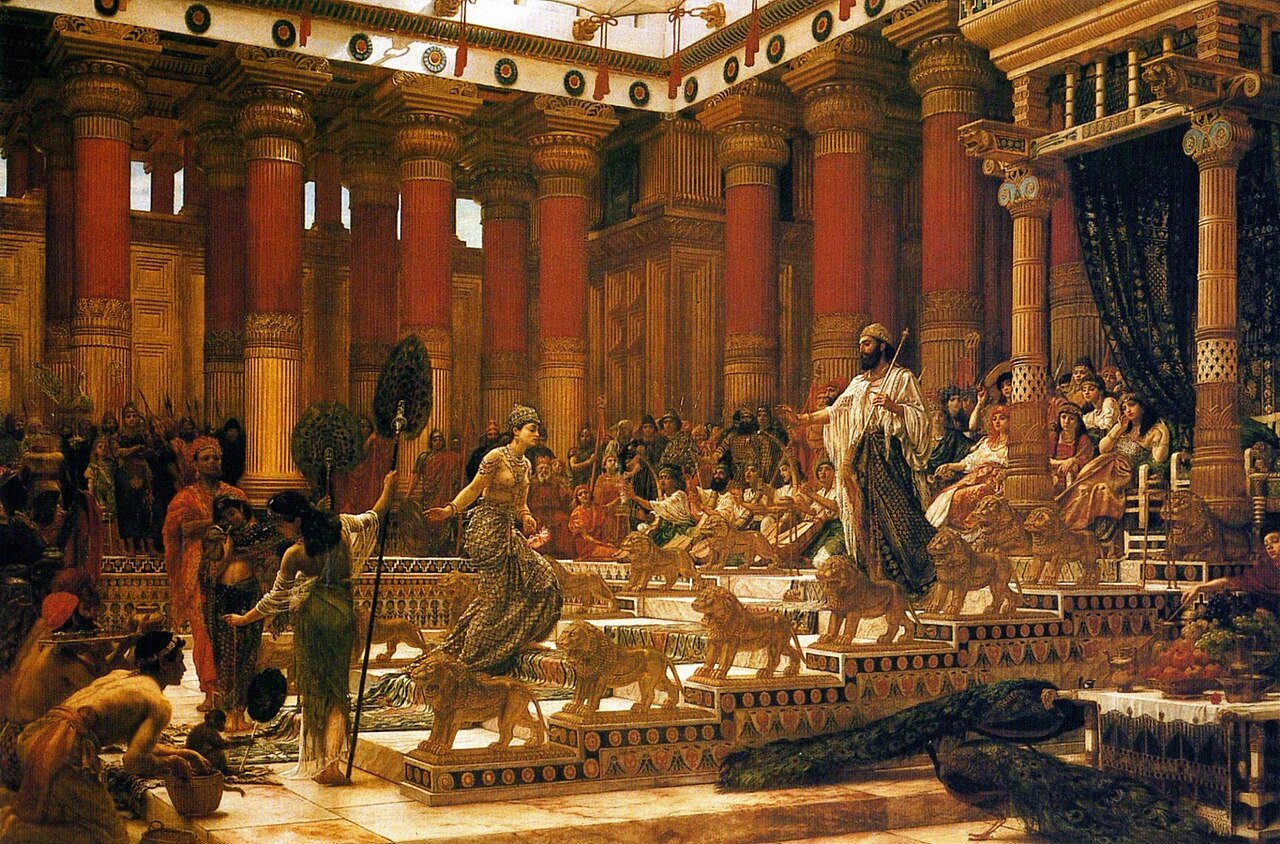
Among them was the famous Queen of Sheba, whose visit became one of the most enduring stories associated with Solomon’s reign.
Whether every detail is historically accurate remains debated among scholars. Ancient texts often exaggerated royal achievements. Yet archaeological evidence suggests that powerful kingdoms throughout the ancient Near East did indeed accumulate remarkable wealth.
Even if biblical descriptions contain embellishments, Solomon’s kingdom may still have possessed enormous riches by the standards of its time.
The First Temple: A House Filled With Treasure
The greatest repository of Solomon’s wealth was believed to be the First Temple.
Located in Jerusalem, this sacred structure served as the spiritual center of ancient Israel.
According to biblical accounts, its construction required immense resources. Cedar wood was imported from Lebanon. Skilled craftsmen worked on elaborate decorations. Gold covered many surfaces inside the building.
The Temple housed sacred objects used in religious ceremonies. It also contained treasures donated by kings, nobles, and worshippers.
The descriptions are striking.
Walls were overlaid with gold.
Sacred furnishings were crafted from precious metals.
Treasury chambers stored valuable offerings.
For generations, the Temple accumulated wealth and religious artifacts.
This concentration of riches would eventually make it a target.
Was Solomon’s Temple Really as Magnificent as Described?
Historians face a difficult challenge when evaluating biblical descriptions of Solomon’s Temple.
The original structure no longer exists.
As a result, scholars cannot directly examine it.
Some researchers believe biblical accounts may exaggerate the Temple’s size and wealth.
Others argue that the building could indeed have been impressive for its era, even if later writers amplified certain details.
Archaeology has revealed that monumental temples throughout the ancient Near East often contained substantial riches.
Gold, silver, bronze, and precious objects were commonly dedicated to religious institutions.
Therefore, while the exact scale remains uncertain, the idea that Solomon’s Temple housed significant wealth is entirely plausible.
The mystery begins not with whether treasures existed, but with what happened to them.
The Long Shadow of Conquest
Ancient kingdoms rarely enjoyed permanent security.
Throughout history, prosperous cities attracted powerful enemies.
Jerusalem was no exception.
After Solomon’s reign, the united kingdom eventually fractured into separate states. Political instability followed.
Foreign powers rose and fell across the region.
As centuries passed, Jerusalem faced invasions, conflicts, and periods of occupation.
Each crisis increased the possibility that Temple treasures could be looted, relocated, hidden, or destroyed.
The fate of Solomon’s wealth became increasingly uncertain.
By the time later generations looked back upon the glory of Solomon’s age, much had already vanished into history.
The Babylonian Catastrophe
One of the most significant events in the treasure mystery occurred in 586 BCE.
That year, the Neo-Babylonian Empire under Nebuchadnezzar II captured Jerusalem.
The city was devastated.
The Temple was destroyed.
Many inhabitants were taken into exile.
Ancient records indicate that Temple treasures were seized and carried away.
Biblical texts describe sacred vessels being removed from the Temple and transported to Babylon.
At first glance, this seems to solve the mystery.
The treasures were looted.
Case closed.
Yet the reality is far more complicated.
Not every treasure may have been taken.
Some could have been hidden beforehand.
Others may have disappeared during later events.
And once treasures entered imperial collections, their subsequent histories often became difficult to trace.
The mystery only deepened.
Did Priests Hide the Treasures?
One enduring theory suggests that Temple priests anticipated the Babylonian invasion.
According to this idea, sacred artifacts and valuable treasures were concealed before enemy forces arrived.
The theory has an understandable logic.
Throughout history, religious communities have hidden sacred objects during times of crisis.
When danger approaches, preserving holy artifacts often becomes a priority.
If priests believed Jerusalem was about to fall, they may have attempted to protect important treasures.
Some legends claim these objects were buried beneath Jerusalem.
Others suggest they were hidden in caves or secret chambers.
No conclusive evidence has ever confirmed these stories.
Yet the possibility continues to intrigue researchers and treasure hunters alike.
The Mysterious Copper Scroll
Among the most fascinating clues connected to hidden Temple treasures is the Copper Scroll.
Discovered near the Dead Sea in the twentieth century, this unusual document differs from other Dead Sea Scrolls.
Instead of religious teachings, it appears to contain a list of hidden treasures and their locations.
The scroll describes large quantities of gold and silver allegedly concealed in various places.
Some researchers have wondered whether these treasures could be connected to the Temple.
Others remain skeptical.
The document’s origins are still debated.
Its treasure descriptions may be symbolic, historical, or even exaggerated.
Despite decades of investigation, none of the treasures listed in the scroll have been conclusively identified.
As a result, the Copper Scroll remains one of archaeology’s most tantalizing mysteries.
Hidden Beneath Jerusalem?
Perhaps no location has inspired more speculation than Jerusalem itself.
For centuries, people have imagined hidden chambers beneath the ancient city.
Legends describe secret tunnels, underground vaults, and forgotten repositories containing sacred relics.
Some stories claim that Solomon himself created hidden passages beneath the Temple complex.
Others suggest that later priests concealed treasures there during periods of crisis.
The problem is that investigating many of these claims is extraordinarily difficult.
Jerusalem is one of the world’s most sensitive archaeological locations.
Layers of history, religious significance, and modern urban development complicate excavation efforts.
Consequently, vast portions of the ancient city remain unexplored.
This uncertainty allows the mystery to endure.
Somewhere beneath Jerusalem, many believe, secrets may still lie hidden.
The Ark of the Covenant Connection
Any discussion of Solomon’s treasures inevitably leads to one of history’s most famous missing artifacts: the Ark of the Covenant.
According to biblical tradition, the Ark was housed within the Temple.
The sacred chest contained the stone tablets associated with Moses and held immense religious significance.
When the Babylonians destroyed Jerusalem, the Ark disappeared from historical records.
Its fate remains unknown.
Some theories propose that it was hidden before the invasion.
Others suggest it was taken away.
Still others believe it was destroyed.
Because the Ark was among the Temple’s most important objects, theories about hidden Temple treasures often include it.
The mystery of the Ark and the mystery of Solomon’s treasures have become deeply intertwined.
Ethiopia and the Solomonic Tradition
One of the most intriguing treasure traditions leads far from Jerusalem.
In Ethiopia, a longstanding tradition connects the country’s history to King Solomon.
According to Ethiopian legend, the Queen of Sheba bore Solomon a son who later established a royal lineage.
The story became central to Ethiopian cultural and religious identity.
Some versions of the tradition claim that the Ark of the Covenant eventually arrived in Ethiopia.
Today, the Church of Our Lady Mary of Zion is traditionally said to house the Ark.
Most historians remain skeptical because independent verification has never been possible.
Nevertheless, the tradition has persisted for centuries.
If even part of these stories were true, some sacred treasures associated with Solomon’s era might have traveled far beyond the borders of ancient Israel.
Lost During the Persian and Roman Eras
Even if treasures survived the Babylonian conquest, later historical events could have altered their fate.
The ancient Near East experienced repeated political upheavals.
Empires rose and fell.
Cities changed hands.
Treasures were moved, redistributed, melted down, gifted, stolen, and repurposed.
Precious metals were especially vulnerable.
A gold vessel might survive for centuries, only to be melted and transformed into coins or jewelry.
As a result, surviving artifacts often lose their original identities.
Even if fragments of Solomon’s treasures still exist today, they may no longer be recognizable as such.
This possibility highlights one of archaeology’s greatest challenges.
Objects can survive while their stories disappear.
The Roman Destruction of Jerusalem
Another major turning point came in 70 CE.
Roman forces under Titus captured Jerusalem and destroyed the Second Temple.
Ancient sources describe sacred objects being carried away to Rome.
The famous Arch of Titus still depicts Roman soldiers transporting Temple treasures.
This event generated further speculation.
Some researchers wonder whether artifacts from earlier periods, possibly even tracing back to Solomon’s era, survived into the Second Temple period.
If so, they may have been among the objects taken by the Romans.
Others argue that centuries of upheaval likely separated Solomon’s treasures from later Temple holdings.
The uncertainty remains unresolved.
Medieval Treasure Legends
During the Middle Ages, stories about Solomon’s treasures grew increasingly elaborate.
Legends spread across Europe, the Middle East, and Africa.
Hidden vaults became larger.
Lost riches became more spectacular.
Secret maps emerged.
Magical guardians appeared.
In some stories, supernatural forces protected Solomon’s wealth from intruders.
These legends reflected a broader human fascination with lost treasures.
As real historical knowledge faded, imagination filled the gaps.
The result was a rich tapestry of folklore that continues to influence treasure stories today.
Solomon’s Mines and the Search for Gold
The mystery expanded further through stories about Solomon’s mines.
Biblical texts mention gold obtained from distant regions.
Over time, people became obsessed with identifying the source.
Various locations were proposed.
Some explorers searched in Arabia.
Others focused on Africa.
Still others looked elsewhere in the ancient world.
The phrase “King Solomon’s Mines” eventually became synonymous with legendary wealth.
Although archaeological discoveries have revealed ancient mining operations in several regions connected to biblical trade networks, no definitive source of Solomon’s fabulous riches has been identified.
The search continues.
Archaeology Enters the Picture
Modern archaeology has transformed our understanding of the ancient Near East.
Excavations have uncovered cities, inscriptions, fortifications, and trade networks once known only through texts.
These discoveries help place Solomon within a broader historical context.
At the same time, archaeology has demonstrated the complexity of separating legend from reality.
Ancient kingdoms often exaggerated their achievements.
Royal inscriptions frequently emphasized power and prosperity.
This does not mean the stories are false.
Rather, it means they must be interpreted carefully.
Archaeology provides valuable evidence, but many questions remain unanswered.
The treasures themselves remain elusive.
Why No Treasure Has Been Found
People often wonder why no definitive cache of Solomon’s treasures has ever been discovered.
Several explanations are possible.
The treasures may have been looted and dispersed centuries ago.
They may have been melted down and recycled.
They may remain hidden in undiscovered locations.
They may never have existed on the scale described in later traditions.
Or the truth may involve a combination of all these possibilities.
History is rarely simple.
The longer time passes, the harder it becomes to reconstruct events accurately.
Three thousand years is a very long time.
Many clues have undoubtedly been lost forever.
The Emotional Power of Lost Treasure
The fascination with Solomon’s treasures goes beyond gold and precious stones.
Lost treasure stories resonate because they combine mystery, hope, and adventure.
They invite us to imagine hidden worlds beneath familiar landscapes.
They suggest that extraordinary discoveries remain possible.
Every generation dreams of being the one that finally uncovers the secret.
The treasure becomes more than an object.
It becomes a symbol of discovery itself.
This emotional appeal explains why the mystery continues to thrive.
What If the Treasures Were Found Tomorrow?
Imagine that archaeologists uncovered a hidden chamber tomorrow.
Inside were artifacts conclusively linked to Solomon’s Temple.
The discovery would rank among the most significant archaeological finds in history.
Historians would gain invaluable insights into ancient Israel.
Religious communities around the world would react with intense interest.
Museums would compete to display the artifacts.
Governments would debate ownership and preservation.
The discovery would reshape discussions that have continued for centuries.
Yet such a find would also raise new questions.
History’s greatest mysteries rarely end neatly.
Each answer often generates additional puzzles.
The Difference Between Legend and History
The story of Solomon’s treasures demonstrates how history and legend interact.
Historical events create a foundation.
Over time, stories expand.
New details emerge.
Symbolic meanings develop.
Generations reinterpret the past according to their own beliefs and hopes.
The result is not necessarily falsehood.
Rather, it is a blending of fact, memory, imagination, and cultural identity.
The treasure mystery survives because it exists within this fascinating space between history and legend.
The Enduring Mystery
After centuries of searching, no one can say with certainty what became of Solomon’s treasures.
Some may have been carried away by conquerors.
Some may remain hidden beneath ancient ruins.
Some may have vanished forever through recycling and destruction.
Others may never have existed exactly as described.
Yet the mystery persists.
Every archaeological discovery in Jerusalem generates new speculation.
Every ancient inscription sparks renewed interest.
Every unexplored tunnel inspires fresh theories.
The treasures continue to occupy a unique place in human imagination.
Conclusion
The treasures of King Solomon remain among history’s most captivating enigmas. Rooted in ancient texts, shaped by religious traditions, and amplified by centuries of storytelling, they represent far more than lost gold and jewels. They symbolize the enduring human desire to uncover the secrets of the past.
Historical evidence suggests that ancient Jerusalem almost certainly possessed valuable religious and royal treasures. The First Temple likely contained precious objects accumulated over generations. Yet invasions, political upheaval, destruction, and the passage of nearly three thousand years have obscured their fate.
Whether hidden beneath Jerusalem, carried away by conquerors, dispersed across empires, or lost forever, the treasures have never been conclusively identified. Archaeologists continue to search for clues, historians continue to debate the evidence, and treasure hunters continue to dream of discovery.
Perhaps the greatest treasure is not the gold itself but the mystery that surrounds it. As long as unanswered questions remain, the story of King Solomon’s lost riches will continue to inspire curiosity, imagination, and wonder. Somewhere between history and legend lies a puzzle that humanity has been trying to solve for centuries—and its final chapter has yet to be written.