Fossils from Wisconsin’s Silurian Brandon Bridge Formation have revealed a newly identified aquatic arthropod with many single-branched legs, suggesting a key “land-style” limb structure evolved while myriapod ancestors were still living in the sea. The species, Waukartus muscularis, dates to about 437 million years ago and challenges the long-held assumption that these limbs first evolved as an adaptation to terrestrial life.
The origin story of centipedes and millipedes has long seemed straightforward: they evolved their distinctive many-legged bodies as they adapted to life on land. But a set of fossils unearthed in Wisconsin is now forcing scientists to rethink that timeline—because this newly discovered creature had those same kinds of legs while still living underwater.
The fossils point to a surprising possibility: one of the traits most closely associated with terrestrial life may have appeared long before myriapods ever crawled onto dry ground.
A fossil discovery from Wisconsin’s Silurian seafloor
Researchers uncovered 35 fossils of a myriapod-like arthropod in the Silurian Brandon Bridge Formation in Waukesha, Wisconsin. These fossils date back roughly 437 million years, placing them in a time when the region preserved evidence of a shallow marine ecosystem.
The formation is known as the Waukesha Lagerstätte, an exceptional fossil site famous for preserving soft-bodied organisms. Its finely laminated dolomitic mudstones have captured a diverse marine community, including early arthropods.
This environment matters because it provides the strongest clue about the lifestyle of the creature itself: it likely lived in the sea, not on land.
Meet Waukartus muscularis, a myriapod-like animal with many legs
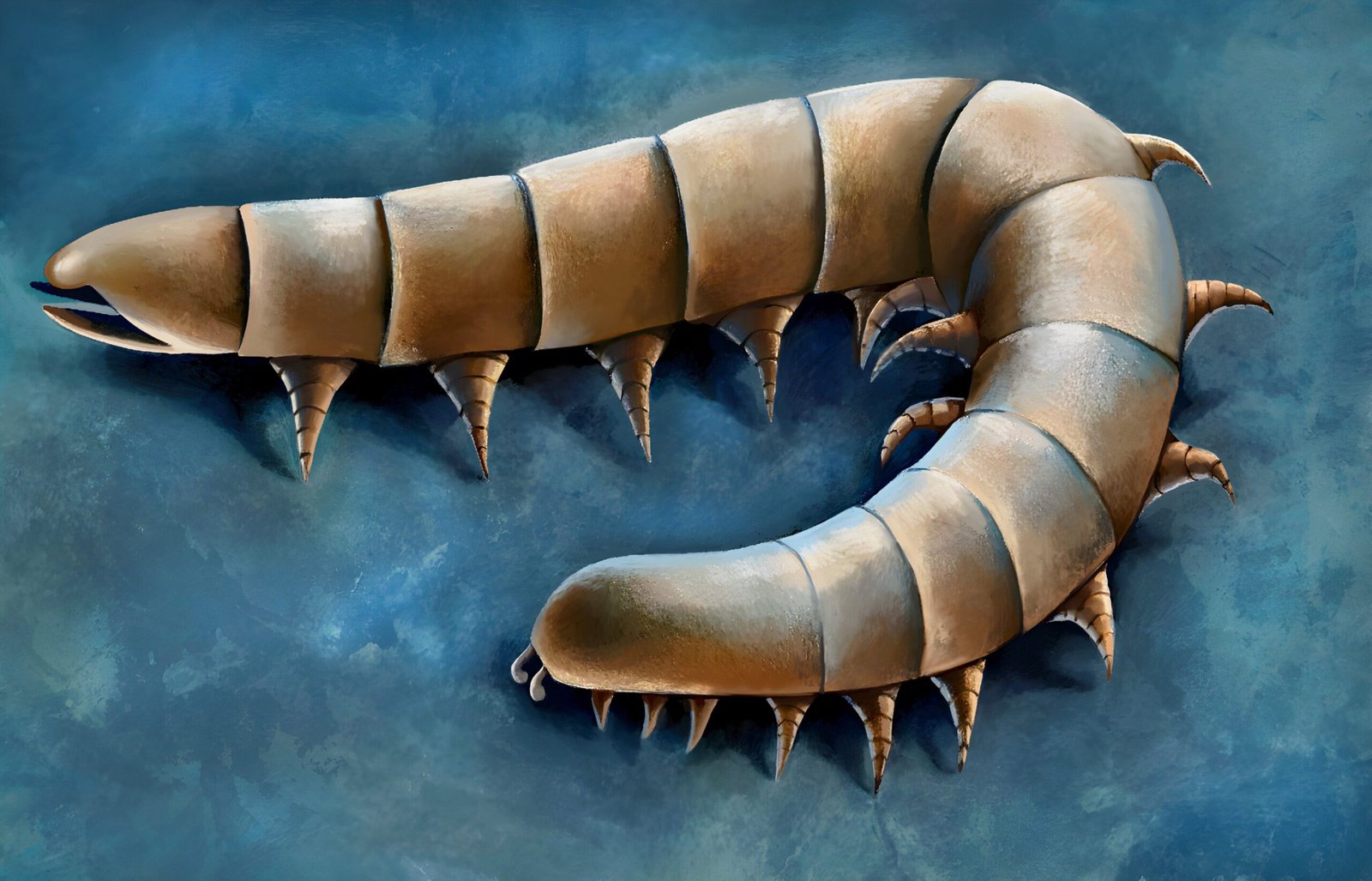
The newly described species has been named Waukartus muscularis. It resembles modern myriapods, with a head and a long segmented body carrying many sets of legs.
Several fossils were unusually well-preserved, showing anatomical details rarely visible in fossils of this age. The researchers report evidence of uniramous limbs, meaning single-branched appendages, along with preserved muscle tissue and even a cuticular endoskeleton.
Even though some specimens were incomplete, the team found no evidence of individuals with fewer than 11 segments, indicating that this animal consistently had a long trunk structure.
One particularly striking feature was the presence of multiple head appendages, which increased in size toward the rear of the head.
According to the study authors, the head appendages resembled those on the trunk, though preservation did not allow fine detail. Their shorter size may suggest they were not used for walking, but instead played sensory or feeding roles—though the exact feeding strategy remains unknown.
The fossils also suggest that the trunk was flexible. Some specimens were curved, and the overlap between segments varied, supporting the idea that the body could bend and move dynamically.
Placing the creature on the arthropod family tree
The team conducted a phylogenetic analysis to determine where Waukartus fits among arthropods. Their results place it just outside the crown group of myriapods, which requires at least 17 pairs of limbs.
That placement makes Waukartus especially important. It sits extremely close to the evolutionary line that eventually produced centipedes and millipedes, while still retaining traits that suggest an earlier stage of myriapod history.
The study also connects Waukartus to another group known as euthycarcinoids, which earlier research identified as stem-group myriapods. Euthycarcinoids are described as an unusual group of aquatic or possibly amphibious arthropods.
In the researchers’ words, the assignment of euthycarcinoids to the myriapod lineage extended the stem-group back into the Cambrian period. But Waukartus goes even further, sitting “stemward” of euthycarcinoids and modern myriapods—making it an even earlier relative.
This position helps fill a major gap in the fossil record of early myriapod evolution.
The most surprising detail: “land-type” legs in a marine animal
The most significant finding comes down to limb structure.
Modern myriapods are terrestrial animals, and their limbs are uniramous, lacking the branched outer limb portion found in many aquatic arthropods. Aquatic arthropods often have limbs with exopods—branched extensions that are common in marine environments.
But Waukartus appears to have been marine while still possessing uniramous limbs made of an endopod alone.
That detail directly challenges the assumption that uniramous limbs were an adaptation that evolved specifically for walking on land. Instead, this fossil suggests the evolutionary loss of branched limbs occurred earlier—before the move onto land ever happened.
The study authors argue that this means the loss of the exopod was not a response to terrestrial life. Rather, it was already present in marine ancestors.
Exaptation: a key evolutionary concept backed by this fossil
The researchers interpret the limb structure of Waukartus as an example of exaptation—a trait that evolves under one set of conditions but later becomes useful for something else.
In this case, losing the exopod may have happened for reasons unrelated to land movement, but later became advantageous when descendants eventually adapted to terrestrial environments.
The authors note that exopod loss is also evident in euthycarcinoids and in the aquatic sister group to arachnids. This broader pattern strengthens the argument that losing branched limbs may have occurred multiple times in evolutionary history, and not always as a direct adaptation to life on land.
In other words, the anatomical groundwork for terrestrial success may have been laid in the ocean.
Why This Matters
Understanding how animals first transitioned from sea to land is one of the most important questions in evolutionary science. This discovery provides rare fossil evidence that a trait strongly associated with terrestrial life—uniramous limbs—may have evolved while myriapod ancestors were still marine.
By placing Waukartus muscularis close to the myriapod lineage, and showing it had advanced limb anatomy before terrestrialization, the study challenges a key assumption about how and why arthropods evolved their body plans.
More broadly, it highlights how evolution doesn’t always work through direct, step-by-step adaptation. Sometimes, features evolve for one reason and later become crucial for something entirely different. Fossils like these help scientists trace those unexpected pathways—and bring more clarity to how complex life reshaped Earth long before humans ever existed.