Archaeologists have identified the earliest scientifically confirmed evidence of prehistoric human occupation in northern Sri Lanka, overturning long-standing assumptions that the region was too dry and resource-poor to support early communities. Excavations on Velanai Island revealed a major shell midden, with human activity dated to around 3460 cal BP, alongside signs of intensive coastal foraging and transported stone tools. The findings suggest that the apparent absence of older northern sites may reflect preservation and sea-level change rather than true human absence.
For decades, northern Sri Lanka was often treated as a blank space in the island’s prehistoric record—a landscape assumed too harsh, too dry, and too lacking in usable stone to support early human life. But a new study suggests that this “empty” region may never have been empty at all.
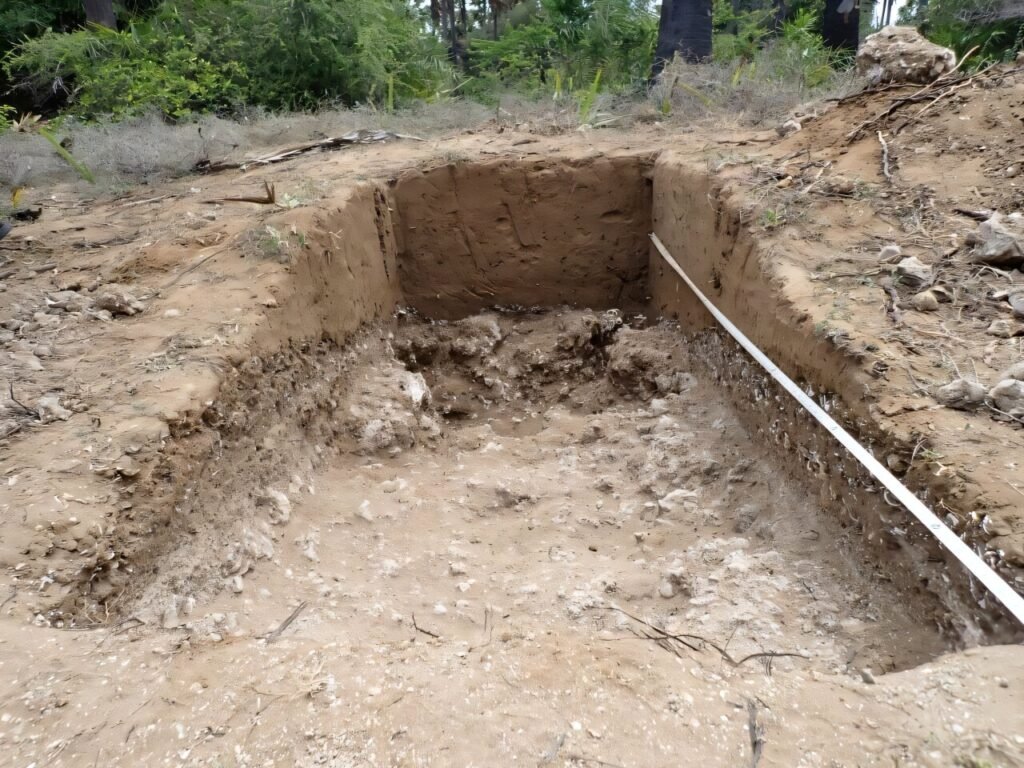
Excavations on Velanai Island, located in the Jaffna Peninsula, have uncovered a large shell midden that provides the earliest confirmed prehistoric evidence of island occupation in northern Sri Lanka. The discovery challenges a long-standing archaeological narrative and adds new detail to how early coastal foragers lived, traveled, and exploited resources.
A Region Once Considered Unlivable
Sri Lanka’s earliest evidence of human occupation is known from sites dating back roughly 25,000 years ago, including Pathirajawela. In the southern wet zone, shell midden sites are well documented, with major occupation phases dated to around 5,300 and 3,400 cal BP.
But northern Sri Lanka has long stood apart in archaeological discussions. Compared to the south, similar shell midden evidence has been scarce or absent.
Researchers have often argued that northern Sri Lanka’s semi-arid environment, limited freshwater availability, reduced vegetation, and lack of lithic raw materials made it unsuitable for sustained prehistoric settlement. Under this view, the region was not occupied until the arrival of agro-pastoralists from India during the 5th century BCE.
The new findings at Velanai Island directly challenge that assumption.
Velanai Island’s Shell Midden Tells a Different Story
The study, published in the Journal of Island and Coastal Archaeology, reports the discovery of an extensive shell midden on Velanai Island.
The midden contains a marine deposit dated to roughly 6300 to 5970 cal BP, indicating early coastal accumulation. However, the earliest confirmed human occupation associated with the site dates to around 3460 cal BP.
That makes Velanai the earliest scientifically confirmed prehistoric occupation site in northern Sri Lanka, according to the research.
This is a major shift for regional archaeology. Rather than showing a late arrival of human communities, Velanai provides evidence that prehistoric foragers were living and exploiting coastal environments in the north much earlier than previously demonstrated.
What the Midden Reveals About Diet and Daily Survival
Detailed analysis of the shell midden shows that Velanai’s prehistoric inhabitants relied heavily on marine resources, especially mollusks.
One species dominates the assemblage: Gafrarium pectinatum, which accounted for nearly 60% of the mollusk remains. This suggests a strong focus on intensive shellfish gathering, likely forming the dietary backbone of the community.
But the midden also reveals a broader subsistence strategy. The Velanai foragers supplemented their shellfish-heavy diet with a range of other animals, including seabreams, deer, wild boar, dugongs, and dolphins.
The variety suggests a flexible approach—one that combined nearshore gathering with both terrestrial hunting and marine exploitation.
Signs of Intensification—and Possible Ecological Pressure
The shells themselves offer more than dietary information. Researchers identified a specific occupational period, referred to as L4, that appears to reflect intensification in mollusk harvesting.
During this phase, the foragers may have collected shellfish so heavily that the average shell size declined over time. Alternatively, the size reduction could reflect a local environmental shift affecting shell growth conditions.
Either way, the pattern indicates change—suggesting that prehistoric resource use was not static, but responsive to pressure, availability, and perhaps growing demand.
This kind of evidence provides a rare window into how human behavior may have shaped coastal ecosystems over long timescales.
Stone Tools That Point to Travel Across Water
One of the most striking discoveries from Velanai is not made of shell at all, but stone.
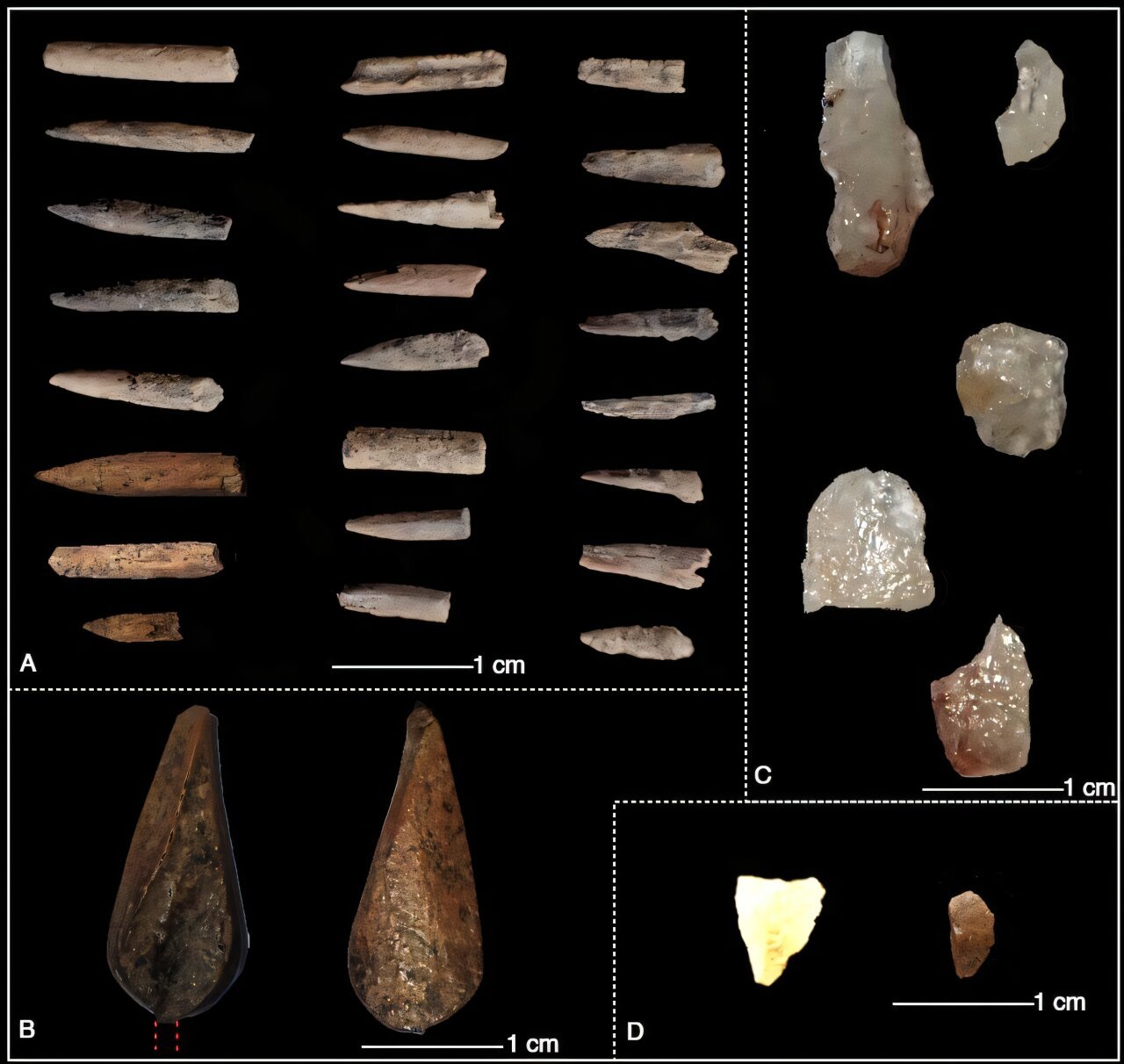
The midden contained non-local quartz and chert flakes, raw materials that would have needed to be sourced from nearly 60 km away on the mainland.
This detail carries major implications. Velanai Island is separated from the mainland by more than 5 km of sea, meaning these materials could not have arrived by simple foot travel. Their presence suggests deliberate transport of raw materials and strongly hints at short-distance seafaring capabilities.
In other words, the people living on Velanai were not isolated scavengers making do with whatever was nearby. They were capable of planning, movement, and material acquisition across significant distances.
The study frames this as evidence of early raw-material exploitation and a level of coastal mobility that fits with broader patterns seen in Sri Lanka’s southern shell midden sites.
Rethinking the “Gap” in Northern Sri Lanka’s Prehistory
Rather than confirming that northern Sri Lanka was unoccupied for millennia, the researchers argue that the region’s missing archaeological record may largely be an illusion.
Lead author Dr. Thilanka Siriwardana explained that the perceived gap between southern and northern occupation likely results from preservational bias, not environmental unsuitability.
During the Late Pleistocene, sea levels were lower, exposing wide coastal plains. In semi-arid northern Sri Lanka, populations may have settled closer to shorelines that no longer exist above water today.
As sea levels rose during the Holocene, those landscapes were gradually submerged. That submergence would have removed many earlier coastal sites from the visible archaeological record.
According to Dr. Siriwardana, what Velanai represents is likely settlement after those older shorelines were lost—evidence of people adapting to newly formed coastlines rather than arriving for the first time.
Where Research Goes Next
The study also outlines future directions for investigating northern Sri Lanka’s deeper prehistory.
Dr. Siriwardana described multiple approaches, including examining uplifted coastal terrains, which may preserve traces of ancient shorelines and shell midden activity. Another strategy is investigating inland archaeological sites for marine-derived materials, which could reveal coastal reliance even when original shoreline sites have disappeared.
The most challenging—but potentially most revealing—approach would involve direct investigation of submerged landscapes, especially in lagoons and low-energy coastal environments where preservation may be better.
For now, the team does not plan to re-excavate the Velanai site unless new analytical techniques become available. With so few sites known in the region, preservation is considered a priority.
Long-Term Shell Records May Reveal Human Environmental Impact
Velanai is also becoming part of a broader ecological investigation. Dr. Siriwardana noted that at Velanai, and again at Punguduthivu, researchers observed a gradual reduction in the size of Gafrarium pectinatum shells over time, visible from the 4th millennium BCE.
This pattern may reflect long-term human exploitation and increasing environmental pressure. The shells may therefore serve as a proxy for reconstructing historical ecological change and human-environment interaction over thousands of years.
Dr. Siriwardana also suggested that similar hunting pressure may have affected animals such as dugongs and rays, potentially producing ecological impacts that are not yet fully visible in the archaeological record. More research may help clarify how widespread and sustained this exploitation was.
Why This Matters
Velanai Island reshapes how archaeologists understand prehistoric life in northern Sri Lanka. Instead of a late-settled region waiting for farming populations to arrive, the evidence points to an established prehistoric community capable of intensive marine foraging and deliberate long-distance transport of stone materials.
Just as importantly, the study highlights how rising sea levels can erase entire chapters of human history. If earlier northern sites were submerged after the Late Pleistocene, then the apparent absence of evidence may reflect what archaeology cannot easily reach—not what humans never did.
Velanai is not just a new site on the map. It is a reminder that prehistoric coastal societies may have been more widespread, more mobile, and more ecologically influential than the surviving record has allowed researchers to see.