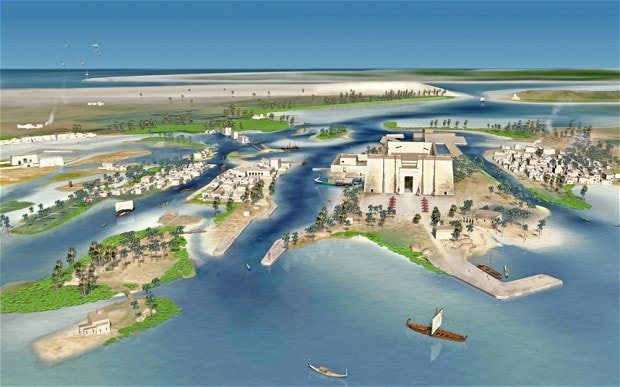
For centuries, stories circulated about a magnificent Egyptian city that had vanished beneath the waters of the Mediterranean Sea. Ancient texts mentioned a thriving port filled with merchants, sailors, temples, and monumental statues. Greek historians wrote about it. Ancient inscriptions referred to it. Yet despite these references, no one knew exactly where the city had gone.
Many scholars believed it had existed somewhere near the Nile Delta. Others suspected that the city might have been exaggerated by ancient writers. Some even wondered whether it had become one more legend from the distant past.
Then, at the dawn of the twenty-first century, an astonishing discovery changed everything.
Beneath the waters of Egypt’s coast, hidden under layers of mud and sand, archaeologists uncovered the remains of a vast ancient city. Giant statues emerged from the seabed. Massive temple blocks appeared where fish had swum for centuries. Ancient anchors, coins, jewelry, and inscriptions revealed the existence of a once-great metropolis.
The city was Heracleion, known to the Egyptians as Thonis.
Its discovery became one of the most remarkable archaeological achievements of modern times.
More than simply finding a lost city, researchers uncovered a forgotten chapter of Egyptian history preserved beneath the sea. Modern technology had succeeded where generations of explorers had failed, revealing a world that had been hidden for more than a thousand years.
The Mystery Before the Discovery
Long before archaeologists located Heracleion, the city occupied a strange place between history and mystery.
Ancient Greek writers referred to a city called Heracleion. According to tradition, the city was associated with the legendary hero Heracles, known to the Romans as Hercules. Greek visitors to Egypt knew the settlement by this name.
Egyptian records, however, referred to a city called Thonis.
For many years, scholars debated whether Thonis and Heracleion were separate places or different names for the same city.
Ancient sources suggested the city had once served as an important gateway into Egypt. Foreign merchants arriving by sea passed through the port before entering the Nile River system. Goods from across the Mediterranean flowed through its harbors.
Yet despite these historical references, the city’s location remained unknown.
As centuries passed, Heracleion seemed to disappear completely.
Its temples vanished.
Its harbor vanished.
Its streets vanished.
Even its memory faded.
The city appeared to have been swallowed by history itself.
Ancient Egypt and the Importance of the Nile Delta
To understand Heracleion, it is necessary to understand the geography of ancient Egypt.
The Nile River was the lifeblood of Egyptian civilization. Flowing northward into the Mediterranean Sea, it provided water, fertile soil, transportation routes, and economic opportunities.
Near its northern end, the Nile split into multiple branches, creating the vast region known as the Nile Delta.
This area served as Egypt’s connection to the wider Mediterranean world.
Ships carrying wine, olive oil, metals, timber, spices, and luxury goods arrived from distant lands. Egyptian products traveled outward in return.
The Nile Delta became a crossroads of cultures.
Egyptians, Greeks, Phoenicians, Persians, and many other peoples interacted there.
Because of its strategic location, any city controlling access to the Delta possessed enormous economic and political importance.
Heracleion occupied precisely such a position.
For centuries, it stood at one of the most important maritime gateways in the ancient world.
A Port City of Wealth and Influence
Before the rise of Alexandria, Heracleion served as one of Egypt’s most important ports.
Merchant ships crowded its waterways.
Trade connected Egypt to numerous Mediterranean societies.
Taxes collected from incoming goods generated wealth for local authorities and religious institutions.
The city was not merely a commercial center.
It was also a religious center.
Temples dominated parts of the urban landscape.
Pilgrims visited sacred sites.
Religious festivals attracted participants from surrounding regions.
Political authority, economic activity, and religious life intersected within the city.
This combination helped Heracleion become one of the most significant urban centers of its time.
For generations, the city prospered.
Its residents likely believed their community would endure indefinitely.
History would prove otherwise.
The Ancient Temple of Amun
One of the most important structures in Heracleion was the great temple dedicated to the god Amun.
Amun occupied a central place in Egyptian religion.
Over time, he became one of the most powerful and widely worshipped deities in ancient Egypt.
The temple at Heracleion served as a major religious institution.
Ceremonies took place there.
Priests managed sacred activities.
Offerings flowed into the temple complex.
Ancient records suggest that important rituals associated with kingship occurred within the city.
The temple was not merely a religious building.
It was also a symbol of political authority and economic power.
When archaeologists later discovered its remains underwater, they gained valuable insights into the city’s significance.
The temple became one of the key pieces of evidence demonstrating that Heracleion had once been a major center of Egyptian civilization.
How a Great City Disappeared
One of the most fascinating questions surrounding Heracleion concerns its disappearance.
Unlike cities destroyed by warfare, Heracleion appears to have fallen victim primarily to natural forces.
The Nile Delta consists largely of soft sediments deposited by the river over thousands of years.
These sediments can become unstable under certain conditions.
Geological evidence suggests that earthquakes, rising sea levels, and a phenomenon called soil liquefaction played crucial roles in the city’s destruction.
Liquefaction occurs when water-saturated sediments suddenly lose strength during seismic activity.
Ground that appears solid can behave almost like liquid.
Buildings sink.
Foundations collapse.
Entire sections of land can subside.
Over centuries, portions of Heracleion gradually descended beneath the sea.
Storms and flooding likely accelerated the process.
Eventually, the city disappeared underwater.
What had once been a thriving metropolis became part of the Mediterranean seabed.
More Than One Thousand Years of Silence
After sinking beneath the sea, Heracleion entered a long period of obscurity.
Generations lived and died without knowing the city still existed beneath the waves.
Empires rose and fell.
Religions changed.
Languages evolved.
The ancient world transformed.
Meanwhile, underwater, Heracleion remained remarkably preserved.
Mud and sediment covered buildings, statues, inscriptions, and artifacts.
Paradoxically, the same conditions that hid the city also protected it.
Unlike sites exposed to centuries of human activity, many parts of Heracleion remained undisturbed.
The sea became both its tomb and its guardian.
For over a thousand years, the city waited.
The Search Begins
Modern interest in locating Heracleion intensified during the twentieth century.
Historians examined ancient texts.
Archaeologists studied historical references.
Researchers attempted to reconstruct the geography of the Nile Delta during antiquity.
The challenge was enormous.
The coastline had changed dramatically over centuries.
Sediments continually altered the landscape.
Ancient waterways shifted their courses.
Many potential locations lay underwater.
Finding Heracleion required more than traditional archaeology.
It required technology capable of seeing beneath the sea and beneath layers of sediment.
Fortunately, such technology was becoming available.
Modern Technology Changes Everything
The discovery of Heracleion demonstrates how technology can revolutionize archaeology.
Traditional excavation methods work well on land, but underwater environments present unique challenges.
Visibility may be poor.
Artifacts may be deeply buried.
Large areas must be surveyed efficiently.
Researchers employed advanced geophysical techniques to investigate the seabed.
Sophisticated sonar systems mapped underwater landscapes.
Magnetometers detected buried structures and metallic objects.
Sub-bottom profiling allowed scientists to examine layers beneath the seafloor.
These tools enabled researchers to identify anomalies suggesting human activity.
Instead of searching blindly, archaeologists could focus on promising locations.
Technology transformed the Mediterranean seabed into a readable archaeological landscape.
The lost city was finally within reach.
The Discovery of Heracleion
In 2000, a team led by French underwater archaeologist Franck Goddio announced a discovery that captured global attention.
Working in Abu Qir Bay near Egypt’s Mediterranean coast, researchers identified the remains of the long-lost city.
The evidence was overwhelming.
Massive statues emerged from the seabed.
Temple ruins appeared.
Ancient inscriptions confirmed the site’s identity.
Artifacts revealed extensive commercial and religious activity.
Most importantly, inscriptions connected the names Thonis and Heracleion, demonstrating that they referred to the same city.
A historical puzzle that had persisted for centuries was finally solved.
The discovery represented one of the greatest underwater archaeological achievements of modern times.
Giant Statues from the Deep
Among the most dramatic discoveries were colossal statues resting on the seafloor.
Some stood several meters tall.
They depicted pharaohs, queens, and deities.
For centuries, these enormous monuments had remained hidden beneath the Mediterranean.
When photographs of the statues were released, they amazed people around the world.
The sculptures provided direct evidence of the city’s former grandeur.
Creating monuments of such scale required wealth, skilled artisans, organized labor, and powerful institutions.
The statues revealed that Heracleion had been no minor settlement.
It was a city capable of undertaking impressive artistic and architectural projects.
Each statue served as a silent witness to a vanished world.
Discovering Ancient Harbors
The underwater investigations also revealed extensive harbor facilities.
Ancient docks and maritime structures appeared beneath the sediment.
Numerous anchors were recovered.
Shipwrecks lay scattered across parts of the site.
These discoveries confirmed Heracleion’s role as a major port.
The city had functioned as a bustling maritime hub connecting Egypt to international trade networks.
Merchant vessels arrived carrying goods from distant lands.
Ships departed loaded with Egyptian products.
The harbor was the city’s economic heart.
Its remains provided archaeologists with invaluable information about ancient commerce and navigation.
The Shipwrecks of Heracleion
One of the most exciting aspects of underwater archaeology is the discovery of ancient ships.
Heracleion has yielded several remarkable shipwrecks.
These vessels offer rare glimpses into ancient maritime technology.
Wooden ships rarely survive for long periods on land.
Underwater environments, however, sometimes preserve them exceptionally well.
By studying ship construction techniques, archaeologists learn about trade, transportation, engineering, and daily life.
Some vessels discovered near Heracleion carried evidence of commercial activities.
Others may have been involved in religious or governmental functions.
Together, the shipwrecks help reconstruct the city’s economic landscape.
They reveal a world connected by water.
Everyday Life Beneath the Waves
The discovery of Heracleion was not limited to monumental structures.
Archaeologists recovered countless smaller artifacts that illuminate everyday life.
Coins reveal economic systems.
Jewelry reflects personal tastes and social status.
Ceramics provide evidence of trade and domestic activities.
Religious objects offer insights into spiritual practices.
Weights and measuring devices help explain commercial transactions.
Each artifact contributes another piece to the puzzle.
Together, they transform Heracleion from an abstract historical name into a real community inhabited by real people.
Merchants negotiated deals.
Priests conducted ceremonies.
Sailors navigated busy waterways.
Families lived ordinary lives amid extraordinary surroundings.
A Meeting Place of Cultures
One of the most fascinating aspects of Heracleion was its multicultural character.
The city existed at the intersection of Egypt and the Mediterranean world.
Egyptian traditions remained deeply influential.
At the same time, foreign merchants and visitors brought their own customs, languages, and beliefs.
Greek influence became especially significant.
Interactions between Egyptians and Greeks helped shape the city’s identity.
Religious practices sometimes blended cultural elements.
Commercial relationships fostered cooperation and exchange.
Heracleion illustrates how ancient societies were interconnected long before the modern era.
The city was not isolated.
It was part of a vibrant international network.
Solving the Mystery of Thonis and Heracleion
One of the most important achievements of the discovery involved historical identification.
For centuries, scholars debated the relationship between Thonis and Heracleion.
Were they separate cities?
Were they neighboring settlements?
Or were they the same place known by different names?
Archaeological evidence provided a clear answer.
Inscriptions found at the site demonstrated that Thonis and Heracleion referred to a single city.
Egyptians used the name Thonis.
Greeks used the name Heracleion.
This discovery resolved a longstanding historical question.
It also highlighted the value of archaeology in clarifying ancient texts.
Sometimes the ground—or in this case the seabed—contains answers unavailable anywhere else.
Religion in the Sunken City
Religion played a central role in Heracleion.
Temples served as major institutions.
Priests exercised influence.
Ceremonies connected local communities with broader Egyptian traditions.
Archaeologists discovered ritual objects, sacred artifacts, and religious structures that reveal the city’s spiritual life.
The worship of Amun appears particularly important.
Religious festivals may have attracted participants from distant regions.
Pilgrims likely visited sacred sites seeking blessings and guidance.
The city’s religious significance helped sustain its prominence for centuries.
Through archaeology, modern researchers gain rare insights into these ancient spiritual practices.
The Science of Underwater Archaeology
The discovery of Heracleion also showcases the remarkable field of underwater archaeology.
Working beneath the sea requires specialized techniques.
Divers must carefully document artifacts before removal.
Precise mapping ensures that contextual information is preserved.
Conservation becomes critical because objects recovered from underwater environments can deteriorate rapidly if improperly handled.
Archaeologists collaborate with geologists, engineers, historians, conservators, and marine scientists.
The investigation of Heracleion involved multiple disciplines working together.
This interdisciplinary approach demonstrates how modern science can recover information from seemingly inaccessible environments.
The sea no longer hides its secrets as effectively as it once did.
Why Heracleion Matters
The importance of Heracleion extends far beyond the excitement of discovering a lost city.
The site provides valuable information about ancient Egypt during periods that remain imperfectly understood.
It illuminates trade networks.
It reveals cultural interactions.
It enhances understanding of religion, politics, and economics.
The city also demonstrates the dynamic relationship between human societies and natural environments.
Even prosperous urban centers can be vulnerable to geological forces.
Earthquakes, flooding, subsidence, and sea-level changes can dramatically alter human history.
Heracleion serves as a powerful reminder of this reality.
Its story is both inspiring and cautionary.
Ongoing Discoveries
The exploration of Heracleion is far from complete.
Archaeologists continue investigating the site.
New artifacts are regularly discovered.
Improved technologies reveal additional details about the submerged landscape.
Each excavation season expands knowledge.
Questions that seemed impossible to answer a generation ago are gradually yielding to scientific investigation.
Researchers continue reconstructing the city’s history, economy, religion, and environment.
Heracleion remains one of the most productive underwater archaeological sites in the world.
Its secrets continue to emerge from beneath the Mediterranean.
Lessons from a Lost City
The story of Heracleion resonates because it combines mystery, tragedy, and discovery.
For centuries, the city existed only in fragments of memory preserved within ancient texts.
Many people doubted it could ever be found.
Yet persistence, science, and technological innovation transformed speculation into evidence.
The discovery reminds us that history still contains hidden chapters.
Important cities can disappear.
Civilizations can fade from view.
Knowledge can be lost.
But sometimes, with patience and ingenuity, the past reveals itself once more.
Heracleion teaches that absence of evidence is not always evidence of absence.
Sometimes the answers simply lie waiting beneath layers of time.
Conclusion
Heracleion, known in ancient Egypt as Thonis, was once one of the most important port cities in the Mediterranean world. Situated near the mouth of the Nile, it served as a gateway to Egypt, a center of commerce, and a major religious hub. For centuries it prospered, welcoming merchants, pilgrims, and travelers from across the ancient world.
Then nature intervened. Geological instability, earthquakes, flooding, and gradual subsidence caused the city to sink beneath the Mediterranean Sea. Hidden under mud and sediment, Heracleion vanished from human sight for more than a thousand years.
Its rediscovery in 2000 stands as one of archaeology’s greatest achievements. Using advanced sonar systems, geophysical surveys, underwater excavation techniques, and modern scientific methods, researchers uncovered monumental statues, temple ruins, shipwrecks, inscriptions, and thousands of artifacts. These discoveries transformed Heracleion from a historical mystery into a documented archaeological reality.
Today, the sunken city offers an extraordinary window into ancient Egypt and the interconnected Mediterranean world. It reveals the complexity of trade, religion, politics, and daily life in antiquity. More importantly, it demonstrates the power of modern technology to recover lost chapters of human history.
Beneath the waters of Abu Qir Bay, Heracleion slept for centuries. Modern science awakened it, allowing a forgotten city to tell its story once again.