History is filled with unsolved puzzles, but few are as haunting as the mystery of the Lost Colony of Roanoke. More than four centuries have passed since over one hundred English settlers disappeared from an isolated colony on the coast of what is now North Carolina. No confirmed record explains their fate. No mass grave has been found. No definitive account survives. The colonists simply vanished.
The story has fascinated generations because it combines hope, hardship, exploration, and mystery. It is not merely a tale of missing people. It is the story of some of the earliest English attempts to establish a permanent foothold in North America. It is also a story about cultural encounters, survival, and the immense challenges faced by people trying to build a new life in an unfamiliar land.
For centuries, theories about Roanoke have ranged from the plausible to the fantastical. Some imagined secret massacres. Others suggested starvation, disease, or migration. More imaginative explanations involved conspiracies and legends that grew larger with each retelling.
Today, modern archaeology, historical analysis, and scientific investigation are providing new clues. While the mystery has not been completely solved, researchers are beginning to construct a clearer picture of what may have happened.
The answer may not involve a dramatic catastrophe at all. Instead, it may reveal a deeply human story of adaptation and survival.
England’s Dream of a New World
The story begins during the late sixteenth century.
European nations were competing to explore and colonize lands across the Atlantic. Spain had already established powerful colonies in the Americas and accumulated enormous wealth. England hoped to challenge Spanish dominance and expand its own influence.
One of the leading figures behind England’s colonial ambitions was Walter Raleigh. Raleigh received royal permission from Elizabeth I to establish colonies in North America.
These colonies would serve multiple purposes. They could provide military bases, expand trade, increase England’s power, and create new opportunities for settlement.
The coast of present-day North Carolina appeared promising. Explorers reported fertile lands, natural harbors, and opportunities for expansion.
What followed would become one of the most famous mysteries in American history.
The First Roanoke Expedition
In 1584, English explorers reached the region around Roanoke Island.
Their reports painted an attractive picture of the area. The landscape appeared rich with natural resources. Relations with some Indigenous communities initially seemed friendly.
Encouraged by these reports, England organized a colonization effort.
The following year, a military settlement was established on Roanoke Island. However, the colony struggled almost immediately.
Food shortages emerged. Relations with local Indigenous groups deteriorated. Supply problems created constant difficulties.
Eventually, the colonists abandoned the settlement and returned to England.
Yet England’s colonial ambitions remained alive.
A second attempt would soon follow.
A Colony of Families
The next expedition was different.
Rather than creating a military outpost, English planners hoped to establish a genuine community. Men, women, and children would cross the Atlantic and build permanent homes.
In 1587, approximately 115 settlers arrived at Roanoke Island under the leadership of John White.
Unlike earlier colonization efforts, this group included entire families.
Among them was White’s daughter, Eleanor Dare.
Soon after arrival, she gave birth to a baby girl named Virginia Dare.
Virginia Dare became the first known English child born in North America.
At the time, her birth symbolized hope and a new beginning.
No one could have imagined that she would later become one of history’s most famous missing persons.
Early Struggles in the Wilderness
Life at Roanoke was difficult from the beginning.
The settlers faced food shortages, unfamiliar environmental conditions, and uncertainty about the future.
The colony depended heavily on supplies arriving from England. Without regular shipments, survival became increasingly challenging.
Relations with local Indigenous peoples were complex.
Some interactions involved cooperation and trade. Others were marked by distrust and conflict.
The colonists quickly realized they needed additional resources if the settlement was to survive.
As conditions worsened, Governor John White agreed to return to England and secure fresh supplies.
It was a difficult decision.
The colonists needed help, but White worried about leaving his family behind.
Ultimately, necessity forced his departure.
John White’s Fateful Journey
When White sailed back to England in 1587, he expected to return relatively quickly.
Events beyond his control changed everything.
England soon became preoccupied with the threat posed by Spain.
The conflict culminated in the famous confrontation with the Spanish Armada.
Ships that might have carried supplies to Roanoke were redirected for military purposes.
As a result, White’s return was delayed for years.
Meanwhile, the colonists remained isolated across the Atlantic.
No one knows exactly what happened during those missing years.
Those years created the mystery.
The Return to an Empty Colony
In 1590, White finally managed to return to Roanoke.
He expected difficulties.
He may have feared starvation, disease, or attacks.
What he found was stranger.
The settlement was deserted.
Homes had been dismantled.
No colonists were present.
No bodies were discovered.
No obvious signs of violence appeared.
The colony seemed abandoned rather than destroyed.
For White, the scene must have been emotionally devastating.
His daughter was missing.
His granddaughter, Virginia Dare, was missing.
Every settler had vanished.
Yet one clue remained behind.
The Word “CROATOAN”
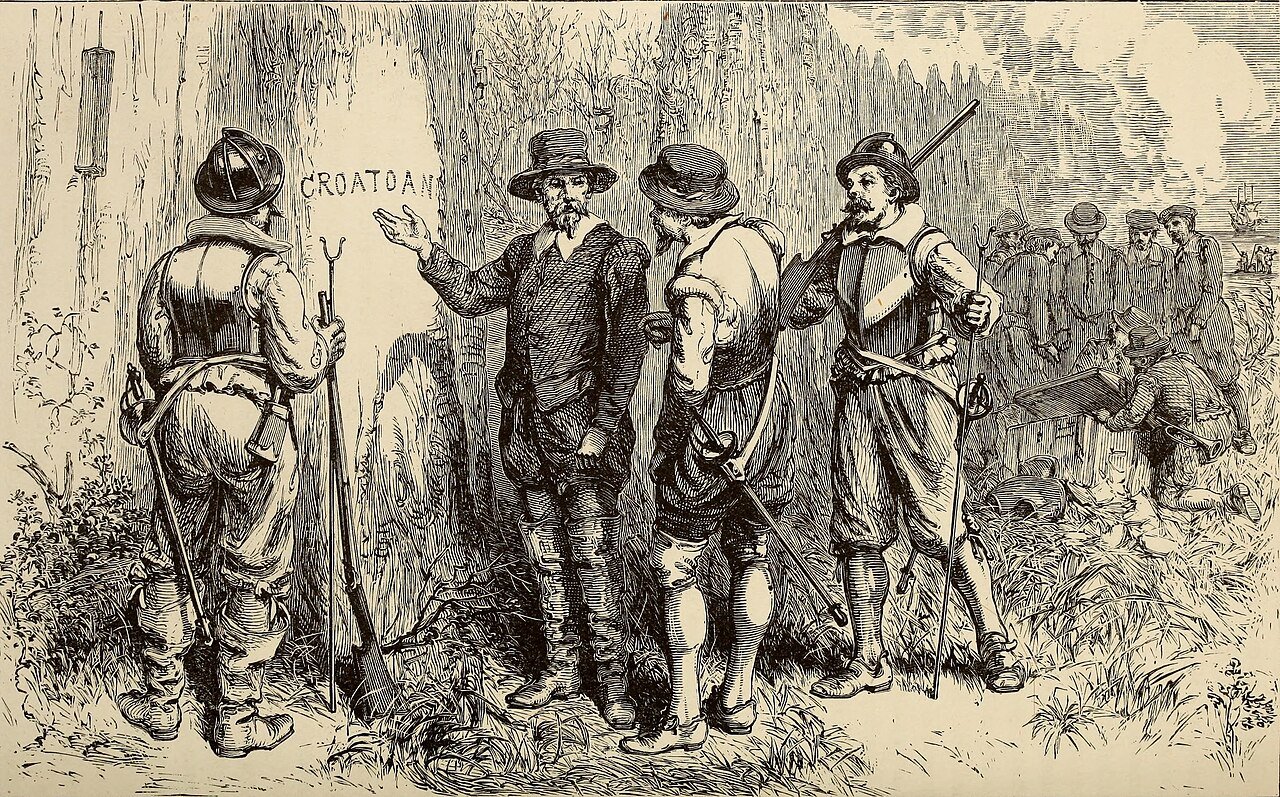
White discovered a single word carved into a wooden post:
CROATOAN.
Nearby, the letters CRO were carved into a tree.
This clue has become one of the most famous pieces of evidence in American history.
Fortunately, it was not entirely unexpected.
Before White departed years earlier, colonists had agreed upon a plan.
If they relocated, they would leave a message indicating their destination.
If they moved under distress or coercion, they would carve a cross as a warning sign.
No cross was present.
This detail has enormous significance.
It suggests that the settlers may have left voluntarily.
The word CROATOAN likely referred to Croatoan Island, now known as Hatteras Island, located south of Roanoke.
White wanted to investigate immediately.
Unfortunately, storms and difficult conditions prevented a thorough search.
He was forced to leave.
The mystery remained unsolved.
Who Were the Croatoan People?
To understand the clue, it is important to understand the Croatoan people.
The Croatoans were an Indigenous group living on nearby islands and coastal regions.
Historical records suggest that relations between the Croatoans and English settlers were generally better than relations with some other neighboring groups.
Trade and communication occurred between them.
The existence of relatively friendly connections makes the Croatoan clue particularly intriguing.
Perhaps the colonists moved to Croatoan Island seeking assistance.
Perhaps they merged with Indigenous communities.
Perhaps they established a new settlement elsewhere.
The clue points toward migration rather than disappearance.
For many historians, this remains one of the strongest explanations.
Early Theories About the Disappearance
Almost immediately, speculation began.
Some believed hostile Indigenous groups had attacked the colony.
Others suggested Spanish forces had destroyed the settlement.
Still others imagined starvation or disease wiping out the population.
The problem with these theories is the lack of supporting evidence.
A massacre would likely leave physical traces.
A catastrophic epidemic might leave bodies or burial sites.
A sudden attack would not easily explain the carefully carved message left behind.
The evidence suggests planning rather than panic.
This observation has shaped modern interpretations of the mystery.
The Assimilation Theory
Today, one of the most widely accepted explanations is assimilation.
According to this theory, the colonists did not disappear.
Instead, they integrated into Indigenous communities.
This possibility would have made practical sense.
The settlers faced food shortages and uncertain support from England.
Local Indigenous societies possessed extensive knowledge of the environment.
Joining established communities may have represented the best chance for survival.
Historical accounts recorded by later English explorers provide intriguing hints.
Some reports described Indigenous people possessing European-style objects.
Others mentioned communities with individuals who appeared to have partial European ancestry.
While such reports are not definitive proof, they suggest that cultural mixing may have occurred.
Archaeological Clues from Hatteras Island
Modern archaeology has provided some of the most compelling evidence supporting the assimilation theory.
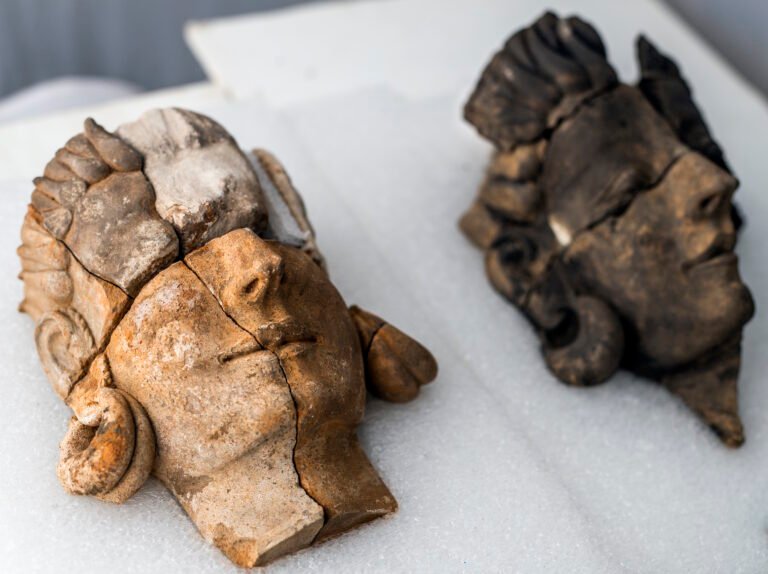
Excavations on Hatteras Island uncovered artifacts linked to both Indigenous populations and English settlers.
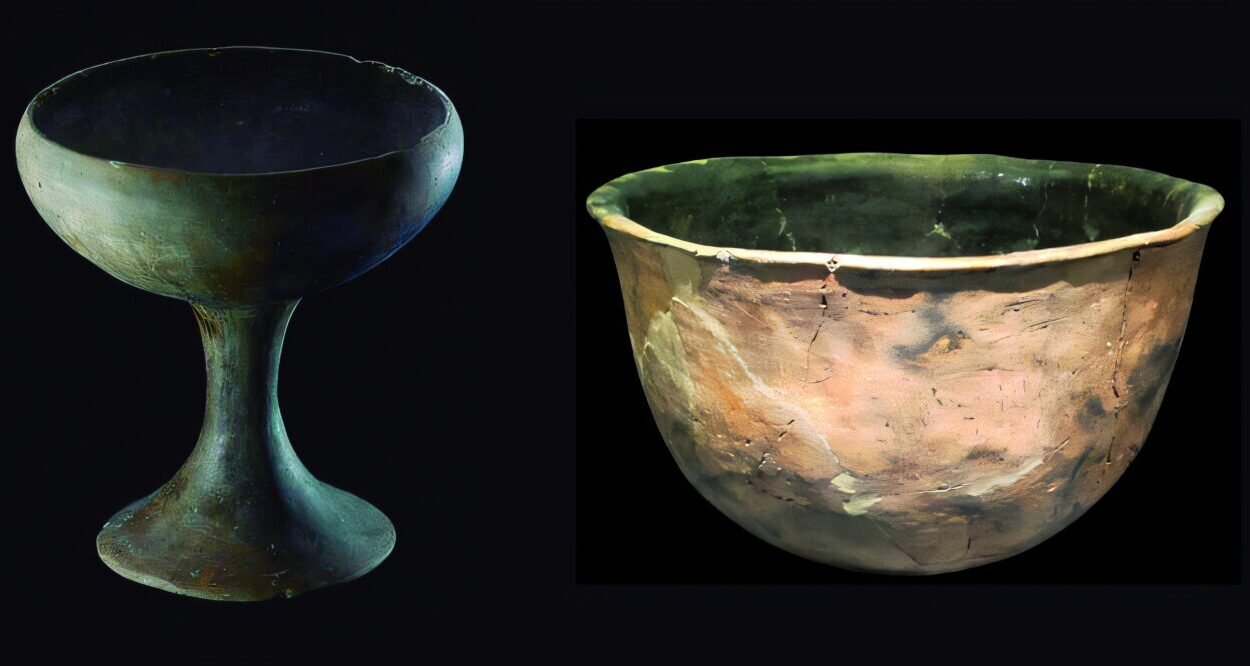
Researchers discovered items such as tools, weapon fragments, pottery, and personal objects that appear connected to sixteenth-century English colonists.
The significance of these finds lies in their context.
The artifacts were discovered within Indigenous settlements rather than isolated colonial sites.
This pattern suggests interaction between the groups.
Some archaeologists argue that at least a portion of the Roanoke colonists may have lived among the Croatoans after leaving Roanoke Island.
Although the evidence remains incomplete, it represents one of the strongest leads ever uncovered.
The Mystery of the Map Patch
One of the most fascinating developments emerged from the study of John White’s maps.
Researchers examining White’s surviving maps noticed something unusual.
A small patch concealed part of a drawing beneath the surface.
Using modern imaging techniques, investigators discovered hidden markings underneath.
These markings appeared to indicate a possible fortification or settlement site inland from Roanoke.
The discovery sparked renewed interest in the possibility that colonists relocated to another location.
Perhaps some settlers moved inland while others joined coastal Indigenous communities.
If true, the story may be more complex than a single migration.
Different groups may have pursued different survival strategies.
Site X and New Investigations
The hidden map clues led researchers to focus attention on an inland location often referred to as Site X.
Archaeologists working there uncovered several artifacts that may date to the Roanoke period.
These included ceramic fragments and other objects associated with sixteenth-century England.
The discoveries generated considerable excitement.
Could this site represent a relocation point for some of the colonists?
The evidence remains debated.
Some experts argue the artifacts support the theory.
Others caution that the objects may have arrived through trade rather than direct settlement.
Nevertheless, Site X illustrates how modern technology continues to uncover new clues.
The mystery remains active rather than frozen in the past.
The Role of Drought
Environmental science has added another important dimension to the investigation.
Researchers studying tree rings reconstructed climate conditions during the Roanoke period.
Their findings revealed a severe drought affecting the region.
This drought appears to have been among the most extreme in centuries.
For colonists already struggling to secure food, the consequences would have been serious.
Agriculture would have suffered.
Resources would have become scarce.
Competition for survival could have intensified.
The drought may help explain why the settlers chose to abandon Roanoke and seek assistance elsewhere.
Environmental pressures likely played a significant role in shaping events.
Could the Colonists Have Starved?
Starvation has long been considered a possible explanation.
Certainly, food shortages affected the colony.
However, starvation alone does not fully account for the available evidence.
If the colonists had died at Roanoke, physical remains would likely have been discovered.
The absence of bodies suggests a different scenario.
Starvation may have acted as a contributing factor rather than the final outcome.
Food scarcity could have encouraged relocation.
The settlers may have moved specifically because remaining at Roanoke became unsustainable.
In this interpretation, starvation helped drive migration rather than causing complete extinction.
The Spanish Attack Theory
Another theory proposes Spanish involvement.
Spain regarded English colonial efforts as a threat.
Spanish forces occasionally attacked rival settlements.
Some researchers wondered whether Spanish troops secretly destroyed Roanoke.
Historical records do not strongly support this idea.
Spanish documents from the period contain extensive information about military operations.
No convincing evidence indicates a Spanish assault on the colony.
Moreover, the CROATOAN message remains difficult to reconcile with a surprise military attack.
Most historians today view the Spanish attack theory as unlikely.
The Mystery of Virginia Dare
No discussion of Roanoke is complete without Virginia Dare.
As the first English child born in North America, she became a powerful symbol in American history.
Her disappearance transformed her into a legendary figure.
Over the centuries, stories and folklore grew around her fate.
Some legends imagined that she lived among Indigenous communities.
Others portrayed her as a tragic figure lost to history.
The truth remains unknown.
Virginia Dare’s story illustrates the emotional power of the Roanoke mystery.
She was not merely a historical figure.
She was a child whose future vanished from the historical record.
That reality continues to resonate centuries later.
Why the Mystery Endures
Many historical mysteries eventually fade from public attention.
Roanoke has not.
Part of its appeal lies in the absence of a clear ending.
Most historical stories conclude with victory, defeat, discovery, or destruction.
Roanoke offers none of these.
Instead, it presents a question mark.
Humans are naturally drawn to unresolved narratives.
We want answers.
We want closure.
Roanoke denies both.
The mystery invites each generation to revisit the evidence and search for solutions.
What Modern Scholars Believe
Today, many historians and archaeologists favor a combination of migration and assimilation.
Rather than imagining a single dramatic event, they envision a gradual process.
The colonists likely faced severe hardships, including drought and food shortages.
Unable to survive alone, they relocated.
Some may have joined Croatoan communities.
Others may have moved inland.
Families may have separated.
Groups may have followed different paths.
Over time, English settlers and Indigenous peoples may have merged culturally and biologically.
Such an outcome would explain many of the available clues.
Importantly, it also reflects what often happened throughout colonial history.
Survival frequently depended on cooperation, adaptation, and cultural exchange.
New Technologies and Future Discoveries
The Roanoke mystery remains open because archaeology continues to evolve.
Ground-penetrating radar allows researchers to examine buried features without excavation.
Advanced imaging techniques reveal hidden details in historical documents.
DNA analysis offers new possibilities for investigating ancestry and population movement.
Future discoveries may provide additional evidence.
A single artifact, document, or archaeological site could dramatically reshape our understanding.
History has repeatedly shown that long-standing mysteries can yield surprising answers.
The search continues.
More Than a Mystery
The Lost Colony of Roanoke is often treated as a puzzle to be solved.
Yet it is also something more.
It represents a meeting of cultures during a transformative period in world history.
It reflects the challenges of colonization, survival, and adaptation.
It reveals the fragility of historical records and the limits of human knowledge.
Most importantly, it reminds us that history is not always neat and complete.
Sometimes people vanish from written records while continuing their lives beyond the view of historians.
The absence of documentation does not necessarily mean disappearance.
It may simply mean that the story continued in ways no one recorded.
Conclusion
The Lost Colony of Roanoke remains America’s oldest enduring mystery. In 1590, Governor John White returned to find an empty settlement, a cryptic message carved into wood, and no clear explanation for the fate of more than one hundred colonists. For centuries, their disappearance inspired speculation, legends, and debate.
Modern research has transformed the discussion. Archaeological discoveries, environmental studies, historical analysis, and advanced technologies increasingly suggest that the colonists may not have vanished in a dramatic catastrophe. Instead, they may have adapted to difficult circumstances by relocating and integrating with Indigenous communities. Evidence from Hatteras Island, clues hidden within old maps, and records of severe drought all support this possibility.
Although definitive proof remains elusive, the mystery is closer to resolution than ever before. The most compelling modern interpretation is not one of sudden destruction but of survival. The colonists may have found ways to endure by embracing new relationships, new environments, and new identities.
More than four hundred years later, Roanoke continues to capture the imagination because it combines history and mystery in equal measure. It reminds us that the past still holds secrets and that sometimes the most fascinating stories are not those with clear endings, but those that continue to invite questions. The Lost Colony endures not because we know what happened, but because we are still searching for the answer.