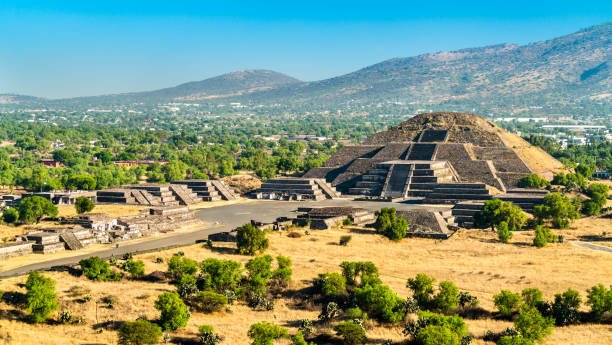
In the highlands of central Mexico, northeast of modern-day Mexico City, stand the remains of one of the greatest cities ever built in the ancient Americas. Massive pyramids rise from the landscape. Broad avenues stretch across the valley. Temples, plazas, palaces, and residential compounds cover miles of terrain. Even in ruin, the site inspires awe.
Yet one extraordinary fact separates this ancient metropolis from many other famous archaeological sites.
No one knows exactly who built it.
The city is known today as Teotihuacan, a name given by the Aztecs centuries after its abandonment. When the Aztecs arrived in the region during the fourteenth century, they discovered the ruins already standing. The enormous pyramids and vast ceremonial complexes appeared so impressive that they believed gods must have created them.
The mystery remains alive today.
Unlike ancient Egypt, where inscriptions identify rulers and builders, or the Maya civilization, whose cities preserve detailed written records, Teotihuacan left behind surprisingly few clues about its founders. Archaeologists have uncovered remarkable evidence about how the city functioned, but the identity of the people who first envisioned and constructed this immense urban center remains uncertain.
Teotihuacan was not merely a city. At its height, it was one of the largest urban centers on Earth. It influenced cultures across Mesoamerica, shaped trade networks extending hundreds of miles, and became a symbol of power and sacred authority.
Yet the civilization behind it remains partly hidden behind the veil of time.
The mystery of Teotihuacan is one of archaeology’s most fascinating puzzles—a story of greatness, influence, disappearance, and unanswered questions.
The Meaning of Teotihuacan
The name Teotihuacan did not come from the people who built the city.
It was given much later by the Aztecs, who encountered the ruins centuries after the city’s collapse.
In the Nahuatl language, Teotihuacan is often translated as “the place where the gods were born” or “the place where men become gods.”
For the Aztecs, the site held profound religious significance.
According to their traditions, the gods gathered there after the destruction of a previous world. It was at Teotihuacan, they believed, that divine beings sacrificed themselves to create the Sun and Moon and bring light to the universe.
Standing before the giant pyramids, it is easy to understand why the Aztecs felt this way.
The structures seem almost supernatural in scale.
Even today, visitors often experience a sense of wonder when walking among the monuments. The city appears less like an archaeological site and more like the remains of a lost world.
The Discovery of an Ancient Giant
Although the ruins were known to Indigenous peoples for centuries, scientific investigation began much later.
As archaeologists gradually explored the site, they realized that Teotihuacan was far larger than anyone had imagined.
What initially appeared to be scattered ruins turned out to be the remains of a carefully planned metropolis.
The city covered more than 20 square kilometers and contained thousands of structures.
At its peak, likely between the first and sixth centuries CE, Teotihuacan may have been home to over 100,000 people. Some estimates suggest its population may have exceeded 150,000.
This made it one of the largest cities in the world during its time.
While many ancient societies developed impressive settlements, Teotihuacan stood apart because of its scale, organization, and influence.
It was not a small ceremonial center.
It was a thriving urban civilization.
The Valley That Made a Civilization Possible
Teotihuacan was built in a strategic location.
The Valley of Mexico offered fertile land, reliable water sources, and access to important trade routes.
Nearby hills provided construction materials, including volcanic stone.
The surrounding region also contained rich deposits of obsidian, a volcanic glass highly valued throughout Mesoamerica.
Obsidian was one of the most important resources in the ancient world of Mexico.
Sharp, durable, and versatile, it was used for tools, weapons, ritual objects, and trade goods.
Control of obsidian resources likely contributed significantly to Teotihuacan’s wealth and influence.
The city’s location enabled it to become both an economic and political powerhouse.
Merchants, artisans, farmers, and travelers all contributed to its growth.
Over time, Teotihuacan emerged as a dominant force across much of Mesoamerica.
The Avenue of the Dead
The most famous feature of Teotihuacan is its grand central boulevard.
Today, archaeologists call it the Avenue of the Dead.
Stretching for kilometers through the heart of the city, the avenue connects many of the site’s most important structures.
The name originated with the Aztecs, who believed the mounds lining the avenue were tombs.
Modern archaeology has revealed that these structures were not primarily burial monuments. Instead, they served ceremonial, administrative, and residential functions.
Nevertheless, the name remains.
Walking along the Avenue of the Dead creates a powerful impression.
The broad roadway directs the eye toward towering pyramids and sacred complexes.
Everything about its design suggests careful planning and symbolic meaning.
The city was not built randomly.
It was laid out according to a deliberate vision.
The Pyramid of the Sun
Dominating the landscape is the immense Pyramid of the Sun.
This monument is among the largest pyramids ever constructed in the ancient world.
Rising more than 65 meters above the surrounding terrain, it remains one of the most recognizable structures in the Americas.
The sheer effort required to build it is staggering.
Millions of tons of stone, earth, and construction material had to be transported and assembled without modern machinery.
Thousands of workers likely participated in the project.
The pyramid’s purpose remains partly mysterious.
Archaeologists believe it served important religious functions, but no definitive explanation exists.
Excavations beneath the pyramid uncovered a cave-like chamber, which may have possessed sacred significance.
In many Mesoamerican traditions, caves symbolized creation, fertility, and connections to the underworld.
The builders clearly regarded the site as extraordinarily important.
The Pyramid of the Moon
At the northern end of the Avenue of the Dead stands the Pyramid of the Moon.
Although smaller than the Pyramid of the Sun, its location gives it dramatic visual prominence.
The pyramid appears framed by the mountains beyond, creating a striking architectural composition.
Researchers have discovered evidence of ritual offerings and sacrificial ceremonies associated with the structure.
Burials beneath the pyramid contained human remains, animals, precious objects, and ritual artifacts.
These discoveries suggest that religious ceremonies played a central role in Teotihuacan society.
The Pyramid of the Moon was not simply an architectural achievement.
It was a sacred monument linked to the city’s spiritual life.
The Temple of the Feathered Serpent
Another remarkable structure is the Temple of the Feathered Serpent.
This building features elaborate stone carvings depicting feathered serpents and other supernatural beings.
The artistry demonstrates extraordinary craftsmanship.
The feathered serpent would later become one of the most important religious symbols in Mesoamerica.
Many cultures associated the figure with creation, wisdom, fertility, and divine authority.
Excavations around the temple uncovered evidence of large-scale ritual sacrifices.
Hundreds of individuals may have been sacrificed during major construction phases.
These discoveries reveal a society capable of organizing complex religious ceremonies on a massive scale.
The temple offers a glimpse into the beliefs that shaped life in Teotihuacan.
A City Designed With Precision
One of the most impressive aspects of Teotihuacan is its urban planning.
The city follows a remarkably organized layout.
Major streets intersect at carefully chosen angles. Residential compounds were arranged according to consistent patterns. Public spaces, temples, and administrative buildings formed part of a unified design.
This level of planning suggests strong centralized authority.
Someone—or some governing institution—was directing the city’s development.
The alignment of structures may also reflect astronomical observations.
Many ancient civilizations incorporated celestial events into architecture and urban design.
Researchers continue studying the relationship between Teotihuacan’s layout and the movements of the Sun, stars, and planets.
The city appears to have been both a practical urban center and a symbolic representation of cosmic order.
The People Who Lived There
For many years, archaeologists focused primarily on monumental structures.
Later research shifted attention toward ordinary residents.
Excavations revealed extensive apartment compounds throughout the city.
These complexes housed families, artisans, merchants, and workers.
The findings transformed understanding of Teotihuacan.
Instead of a city dominated solely by elites, it appears to have supported a diverse urban population.
Many residents enjoyed access to relatively comfortable living conditions.
Some compounds featured courtyards, drainage systems, workshops, and painted murals.
Evidence suggests people from various ethnic backgrounds lived within the city.
Immigrants from distant regions may have formed distinct communities while maintaining cultural traditions.
Teotihuacan was likely one of the most cosmopolitan cities of its era.
The Art of Teotihuacan
Although the civilization left few written records, it produced remarkable art.
Murals decorate walls throughout the city.
These paintings depict deities, animals, ritual scenes, plants, and symbolic imagery.
Bright colors and intricate designs reveal a sophisticated artistic tradition.
The murals also provide valuable clues about religion and social organization.
Many images emphasize themes of fertility, water, agriculture, and sacred power.
Some portray supernatural beings whose identities remain debated among scholars.
Without extensive written texts, interpretation remains challenging.
Yet the artwork offers rare windows into the minds of the people who created the city.
A Powerful Economic Center
Teotihuacan’s influence extended far beyond its borders.
The city occupied a central position within extensive trade networks.
Obsidian from Teotihuacan reached distant regions.
Imported materials arrived from across Mesoamerica.
Archaeologists have discovered evidence of jade, shells, exotic feathers, ceramics, and other luxury goods.
Trade generated wealth and connected Teotihuacan to numerous cultures.
The city became an economic engine whose influence stretched hundreds of miles.
Its prosperity helped sustain large populations and ambitious construction projects.
Economic power and political influence reinforced one another, enabling continued growth.
Teotihuacan’s Reach Across Mesoamerica
Archaeological evidence indicates that Teotihuacan exerted influence over vast territories.
Its artistic styles appear in distant cities.
Its goods circulated widely.
Its religious symbols spread throughout Mesoamerica.
Perhaps most remarkably, evidence suggests direct interaction between Teotihuacan and Maya cities located far to the southeast.
Artifacts, inscriptions, and architectural influences indicate significant connections.
Some scholars believe Teotihuacan actively intervened in the political affairs of certain Maya kingdoms.
Others argue for more complex forms of cultural exchange.
Regardless of the exact nature of these relationships, Teotihuacan’s influence was immense.
Its impact extended far beyond the Valley of Mexico.
The Great Mystery: Who Built It?
Despite decades of research, one question remains surprisingly difficult to answer.
Who founded Teotihuacan?
Unlike the Maya, whose inscriptions identify rulers and dynasties, Teotihuacan left behind few written records.
Archaeologists know a great deal about the city’s architecture, economy, religion, and daily life.
Yet the identity of its founders remains uncertain.
Several possibilities have been proposed.
Some researchers suggest the builders were ancestors of later Nahua-speaking peoples.
Others point toward Totonac groups.
Still others believe the city represented a multiethnic society formed from diverse populations.
The evidence remains inconclusive.
No single theory has achieved universal acceptance.
This uncertainty contributes greatly to the city’s enduring fascination.
Why Are There So Few Written Records?
The absence of clear written records is one of archaeology’s greatest frustrations.
Teotihuacan certainly used symbols and visual communication.
However, no extensive writing system comparable to Maya inscriptions has been identified.
Several explanations are possible.
The civilization may have relied more heavily on visual symbolism than written language.
Important records may have been created on perishable materials that did not survive.
Political changes or later destruction may have erased valuable information.
Whatever the reason, the lack of written evidence makes reconstruction of Teotihuacan’s history unusually difficult.
Archaeologists must rely heavily on artifacts, architecture, burials, and environmental data.
Religion at the Heart of the City
Religion permeated every aspect of life in Teotihuacan.
Monuments dominated the urban landscape.
Sacred imagery appeared in public spaces.
Ritual offerings accompanied construction projects.
Burials reveal elaborate ceremonial practices.
The city itself may have been designed as a sacred landscape reflecting cosmological beliefs.
Many structures align with celestial events and symbolic directions.
Mountains, caves, water sources, and architectural features likely carried spiritual significance.
For the people of Teotihuacan, religion was not separate from daily life.
It shaped politics, architecture, economics, and social organization.
The Sudden Decline
Around the sixth century CE, Teotihuacan began to decline.
The reasons remain debated.
Evidence suggests major parts of the city were deliberately burned.
Important political and ceremonial structures suffered destruction.
Population levels fell dramatically.
Eventually, the city was abandoned.
The collapse remains one of the greatest mysteries in Mesoamerican history.
Several factors may have contributed.
Environmental stress could have weakened agricultural production.
Political instability may have triggered internal conflict.
Economic changes may have undermined the city’s power.
Social unrest could have fueled violence against ruling elites.
Most researchers believe multiple causes interacted rather than a single catastrophic event.
The decline appears complex and gradual, even if some episodes were dramatic.
A Ghost City in the Valley
After abandonment, Teotihuacan did not vanish entirely.
Its immense monuments remained visible.
Generations passed.
New cultures emerged.
Empires rose and fell.
Yet the pyramids continued standing.
By the time the Aztecs encountered the ruins centuries later, the original builders were long gone.
The city had become a sacred relic.
The Aztecs incorporated Teotihuacan into their own mythology and religious worldview.
They saw it not as an ordinary ancient city but as a place where cosmic events occurred.
Its true history had already faded into mystery.
Modern Archaeology and New Discoveries
Research at Teotihuacan continues to produce surprises.
Advanced technologies allow scientists to explore previously inaccessible areas.
Ground-penetrating radar, laser mapping, chemical analysis, and remote sensing reveal new details about urban life.
Recent discoveries have identified tunnels beneath major monuments.
Excavations uncovered ritual deposits containing exotic artifacts.
Researchers continue studying human remains to learn about migration, health, and social organization.
Each new discovery deepens understanding while also generating new questions.
The city still holds many secrets.
Why the Mystery Endures
The mystery of Teotihuacan survives because it combines extraordinary achievements with profound uncertainty.
Archaeologists know the city existed.
They know it was immense.
They know it influenced vast regions.
They know it possessed remarkable engineering and artistic traditions.
Yet they cannot confidently identify its founders or fully explain its political system.
This unusual combination is rare in ancient history.
Most great civilizations leave clearer records.
Teotihuacan remains elusive.
Its monuments speak loudly, but its builders remain largely silent.
The Legacy of Teotihuacan
Although the civilization disappeared, its influence endured.
Later cultures admired the city.
Religious ideas associated with Teotihuacan spread across Mesoamerica.
Architectural styles inspired subsequent generations.
Its symbols continued appearing long after its decline.
Even today, Teotihuacan remains one of the most important archaeological sites in the Americas.
It offers invaluable insights into urbanism, religion, economics, and cultural interaction.
Its study has transformed understanding of ancient Mexico.
The city may have vanished as a political power, but its legacy survived.
Conclusion
Teotihuacan stands among humanity’s greatest ancient achievements. At its height, it was a thriving metropolis filled with monumental architecture, diverse populations, flourishing trade, and powerful religious traditions. Its pyramids rival some of the most famous structures ever built, and its influence reached across much of Mesoamerica.
Yet for all that archaeologists have learned, the city’s greatest mystery remains unresolved. The identity of its original builders, the nature of its government, and many aspects of its history continue to challenge researchers. Unlike many ancient civilizations that left extensive written records, Teotihuacan speaks primarily through stone, art, architecture, and archaeology.
This silence has only increased its allure.
The city reminds us that history is not a completed story. Beneath ancient ruins lie unanswered questions, hidden connections, and forgotten lives waiting to be understood. Every excavation uncovers new clues, but the full truth remains just beyond reach.
That enduring mystery is what makes Teotihuacan so captivating. It is not merely a city of pyramids. It is a monument to human creativity, ambition, and resilience—and one of the world’s most fascinating reminders that even the greatest civilizations can leave behind mysteries that survive for centuries.