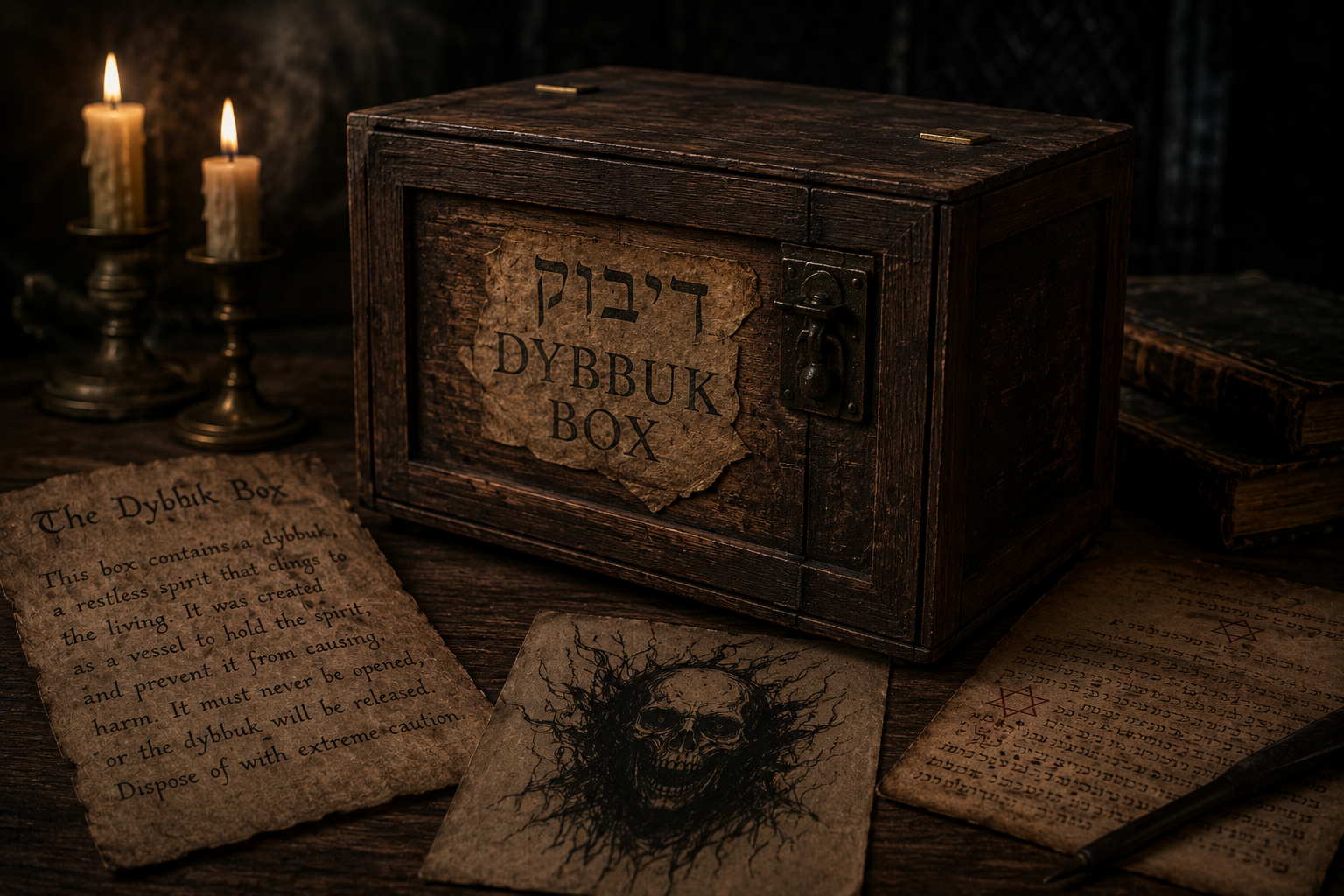
A dusty wooden cabinet sits quietly on a shelf.
It looks ordinary enough. The wood is old, the hinges are worn, and its size is small enough to carry with both hands. At first glance, it seems like something you might find in an antique shop or at an estate sale. But according to one of the internet’s most famous paranormal stories, this simple box is anything but ordinary.
Some people claim it carries a terrible curse.
Others believe it houses a malevolent spirit known as a dybbuk.
Stories surrounding the object include unexplained nightmares, mysterious illnesses, strange smells, shadowy figures, electrical failures, terrifying dreams, and a long series of owners who supposedly regretted ever touching it.
The object became famous worldwide through online articles, television programs, paranormal investigations, books, documentaries, and even a Hollywood horror film. Today, millions of people know it simply as “the Dybbuk Box.”
But how much of the story is actually true?
Did an ancient Jewish spirit really become trapped inside a small wooden wine cabinet?
Did generations of owners genuinely experience supernatural events?
Or is the Dybbuk Box one of the most successful modern horror legends ever created?
The true history of the Dybbuk Box is fascinating precisely because it blends folklore, religion, internet culture, psychology, popular entertainment, and mystery. Some parts of the story are well documented. Other parts rely entirely on personal testimony. Still others have been openly acknowledged by people involved as fictional additions or creative storytelling.
Separating history from legend is not always easy.
That is exactly what makes the Dybbuk Box such an enduring mystery.
What Is the Dybbuk Box?
The Dybbuk Box is a small antique wooden cabinet that became famous after being sold online in the early 2000s with an extraordinary story attached to it.
Unlike many supposedly haunted objects that fade into obscurity, this box attracted worldwide attention because its owner published a detailed account of the strange events he claimed surrounded it.
The object itself is not particularly remarkable.
It resembles a small wine cabinet or storage box.
Its appearance is simple rather than frightening.
The mystery comes almost entirely from the stories connected to it rather than from the object itself.
Today, the phrase “Dybbuk Box” has become almost synonymous with haunted antiques.
What Is a Dybbuk?
To understand the legend, it is important to understand the word “dybbuk.”
A dybbuk belongs to Jewish folklore rather than mainstream Jewish religious doctrine.
The word comes from a Hebrew root meaning “to cling” or “to attach.”
According to traditional folklore, a dybbuk is the restless spirit of a deceased person that attaches itself to a living individual.
In many traditional stories, the spirit is unable to move peacefully into the afterlife because of unresolved sins, unfinished business, or spiritual unrest.
Instead of haunting an object, classic dybbuk stories almost always involve possession of a person.
This is an important distinction.
Historically, Jewish folklore describes dybbuks as possessing human beings—not living inside wooden boxes.
The idea of trapping a dybbuk inside a cabinet is largely a modern adaptation rather than a traditional belief.
The Origins of the Legend
The modern Dybbuk Box story began in 2001.
An antique dealer named Kevin Mannis purchased an old wooden cabinet at an estate sale in Portland, Oregon.
According to his account, the cabinet had belonged to an elderly Holocaust survivor.
The woman’s granddaughter supposedly warned him not to buy it.
She allegedly claimed her grandmother believed the cabinet contained a dybbuk.
Mannis later wrote that he ignored the warning.
He took the cabinet home.
Soon afterward, he claimed strange events began occurring.
These experiences formed the foundation of the entire legend.
The Strange Experiences
According to Mannis, unusual incidents began shortly after acquiring the cabinet.
He described unexplained electrical problems.
He claimed lights failed unexpectedly.
He reported a strange smell resembling jasmine flowers mixed with cat urine.
He said family members experienced disturbing nightmares involving an elderly woman.
Some reportedly awoke with bruises.
He also claimed various owners suffered illnesses, anxiety, financial problems, and other unfortunate events.
These experiences convinced him that the cabinet was haunted.
Whether these events truly occurred exactly as described remains impossible to verify independently.
Most rely solely on personal testimony.
The Famous Online Auction
The Dybbuk Box became internationally famous after Mannis listed it for sale on eBay.
Instead of writing a normal product description, he published a long narrative detailing the cabinet’s frightening history and the disturbing experiences he claimed it caused.
The description spread rapidly across the internet.
Readers found the story captivating.
Many believed it.
Others viewed it as creative marketing.
Regardless of whether people accepted the supernatural claims, the listing transformed an ordinary antique cabinet into a worldwide paranormal sensation.
The internet played a major role in the object’s growing fame.
The Box Changes Hands
After the online auction, the cabinet passed through multiple owners.
Several reported their own unusual experiences.
Some claimed they suffered persistent nightmares.
Others described mysterious illnesses.
A few believed they experienced shadowy apparitions or unexplained bad luck.
However, these reports remain anecdotal.
They have not been independently verified under controlled scientific conditions.
It is also possible that owners familiar with the object’s frightening reputation became more likely to interpret ordinary events as supernatural.
Psychologists refer to this tendency as expectation bias.
When people expect unusual experiences, they may notice events they would otherwise ignore.
The Items Said to Be Inside
Descriptions of the cabinet often mention several unusual objects supposedly found inside.
These reportedly included old coins, locks of hair, dried rosebuds, a small golden goblet, a granite statue, and candles.
The significance of these items remains uncertain.
Some paranormal writers suggest they formed part of a ritual.
Others believe they were simply miscellaneous belongings collected over many years.
No clear historical evidence links these objects to any authentic Jewish ritual involving dybbuks.
Their true origin remains unknown.
Did the Box Really Belong to a Holocaust Survivor?
One of the most emotionally powerful elements of the legend involves the alleged Holocaust survivor.
According to the story, she escaped Nazi persecution and eventually immigrated to the United States, bringing the cabinet with her.
However, historians have found little independent documentation confirming this account.
The available evidence relies primarily on personal narratives rather than historical records.
This does not necessarily mean the story is false.
It simply means it cannot currently be verified with confidence.
Responsible historical research distinguishes between documented facts and traditions passed through oral storytelling.
Jewish Folklore and the Dybbuk
Dybbuks occupy an important place in Jewish folklore.
Stories about spirit possession became especially common in Eastern European Jewish communities during the sixteenth and seventeenth centuries.
These tales often emphasized morality, repentance, and spiritual healing.
In traditional accounts, respected rabbis performed religious rituals intended to expel possessing spirits.
The stories reflected religious beliefs, cultural traditions, and attempts to explain mysterious illnesses or unusual behavior before modern psychology existed.
Importantly, these stories focused on people rather than haunted objects.
The Dybbuk Box legend represents a modern reinterpretation of much older folklore.
How Folklore Evolves
Folklore changes over time.
Every culture adapts traditional stories to new settings and audiences.
Ghost stories once centered on castles.
Later generations shifted them to abandoned hospitals, hotels, cemeteries, and haunted houses.
Similarly, the modern Dybbuk Box transformed an ancient possession legend into the story of a cursed object.
This evolution illustrates how folklore remains alive rather than frozen in history.
New generations reshape old ideas to match contemporary fears.
The Internet’s Role
Without the internet, the Dybbuk Box would probably have remained an obscure antique.
Online discussion forums, paranormal websites, blogs, podcasts, and social media amplified the story enormously.
Each retelling added new details.
Some accounts exaggerated earlier claims.
Others introduced entirely fictional events.
This process is common in internet folklore.
Stories evolve rapidly as they spread.
Distinguishing original claims from later additions becomes increasingly difficult.
The Dybbuk Box became one of the first major paranormal legends born during the digital age.
Paranormal Investigations
Numerous paranormal investigators have examined the Dybbuk Box.
Television programs featured dramatic investigations using electronic equipment, infrared cameras, electromagnetic field detectors, and audio recording devices.
Some investigators reported unusual readings.
Others experienced nothing remarkable.
Importantly, no scientific investigation has produced evidence demonstrating that the cabinet contains supernatural forces.
Scientific testing requires controlled experiments capable of eliminating ordinary explanations.
Such evidence has never been established for the Dybbuk Box.
Psychology and Haunted Objects
Psychology offers several possible explanations for experiences associated with supposedly haunted objects.
Expectation strongly influences perception.
If someone believes an object is cursed, normal events may seem extraordinary.
Coincidences become meaningful.
Dreams become frightening.
Ordinary household noises appear mysterious.
Stress and anxiety themselves can produce vivid nightmares, sleep disturbances, and heightened awareness of ambiguous sounds or shadows.
None of this proves paranormal claims false.
However, it demonstrates why scientists require carefully controlled evidence before accepting extraordinary explanations.
Why People Love Haunted Object Stories
Stories about cursed objects have existed for centuries.
People naturally assign emotional significance to physical objects.
Family heirlooms carry memories.
Historical artifacts connect us with the past.
When mysterious stories become attached to these objects, imagination fills remaining gaps.
Haunted object stories combine curiosity, suspense, history, and fear.
The Dybbuk Box follows this timeless storytelling tradition.
Its appeal lies partly in uncertainty.
People enjoy asking, “What if it were true?”
The Hollywood Connection
The Dybbuk Box gained even greater popularity after inspiring the 2012 supernatural horror film The Possession.
Although the filmmakers described the movie as being inspired by the famous cabinet, the story itself is fictional.
The film dramatically expanded the legend.
Many viewers assumed the movie accurately represented historical events.
In reality, numerous details were invented for entertainment purposes.
Like many “based on true events” horror films, it combined real inspiration with fictional storytelling.
Did the Original Creator Change the Story?
One of the most surprising developments occurred years after the legend became famous.
Kevin Mannis later acknowledged in interviews that significant parts of the Dybbuk Box narrative had been created as a work of horror storytelling.
He explained that he enjoyed writing and intended to create an engaging supernatural story around the antique cabinet.
This admission fundamentally changed how many researchers viewed the legend.
However, some paranormal enthusiasts continue believing that unusual events occurred regardless of how the story originated.
Others see the confession as strong evidence that the haunting narrative was largely fictional.
Why the Legend Continued Anyway
One might expect the story to disappear after its creator acknowledged fictional elements.
Instead, interest continued growing.
Why?
Because stories often become larger than their creators.
Once thousands of people contributed additional experiences, interpretations, television programs, books, and documentaries, the legend developed a life of its own.
Modern folklore frequently operates this way.
An initial fictional narrative can inspire genuine belief, personal experiences, and continuing cultural influence.
Scientific Skepticism
Scientists approach haunted object claims cautiously.
Extraordinary claims require extraordinary evidence.
So far, no controlled scientific study has demonstrated that the Dybbuk Box possesses supernatural properties.
Most reported experiences involve subjective perceptions.
Nightmares, illnesses, anxiety, electrical problems, and coincidences occur regularly in everyday life.
Establishing that an object directly causes such events requires evidence far beyond personal testimony.
At present, such evidence does not exist.
Cultural Significance
Regardless of whether one believes the supernatural claims, the Dybbuk Box remains culturally important.
It demonstrates how folklore evolves in the modern world.
It shows the influence of internet storytelling.
It illustrates how ancient religious concepts can become transformed within popular culture.
It also highlights humanity’s enduring fascination with mysteries that cannot be easily explained.
The Dybbuk Box has become part of contemporary folklore.
The Difference Between History and Legend
One of the most valuable lessons of the Dybbuk Box concerns critical thinking.
History depends upon evidence.
Legends depend upon storytelling.
Sometimes the two overlap.
The historical facts are relatively straightforward.
An antique cabinet existed.
It was sold.
Its owner published a dramatic online story.
The object became famous.
Movies, books, and television programs expanded the legend.
Everything beyond these documented facts requires varying degrees of interpretation.
Responsible research distinguishes clearly between documented evidence and supernatural claims.
Why the Story Endures
The Dybbuk Box continues captivating audiences because it combines several powerful elements.
It connects ancient religious folklore with modern horror.
It includes mystery, uncertainty, personal testimony, and unanswered questions.
It invites readers to decide for themselves what they believe.
Unlike mysteries that receive definitive solutions, the Dybbuk Box leaves room for imagination.
That uncertainty keeps the story alive.
Every generation retells it in new ways.
Conclusion
The Dybbuk Box is one of the most famous haunted object stories of the modern era, but its true history is far more complex than many popular accounts suggest. At the center of the legend is a simple antique wooden cabinet that became internationally known after a dramatic online auction description in 2001. Stories of nightmares, strange smells, mysterious illnesses, and unexplained misfortune transformed the box into a worldwide paranormal phenomenon, inspiring books, television programs, documentaries, and a Hollywood horror film.
Yet careful historical investigation reveals a clear distinction between documented facts and legendary claims. Traditional Jewish folklore describes dybbuks as restless spirits that possess people, not spirits imprisoned inside wooden boxes. Much of the modern legend developed through internet storytelling, repeated personal accounts, media attention, and fictional adaptations. The creator of the original online narrative later acknowledged that significant parts of the story had been written as horror fiction, although debate continues among paranormal enthusiasts about whether unexplained experiences may still have occurred.
Ultimately, the Dybbuk Box reveals something fascinating about human nature. It shows how ancient folklore can evolve into modern legends, how the internet can transform a local story into global mythology, and how mystery often grows stronger when fact and fiction become intertwined. Whether viewed as a genuinely haunted object, an elaborate piece of storytelling, or a remarkable example of contemporary folklore, the Dybbuk Box has secured its place in modern cultural history.
Its greatest mystery may not be whether a spirit ever lived inside the cabinet. Instead, it is how a modest wooden box became one of the world’s most enduring supernatural legends, reminding us that stories—especially frightening ones—can sometimes become as powerful as the objects they are meant to explain.