Few gemstones in the world have stories as strange as the Delhi Purple Sapphire. Unlike the dazzling Hope Diamond or the legendary Koh-i-Noor, this mysterious stone is not famous because of its size or extraordinary value. Instead, it has earned its reputation because of an unsettling legend that has followed it for more than a century—a legend of bad luck, financial ruin, mysterious illnesses, and unexplained misfortune.
The story sounds like something from a gothic novel.
According to its legend, the stone was taken from a sacred temple in India during the nineteenth century. Soon afterward, disaster supposedly struck nearly everyone who owned it. Wealth vanished. Health declined. Relationships collapsed. Strange accidents occurred. Owners became convinced that the gemstone carried an ancient curse.
Eventually, the stone’s final private owner became so frightened that he locked it away inside multiple protective boxes, surrounded it with written warnings, and instructed that it should never again be worn as jewelry.
Today, the Delhi Purple Sapphire is kept safely inside the collections of the Natural History Museum in London, where visitors can see it behind glass. Surprisingly, despite its famous name, scientists have discovered that it is not actually a sapphire at all.
So what is the truth behind this mysterious gem?
Was it really cursed?
Why did one educated collector go to extraordinary lengths to imprison a single stone inside layers of locked containers?
And what do modern historians and scientists believe about the strange events connected to it?
The real story of the Delhi Purple Sapphire is a fascinating blend of colonial history, geology, psychology, folklore, and one man’s sincere belief that he possessed one of the world’s most dangerous gemstones.
What Is the Delhi Purple Sapphire?
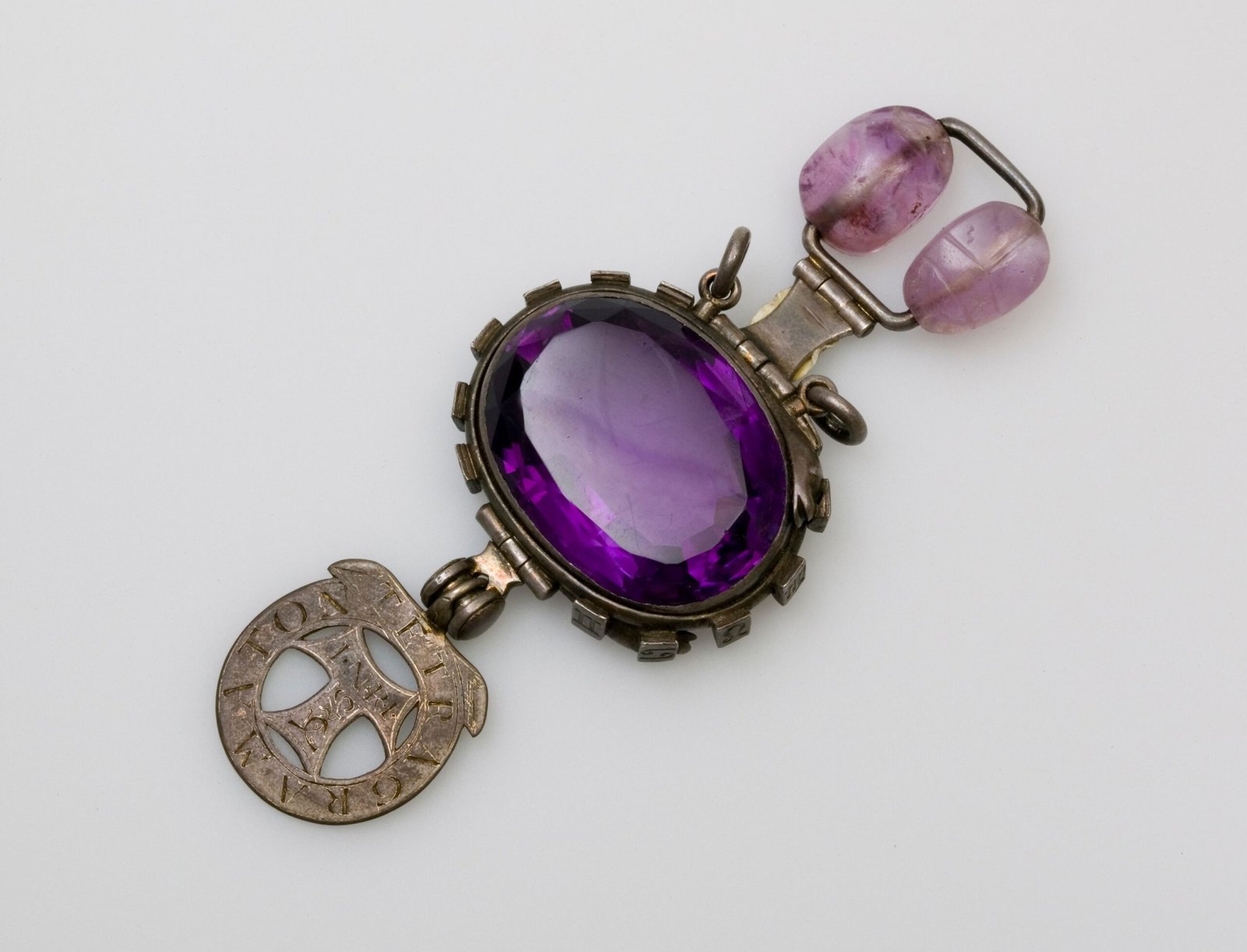
The Delhi Purple Sapphire is a polished violet gemstone housed in the Natural History Museum in London.
Although it is widely known as a sapphire, modern mineralogical analysis has shown that this name is incorrect.
The stone is actually an amethyst, a purple variety of the mineral quartz.
This mistaken identity probably dates back to the nineteenth century, when gemstone classification was less precise than it is today.
The name remained attached to the stone because it had already become famous before scientists correctly identified its composition.
Today, the misleading name survives as part of the artifact’s remarkable history.
Ironically, the fact that it is not a sapphire has done nothing to diminish its legendary reputation.
The Beauty of the Stone
The Delhi Purple Sapphire is attractive but not exceptionally large or valuable compared with many famous gemstones.
Its deep purple color catches the light beautifully.
Careful polishing gives it a smooth, elegant appearance.
Unlike diamonds, which sparkle intensely, amethysts possess a softer beauty that changes subtly depending on the surrounding light.
From a purely geological perspective, it is an interesting mineral specimen.
Its worldwide fame comes almost entirely from its extraordinary story rather than its monetary value.
The Legend Begins in India
According to the traditional story attached to the stone, it originally came from the Temple of Indra in Cawnpore, now known as Kanpur, India.
The legend claims that during the Indian Rebellion of 1857, sometimes called the Indian Mutiny in older British sources or the First War of Independence in many Indian accounts, a British soldier removed the gemstone from the temple.
Whether this event actually occurred exactly as described remains uncertain.
No independent historical evidence confirms every detail of the story.
However, it reflects a broader historical reality.
The rebellion created enormous chaos throughout northern India.
Temples, palaces, homes, and public buildings suffered destruction and looting from multiple sides during the conflict.
Many cultural treasures changed hands during this turbulent period.
The story claims that removing the sacred stone from the temple awakened a curse that pursued every subsequent owner.
This belief became the foundation of the gem’s frightening reputation.
The Indian Rebellion of 1857
Understanding the historical setting helps separate documented history from legend.
The Indian Rebellion of 1857 was one of the most significant conflicts of the nineteenth century.
It began as a military uprising among Indian soldiers serving the British East India Company but quickly expanded into a much larger revolt involving numerous regions and communities.
The fighting resulted in widespread destruction and heavy loss of life.
Following the rebellion, British rule in India changed dramatically, with direct control passing from the East India Company to the British Crown.
Many valuable artifacts left India during this period, legally or otherwise.
Because historical records concerning the gemstone’s earliest ownership remain incomplete, historians cannot verify every claim surrounding its supposed removal from the temple.
The First Reports of Misfortune
According to the legend, the British officer who obtained the gemstone soon experienced severe personal difficulties.
Financial losses reportedly followed.
Health problems emerged.
His life allegedly entered a period of continuous hardship.
As the gemstone passed from owner to owner, similar stories accumulated.
Each new misfortune strengthened belief in the curse.
Over time, the legend became more elaborate.
Some accounts included business failures.
Others described illnesses, family tragedies, or unexpected deaths.
As with many famous cursed objects, the stories often grew with repeated retelling.
Determining exactly which events occurred and which became exaggerated over time is extremely difficult.
Edward Heron-Allen Enters the Story
The Delhi Purple Sapphire became truly famous because of one remarkable individual.
Edward Heron-Allen was a respected British scholar, writer, scientist, linguist, musician, and collector.
He was not generally regarded as a superstitious man.
His wide-ranging intellectual interests reflected careful observation and curiosity.
Around the end of the nineteenth century, Heron-Allen acquired the gemstone.
At first, he probably viewed it simply as another interesting addition to his collection.
However, according to his later writings, unusual events soon convinced him that the stories surrounding the stone deserved serious attention.
Whether those events were genuinely extraordinary or interpreted through the lens of expectation remains an open question.
Strange Experiences
Heron-Allen later wrote that misfortune seemed to accompany the gemstone.
He believed accidents, illnesses, and personal setbacks occurred while the stone remained in his possession.
He also claimed that individuals who handled or temporarily owned the gemstone experienced unfortunate events.
At one point, he reportedly attempted to give the stone away.
When the recipient also encountered difficulties, the gemstone eventually returned to him.
As these experiences accumulated, Heron-Allen became increasingly convinced that the stone carried dangerous supernatural influence.
His belief was sincere.
Whether the curse existed objectively is another matter entirely.
The Decision to Lock It Away
Eventually, Heron-Allen decided drastic action was necessary.
Instead of displaying the gemstone or wearing it, he imprisoned it.
He enclosed it inside multiple protective boxes.
He included written warnings describing the gemstone’s supposedly dangerous history.
The packaging itself became part of the legend.
Future handlers would immediately encounter detailed explanations of why the stone should never be removed casually.
Heron-Allen apparently hoped that isolating the gemstone would prevent further misfortune.
This unusual treatment transformed an already curious artifact into one of history’s most famous allegedly cursed objects.
The Warning Letter
Perhaps the most remarkable part of the Delhi Purple Sapphire’s history is Heron-Allen’s written warning.
In his letter, he described the stone as possessing extraordinary destructive power.
He urged future owners to exercise extreme caution.
He requested that the gemstone never again become personal property after his death.
Instead, he wanted it entrusted to a museum where it could remain safely stored.
His words reveal genuine concern rather than theatrical storytelling.
Whether modern readers accept the curse or not, Heron-Allen clearly believed the danger was real.
Arrival at the Natural History Museum
Heron-Allen’s wishes were eventually fulfilled.
The gemstone entered the Natural History Museum in London.
There it remains today.
Museum staff treat it primarily as an object of historical and cultural interest rather than supernatural concern.
Visitors often come specifically to see the famous “cursed” gemstone.
Ironically, countless museum employees, researchers, conservators, and visitors have interacted with the stone over many decades without documented evidence of any unusual pattern of disasters.
Its modern history appears considerably less dramatic than its legendary past.
It Isn’t Actually a Sapphire
One of the biggest surprises surrounding the Delhi Purple Sapphire is that it is not a sapphire.
Scientific examination identified the stone as amethyst.
Understanding this difference requires a brief look at mineralogy.
Sapphires belong to the mineral corundum.
Most sapphires are blue, although other colors exist.
Amethyst belongs to the quartz family.
Its purple color results primarily from trace amounts of iron combined with natural radiation affecting the crystal structure over geological time.
These are completely different minerals with different chemical compositions.
Despite this correction, historians continue using the traditional name because it has become historically established.
Why People Believe in Cursed Objects
The Delhi Purple Sapphire raises fascinating psychological questions.
Why do intelligent people sometimes become convinced that an object carries supernatural power?
One explanation involves confirmation bias.
When people expect bad luck, they naturally pay greater attention to unfortunate events.
Ordinary accidents suddenly seem meaningful.
Positive experiences receive less attention.
Negative experiences reinforce existing beliefs.
Over time, isolated incidents appear connected even when no objective relationship exists.
This psychological tendency affects people in many areas of life.
It does not imply dishonesty.
Rather, it reflects how the human mind searches for patterns.
The Power of Suggestion
Expectations strongly influence human perception.
Imagine receiving a gemstone accompanied by detailed stories describing illness, financial ruin, and death.
Every minor problem afterward might appear connected.
A headache becomes suspicious.
An unexpected expense feels ominous.
Normal life’s ups and downs begin fitting an increasingly frightening narrative.
Psychologists call this the nocebo effect.
Just as positive expectations sometimes improve perceived well-being, negative expectations can increase anxiety and heighten awareness of unpleasant experiences.
The legend itself may therefore contribute to its own apparent confirmation.
Other Famous Cursed Gems
The Delhi Purple Sapphire is far from unique.
History contains numerous stories about cursed gemstones.
The Hope Diamond has long been associated with legends of misfortune, although many famous owners lived perfectly successful lives.
The Black Orlov Diamond also carries tales of temple theft and tragedy.
The Koh-i-Noor diamond is surrounded by traditions claiming it brings misfortune to male rulers.
Most of these stories grew gradually over many decades.
Historical events became intertwined with folklore.
Ordinary misfortunes transformed into evidence supporting supernatural narratives.
The Delhi Purple Sapphire fits comfortably within this broader tradition.
Colonial History and Cultural Memory
The gemstone’s legend cannot be separated entirely from colonial history.
Many stories about cursed artifacts involve objects removed from their original cultural settings.
Whether or not supernatural forces exist, such stories often express moral concerns about conquest, looting, and cultural loss.
The Delhi Purple Sapphire’s supposed removal from an Indian temple reflects these broader historical themes.
The “curse” may symbolically represent consequences associated with taking sacred objects from their communities.
Folklore frequently uses supernatural language to express ethical questions.
Could the Curse Be Real?
From a scientific perspective, no credible evidence demonstrates that gemstones possess supernatural powers capable of causing misfortune.
Extensive experience with museum collections supports this conclusion.
Millions of ancient artifacts exist worldwide.
Many carry legends of curses.
Careful investigation rarely reveals statistically unusual patterns of accidents associated with them.
This does not diminish the emotional impact of such stories.
Legends often persist because they resonate with deep human emotions rather than because they withstand scientific testing.
The Museum’s Perspective
Today, the Natural History Museum presents the Delhi Purple Sapphire as both a mineral specimen and a fascinating historical artifact.
Its value lies not in paranormal claims but in the rich cultural story surrounding it.
Visitors learn about mineralogy, colonial history, collecting practices, folklore, and human psychology.
The museum preserves not only the gemstone itself but also Heron-Allen’s letters and documentation.
Together, these materials tell a remarkable story about belief and history.
Why the Legend Endures
The Delhi Purple Sapphire continues captivating people because it combines several irresistible elements.
There is an ancient temple.
A violent historical conflict.
A mysterious gemstone.
Repeated stories of misfortune.
An educated owner who sincerely believed in its dangerous power.
And finally, a museum display preserving the entire narrative.
Even skeptical readers often find themselves wondering.
What if?
That tiny question keeps legends alive.
Separating History from Myth
Modern historians distinguish carefully between documented facts and traditional stories.
Several facts are well established.
The gemstone exists.
It is housed in the Natural History Museum.
It belonged to Edward Heron-Allen.
He genuinely believed it carried a curse.
He enclosed it with warning letters before donating it.
Scientific testing shows it is an amethyst rather than a sapphire.
Other aspects remain uncertain.
The exact circumstances of its removal from India cannot be confirmed conclusively.
Many reported misfortunes rely primarily on anecdotal accounts.
The supernatural curse itself cannot be tested or demonstrated scientifically.
Understanding these distinctions allows appreciation of the story without confusing legend with historical evidence.
A Symbol Rather Than a Supernatural Force
Whether or not one believes in curses, the Delhi Purple Sapphire has become a powerful symbol.
It symbolizes humanity’s fascination with mystery.
It symbolizes the emotional weight objects can acquire through storytelling.
It symbolizes colonial history and the movement of cultural treasures.
It symbolizes the remarkable influence belief can exert upon human experience.
Most importantly, it reminds us that artifacts are not merely physical objects.
They also carry narratives that shape how future generations understand them.
Why the Stone Was Really Locked Away
The answer depends upon perspective.
According to the legend, the stone was locked away because it possessed dangerous supernatural power.
According to historical evidence, it was locked away because Edward Heron-Allen sincerely believed that power existed.
This distinction matters.
The boxes surrounding the gemstone tell us more about human belief than about the gemstone itself.
Heron-Allen’s actions demonstrate genuine conviction.
His careful warnings transformed an ordinary mineral specimen into one of the world’s most intriguing museum objects.
Conclusion
The Delhi Purple Sapphire is one of history’s most fascinating examples of how legend and reality can become intertwined. Although its famous name suggests a precious sapphire, scientific examination has revealed that it is actually an amethyst. Yet this simple correction has done little to diminish the stone’s remarkable reputation. Its fame rests not on its geological rarity but on the extraordinary story that has followed it for more than a century.
The historical record confirms that the gemstone belonged to the British scholar Edward Heron-Allen, who became convinced it brought terrible misfortune to anyone who possessed it. His decision to seal the stone inside protective boxes, accompanied by detailed warning letters, ensured that its legend would survive long after his death. Today, those documents remain almost as important as the gemstone itself, offering a rare glimpse into the sincere beliefs of an educated collector.
Modern science has found no evidence that gemstones can cause supernatural disasters. Psychology provides convincing explanations for why cursed objects appear to influence people’s lives, including confirmation bias, expectation, and the powerful effect of storytelling. At the same time, the legend reflects deeper historical themes involving colonialism, sacred objects, cultural memory, and humanity’s enduring fascination with the unknown.
Perhaps that is the true mystery of the Delhi Purple Sapphire. Its greatest power may never have been hidden within the crystal itself. Instead, its influence lies in the stories people have attached to it—the fears they felt, the warnings they wrote, and the questions they continue to ask. Locked safely behind museum glass, the stone no longer frightens its visitors. Instead, it invites them to explore something even more enduring than a curse: the extraordinary human ability to transform an ordinary object into an unforgettable legend.