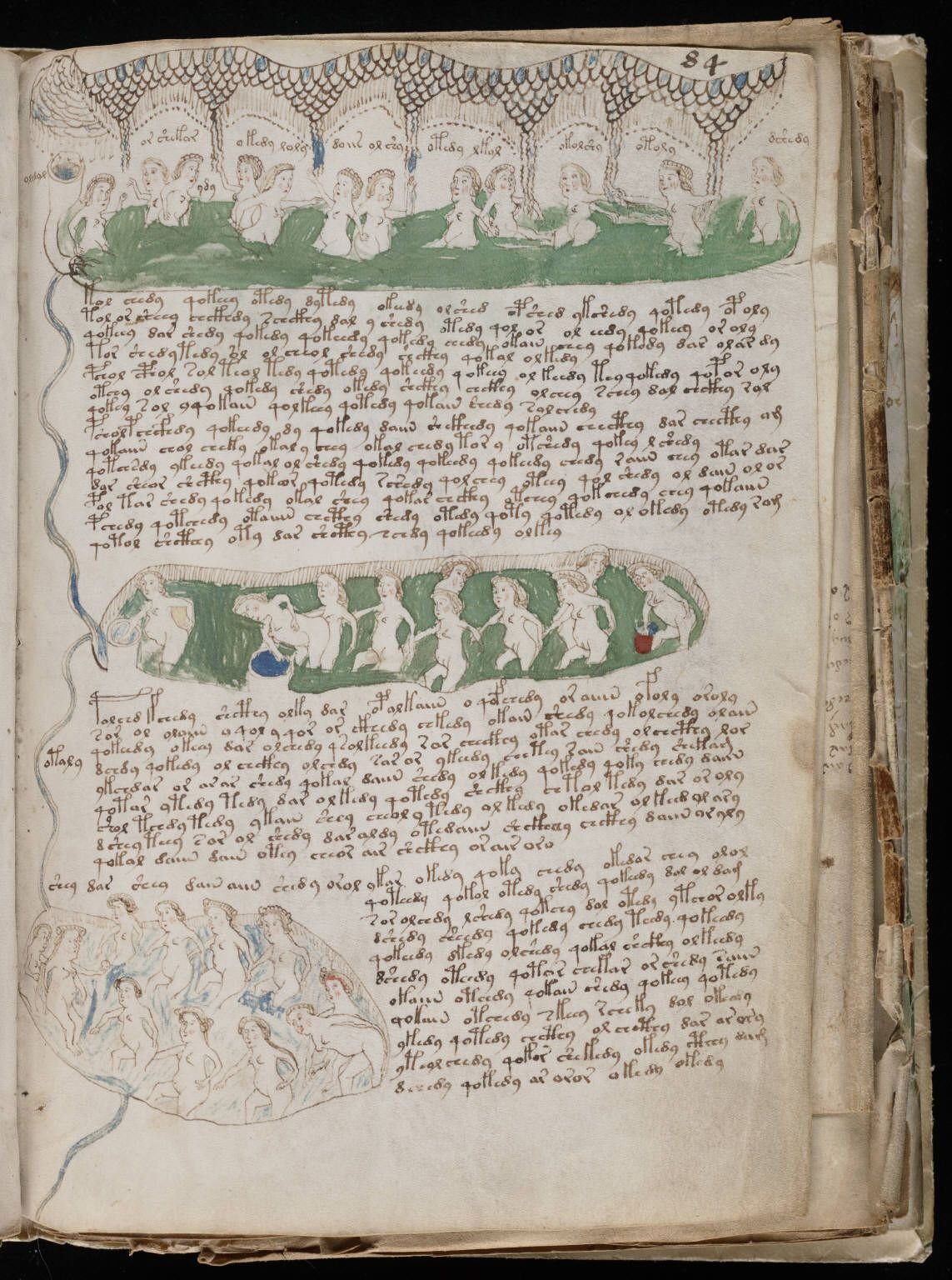
Imagine opening a book unlike any other ever created. Its pages are filled with elegant handwriting, yet not a single word belongs to any known language. Strange plants grow from its illustrations, but no botanist can identify them. Women bathe in mysterious green pools connected by impossible pipes, while unfamiliar stars and strange circular diagrams fill the remaining pages. Hundreds of years have passed. The world’s greatest codebreakers, linguists, historians, mathematicians, cryptographers, computer scientists, and artificial intelligence systems have all tried to understand it. None has succeeded.
The Voynich Manuscript is more than an old book. It is one of history’s greatest intellectual puzzles.
Unlike many historical mysteries that gradually yield their secrets through new discoveries, this manuscript has remained stubbornly silent. Every page invites interpretation while refusing to reveal its meaning. Every breakthrough has raised new questions. Every proposed solution has eventually collapsed under scientific scrutiny.
For more than a century, this extraordinary manuscript has inspired theories ranging from forgotten languages and secret scientific knowledge to elaborate medieval hoaxes and even extraterrestrial communication. Yet despite all the speculation, one remarkable fact remains unchanged:
No one can read it.
Its mystery lies not simply in what it says—but in the unsettling possibility that we may never know.
A Book Unlike Any Other
The Voynich Manuscript is a handwritten illustrated codex consisting of approximately 240 surviving pages made from fine-quality vellum, a writing material prepared from animal skin. Some pages have been lost over time, and several large foldout pages contain elaborate diagrams unlike anything seen in other medieval books.
Its dimensions are modest, roughly the size of a modern hardcover book, yet its contents are anything but ordinary.
Every page is covered with neat, flowing handwriting composed of symbols found nowhere else in human history. There are around twenty to thirty recurring characters, accompanied by a number of rarer symbols. The writing flows from left to right, with spaces separating apparent words, giving the strong impression that it records a genuine language.
The illustrations are equally perplexing.
Many pages depict plants, but almost none can be confidently matched to known species. Others contain astronomical diagrams, zodiac-like symbols, mysterious biological scenes involving nude female figures immersed in green liquid, pharmaceutical-looking jars, and dense collections of unidentified roots and herbs.
Nothing quite resembles any other medieval manuscript.
The book feels strangely familiar and utterly alien at the same time.
The Discovery That Made the Manuscript Famous
Although the manuscript is now known worldwide, it remained largely unknown for centuries.
Its modern story began in 1912 when Polish-American rare book dealer Wilfrid Voynich purchased the manuscript from the Jesuit Villa Mondragone near Rome.
Voynich immediately recognized that he had discovered something extraordinary.
He believed the manuscript might be the work of the English philosopher Roger Bacon, a brilliant thirteenth-century scholar celebrated for his interest in science and experimentation.
If true, the discovery would have transformed medieval history.
However, later scientific investigations would show that this attractive theory was almost certainly incorrect.
Nevertheless, Voynich’s name became permanently attached to the mysterious volume.
Dating the Manuscript
One of the biggest breakthroughs came not from deciphering the text but from dating the book itself.
In 2009, researchers performed radiocarbon dating on the vellum.
The results showed that the animal skins used to create the manuscript most likely came from the early fifteenth century, approximately between 1404 and 1438.
This discovery significantly narrowed the historical timeframe.
It also ruled out Roger Bacon as its author, since he had lived more than a century earlier.
Importantly, radiocarbon dating applies only to the parchment itself. The ink could have been added later, although most experts believe the writing was likely produced relatively soon after the vellum was prepared.
The pigments used in the illustrations are also consistent with materials available during the fifteenth century.
Taken together, the scientific evidence strongly suggests that the manuscript is an authentic medieval document rather than a modern forgery.
The Strange Language That Nobody Knows
The greatest mystery lies in the writing itself.
At first glance, the text appears remarkably consistent.
Words repeat with regular patterns.
Some symbols frequently appear together.
Certain words occur only in particular sections of the manuscript.
Statistical analysis reveals properties surprisingly similar to natural human languages.
This consistency is important.
Random gibberish usually lacks such structure.
Instead, the manuscript follows complex patterns that suggest deliberate organization.
Words vary in length within expected ranges.
Some combinations of characters never occur.
Others appear repeatedly in meaningful-looking positions.
These characteristics have convinced many linguists that the text was not written randomly.
Yet despite decades of analysis, no known language matches it.
No alphabet corresponds to the symbols.
No direct translation has ever succeeded.
No bilingual “Rosetta Stone” exists to unlock its meaning.
The manuscript remains linguistically isolated.
Could It Be a Secret Code?
One of the earliest ideas proposed that the manuscript hides encrypted information.
Secret writing has existed for thousands of years.
Kings, diplomats, military leaders, merchants, and scholars have long used ciphers to conceal important messages.
If the Voynich Manuscript were encrypted, perhaps it represented an ordinary language disguised through sophisticated coding.
This possibility attracted some of history’s finest cryptographers.
During the twentieth century, experts who successfully broke military codes during both World Wars examined the manuscript.
Some believed they would solve it within weeks.
Years passed.
No solution emerged.
Modern cryptographic analysis has produced similar disappointment.
Known medieval encryption systems generally leave detectable mathematical fingerprints.
The Voynich text does not fit comfortably into these models.
Although encryption remains possible, no convincing cipher has ever explained the manuscript in its entirety.
The Botanical Mystery
Nearly half of the manuscript consists of plant illustrations.
This has led many scholars to suspect that it may be some form of herbal or medical reference.
Medieval herbals were common books describing medicinal plants and their uses.
However, the Voynich plants present an extraordinary problem.
Most appear unfamiliar.
Some resemble real species but combine leaves, flowers, and roots from entirely different plants.
Others seem almost completely imaginary.
Researchers have attempted to identify individual plants for decades.
Occasionally one illustration appears similar to a sunflower, water lily, pansy, or lily, but none of these identifications has achieved broad agreement.
Some scholars argue the illustrations are stylized versions of genuine plants.
Others believe they deliberately combine multiple species.
Still others think they may represent entirely fictional organisms.
Without understanding the accompanying text, certainty remains impossible.
The Women in Green Pools
Among the manuscript’s most memorable images are hundreds of nude female figures.
Many stand inside interconnected pools filled with green liquid.
Some hold stars.
Others emerge from pipe-like structures.
Still others interact with strange mechanical-looking channels linking one chamber to another.
These scenes have inspired endless speculation.
Some historians believe they represent medieval medical ideas concerning the human body.
Others suggest they depict alchemical symbolism, fertility, bathing rituals, or philosophical concepts.
Because medieval artists often used symbolic imagery unfamiliar to modern viewers, interpreting these scenes is extraordinarily difficult.
Without reading the text, every explanation remains tentative.
A Universe of Strange Stars
Another section contains astronomical and astrological imagery.
Circular diagrams display stars, suns, moons, and zodiac symbols.
Many zodiac illustrations resemble familiar medieval traditions.
Recognizable constellations such as Aries, Taurus, Gemini, Cancer, Leo, Virgo, Libra, Scorpio, Sagittarius, Capricorn, Aquarius, and Pisces appear in stylized forms.
However, even here the manuscript departs from convention.
The surrounding text remains undeciphered.
Additional circular diagrams possess no obvious parallels elsewhere.
Whether these images describe astronomy, astrology, calendars, or something entirely different remains unknown.
Medicine, Alchemy, or Something Else?
Many researchers suspect the manuscript concerns medicine.
The apparent plant illustrations, bathing scenes, pharmaceutical jars, and root drawings resemble elements found in medieval medical texts.
During the fifteenth century, medicine combined practical observation with astrology, herbal remedies, and ancient traditions inherited from Greek, Roman, and Islamic scholarship.
The manuscript could theoretically represent a unique medical encyclopedia.
Others favor alchemy.
Alchemy blended chemistry, philosophy, spirituality, and experimentation.
Its practitioners frequently employed symbolic language to conceal knowledge from outsiders.
This secrecy could explain both the unusual writing and the mysterious illustrations.
Yet no interpretation fully accounts for every section.
The manuscript refuses to fit neatly into any known intellectual tradition.
The Statistical Puzzle
Modern computers have transformed Voynich research.
Instead of focusing only on individual words, scientists analyze enormous statistical patterns.
Surprisingly, the manuscript behaves much like genuine language.
Certain words occur frequently.
Others are rare.
Word frequencies resemble distributions found in real languages.
Some sections use distinct vocabularies, suggesting different topics.
Neighboring words often share similar structures.
These patterns appear too sophisticated for simple random nonsense.
However, statistical similarity alone does not prove meaningful content.
A carefully designed meaningless text could theoretically imitate some linguistic properties.
This uncertainty lies at the heart of the debate.
Artificial Intelligence Joins the Search
Artificial intelligence has become one of the newest tools in Voynich research.
Machine learning algorithms can examine millions of possible linguistic relationships far faster than humans.
Researchers have trained AI systems on hundreds of known languages, hoping to identify hidden similarities.
Some studies have suggested possible connections with Hebrew, Nahuatl, or other languages.
Others have proposed extinct dialects or artificially constructed languages.
Yet every widely publicized claim has faced serious criticism from specialists.
The primary challenge is verification.
A proposed translation must consistently explain every page.
It must account for grammar, vocabulary, repeated words, illustrations, and historical context.
No AI-generated solution has met this demanding standard.
Instead, artificial intelligence has become another powerful analytical tool rather than a magical decoder.
Was It Written in a Lost Language?
One intriguing possibility is that the manuscript records a language no longer spoken.
History contains countless extinct languages.
Many disappeared without leaving substantial written records.
If the Voynich text preserves one such language in an otherwise unknown writing system, decipherment becomes immensely difficult.
Successful translation usually requires comparison.
Ancient Egyptian hieroglyphs were deciphered because the Rosetta Stone presented the same text in multiple scripts.
Linear B yielded its secrets because enough inscriptions survived for careful analysis.
The Voynich Manuscript lacks these advantages.
There is no bilingual inscription.
No dictionary.
No confirmed parallel text.
If it truly represents a lost language, it may remain unreadable indefinitely.
The Hoax Theory
Not everyone believes the manuscript contains meaningful information.
Some scholars have argued that it is an elaborate medieval hoax.
According to this idea, the unknown script merely imitates language without conveying real meaning.
Perhaps the creator intended to impress wealthy patrons, collectors, or rulers with an apparently profound but ultimately meaningless book.
At first glance, this seems plausible.
Yet creating hundreds of pages filled with statistically consistent pseudo-language would have required extraordinary patience and planning.
Moreover, medieval parchment was expensive.
Producing such an elaborate deception would have demanded enormous time, skill, and financial resources.
Many researchers therefore doubt the hoax explanation, although it cannot be completely dismissed.
Famous Attempts at Decipherment
Throughout the twentieth and twenty-first centuries, countless individuals have announced that they had solved the mystery.
Nearly all have eventually been disproven.
Some claimed the manuscript recorded Latin.
Others argued for Old Czech, medieval German, Hebrew, Arabic, Chinese, Aztec languages, or forgotten dialects.
Some proposed secret societies.
Others invoked alchemy, astrology, medicine, religion, or coded political messages.
Several claimed extraterrestrial origins.
None has produced a translation accepted by the scholarly community.
A successful decipherment must explain every page consistently.
No proposed solution has yet achieved that goal.
Why Is It So Difficult?
The challenge is far greater than translating an unfamiliar language.
Researchers do not even know what kind of writing system they are facing.
Is each symbol a letter?
A syllable?
An entire word?
Does one symbol represent several sounds?
Are vowels omitted?
Is the text encrypted?
Does grammar resemble known languages?
Or is it something completely different?
Every uncertainty multiplies the difficulty.
Imagine trying to solve a crossword puzzle without knowing the language, alphabet, or rules.
That is the challenge confronting every Voynich researcher.
What the Manuscript Has Already Taught Us
Ironically, although nobody can read the manuscript, it has already transformed several scientific fields.
Cryptographers have developed new methods for analyzing unknown writing systems.
Computer scientists have designed algorithms capable of detecting subtle linguistic patterns.
Historians have gained deeper understanding of medieval manuscripts, pigments, parchment production, and bookmaking.
Artificial intelligence researchers continue using the manuscript as a challenging benchmark for language analysis.
In this sense, the mystery has generated valuable scientific knowledge even without revealing its own secrets.
Could It Ever Be Solved?
The answer remains uncertain.
New technologies continue to emerge.
Multispectral imaging can reveal faded writing invisible to the naked eye.
Advanced computational linguistics grows increasingly sophisticated.
Artificial intelligence becomes more capable each year.
Historical archives may yet uncover forgotten documents connected to the manuscript.
A single newly discovered letter mentioning its author could transform the entire investigation.
History has repeatedly shown that impossible puzzles sometimes yield unexpectedly.
Ancient scripts once believed forever unreadable have eventually been deciphered.
The Voynich Manuscript may one day join them.
Or it may remain one of humanity’s permanent mysteries.
Why the Voynich Manuscript Continues to Fascinate Us
Perhaps the manuscript’s greatest power lies not in what it says but in what it represents.
Modern society often assumes that every mystery will eventually be solved. We live in an age of satellites, genome sequencing, particle accelerators, and artificial intelligence. Vast libraries are searchable in seconds, and algorithms can recognize faces, translate languages, and discover patterns hidden within enormous datasets.
Yet this small fifteenth-century book quietly reminds us of the limits of human knowledge.
It sits behind protective glass in the Beinecke Rare Book and Manuscript Library at Yale University, its elegant script as unreadable today as when it first appeared centuries ago. Thousands of experts have examined it. Millions of words have been written about it. Entire careers have been devoted to understanding it. Still, its pages refuse to surrender their meaning.
There is something deeply compelling about that silence.
Every unreadable word invites the imagination. Every mysterious illustration encourages new questions. The manuscript challenges our confidence, reminding us that even in an age of extraordinary scientific achievement, history still guards some of its greatest secrets.
Whether the Voynich Manuscript proves to be an encoded scientific text, a forgotten language, an elaborate intellectual game, or something no one has yet imagined, it continues to inspire the very quality that drives both science and scholarship: curiosity.
Perhaps that is its greatest message.
Not one written in mysterious symbols, but one understood without reading a single word.
The pursuit of knowledge never truly ends. Some mysteries are valuable not because they are solved, but because they continue to inspire generations to keep asking questions.