In the spring of 1900, a group of sponge divers seeking treasure beneath the crystal-clear waters of the Mediterranean Sea made an astonishing discovery. Off the small Greek island of Antikythera, they stumbled upon the remains of an ancient shipwreck lying nearly 45 meters (150 feet) below the surface. Scattered across the seabed were magnificent bronze statues, marble sculptures, coins, jewelry, pottery, and countless artifacts that had rested undisturbed for almost two thousand years.
It looked like one more spectacular archaeological find from the ancient world.
But hidden among the corroded bronze fragments was an object unlike anything anyone expected.
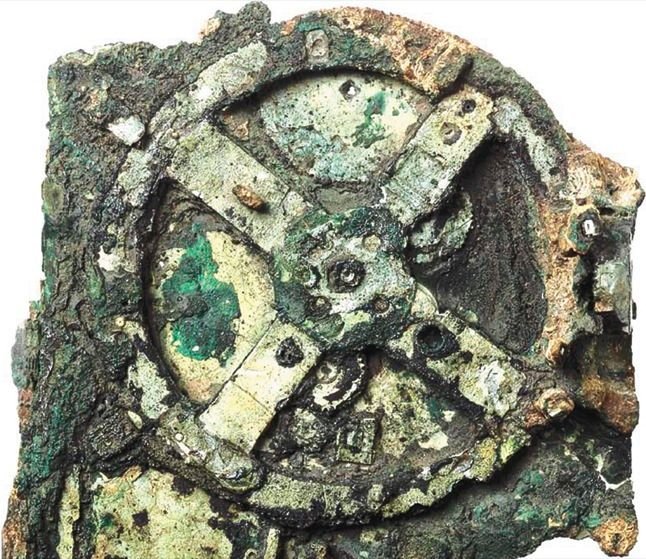
At first glance, it appeared to be nothing more than a lump of greenish, mineral-encrusted metal. It seemed insignificant compared to the beautiful statues recovered from the wreck. Yet months later, after the fragments began drying inside a museum, something extraordinary caught the attention of archaeologists.
Tiny bronze gears.
Hundreds of finely cut gear teeth emerged from the corrosion.
Ancient Greece was known for philosophy, mathematics, literature, astronomy, and engineering, but no one believed people living more than 2,000 years ago possessed the technology to build an intricate machine filled with precision gears.
As researchers gradually examined the fragments, disbelief turned into amazement.
This was not a simple mechanical device.
It was an ancient analog computer.
The Antikythera Mechanism could predict the motions of the Sun and Moon, forecast eclipses, track astronomical cycles, and perhaps even indicate the positions of the known planets.
It was a technological achievement so advanced that nothing comparable would appear again for more than a thousand years.
The obvious question followed.
Who built this incredible machine?
And perhaps even more puzzling:
How did such astonishing knowledge disappear?
The Discovery Beneath the Sea
The Antikythera shipwreck itself tells an extraordinary story.
The vessel was likely a large Roman-era cargo ship sailing sometime between approximately 70 and 60 BCE. It probably carried luxury goods from the Greek world toward Rome, where wealthy collectors eagerly purchased masterpieces of Greek art.
The ship never reached its destination.
Caught in rough seas near Antikythera, it sank, taking its precious cargo to the ocean floor.
For nearly two millennia, waves, currents, marine organisms, and corrosion slowly buried the wreck.
When sponge divers rediscovered it in 1900, underwater archaeology barely existed. Divers worked under dangerous conditions using heavy copper helmets supplied with air from the surface. Several suffered decompression sickness, and one diver died during the recovery efforts.
Despite these risks, hundreds of artifacts were recovered.
Among them were eighty-two surviving fragments of the mysterious mechanism.
No one realized they had found one of history’s greatest technological treasures.
A Puzzle Made of Bronze
Today, the Antikythera Mechanism survives only as broken fragments.
Time has not been kind.
Wooden parts disappeared long ago.
Bronze corroded heavily after centuries beneath seawater.
Many gears survive only partially.
Nevertheless, enough remains to reveal its astonishing complexity.
Originally, the mechanism was housed inside a wooden case roughly the size of a modern shoebox.
Bronze plates formed its internal framework.
Within this compact space sat a remarkably sophisticated arrangement of interlocking gears.
Modern studies estimate that the complete device contained around thirty carefully crafted bronze gears, although some reconstructions suggest there may have been slightly more.
Every gear served a specific purpose.
Their carefully chosen numbers of teeth translated rotational motion into precise astronomical calculations.
Turning a single hand crank caused the entire mechanical universe inside the box to come alive.
The World’s First Known Analog Computer
Calling the Antikythera Mechanism a “computer” sometimes surprises people.
Modern computers rely on electricity, electronic circuits, and digital calculations.
The Antikythera Mechanism did none of these things.
Instead, it was an analog computer.
An analog computer solves problems by physically representing mathematical relationships through mechanical motion.
Each gear represented part of an astronomical calculation.
Instead of performing calculations with numbers displayed on a screen, the machine produced answers through moving pointers and rotating dials.
In essence, mathematics became machinery.
Every rotation translated into predictions about celestial events.
The concept is breathtakingly elegant.
Why Astronomy Mattered So Much
To understand why someone built such an extraordinary machine, we must understand the ancient world.
Astronomy was not merely an academic subject.
It governed everyday life.
Farmers relied on seasonal cycles for planting and harvesting.
Religious festivals occurred on specific dates.
Navigation depended upon celestial observations.
Political events often followed established calendars.
Predicting eclipses held enormous cultural importance.
Although ancient astronomers did not understand gravity or planetary motion as modern science does, they recognized many repeating patterns in the sky through centuries of careful observation.
The Antikythera Mechanism transformed these observations into mechanical predictions.
It was effectively a portable model of the heavens.
How the Mechanism Worked
The front of the device displayed a large circular dial.
Pointers moved across carefully engraved scales showing the positions of the Sun and Moon against the zodiac.
A user simply turned the crank.
As gears rotated, the pointers advanced through time.
One complete rotation could represent days, months, or even years depending upon the gearing.
On the back of the mechanism were two remarkable spiral dials.
These tracked long astronomical cycles discovered by ancient astronomers.
One spiral represented the Metonic cycle, a period of nineteen years after which the phases of the Moon nearly repeat on the same calendar dates.
Another tracked the Saros cycle, approximately eighteen years long, which allows prediction of solar and lunar eclipses.
Ancient astronomers had recognized these repeating patterns through generations of observation.
The Antikythera Mechanism transformed this accumulated knowledge into moving bronze gears.
Predicting Eclipses
Perhaps the machine’s most astonishing capability involved eclipses.
Solar and lunar eclipses appear unpredictable to casual observers.
In reality, they follow precise orbital cycles.
Ancient Babylonian astronomers had identified the Saros cycle centuries before the mechanism was built.
Greek scientists inherited and expanded this knowledge.
The Antikythera Mechanism incorporated these cycles mechanically.
As the gears turned, an eclipse prediction dial indicated when eclipses would likely occur.
Surviving inscriptions even included information about the expected characteristics of certain eclipses.
For an ancient observer, such predictive power must have seemed extraordinary.
It demonstrated not magic but mathematical understanding.
Modeling the Moon’s Uneven Motion
The Moon does not move across the sky at a perfectly constant speed.
Its orbit around Earth is elliptical, causing subtle variations in its apparent motion.
Remarkably, the Antikythera Mechanism accounted for this complexity.
Researchers discovered that one section of the gear system employed an ingenious arrangement involving offset rotational axes and a pin-and-slot mechanism.
This mechanical design produced variable motion remarkably similar to the Moon’s changing speed.
This is one of the most sophisticated engineering features ever found in surviving ancient technology.
It demonstrates that the creators understood not merely simple cycles but subtle astronomical irregularities.
The Hidden Instructions
For decades, much of the mechanism remained impossible to interpret.
Corrosion concealed important inscriptions.
Then modern imaging technologies changed everything.
High-resolution X-ray computed tomography allowed researchers to peer inside the fragments without damaging them.
Polynomial texture mapping revealed faint surface details invisible under ordinary lighting.
Suddenly, hundreds of previously unreadable Greek letters emerged.
The inscriptions functioned almost like an instruction manual.
They described astronomical cycles.
They labeled dials.
They explained pointers.
They identified constellations and calendar systems.
Although many passages remain incomplete, these hidden texts confirmed that the mechanism was indeed an astronomical calculating instrument rather than a mysterious ritual object.
Modern technology finally allowed ancient voices to speak again.
Who Built the Antikythera Mechanism?
This remains one of history’s greatest unanswered questions.
No surviving document directly identifies its maker.
No signature appears on the fragments.
No ancient historian clearly describes this particular machine.
Yet historians have assembled several compelling possibilities.
The mechanism almost certainly originated within the tradition of Hellenistic Greek science, which flourished after the campaigns of Alexander the Great.
During this remarkable period, mathematics, engineering, astronomy, philosophy, and mechanics reached extraordinary heights.
Several cities became major scientific centers.
Among them, Rhodes occupies a particularly important place.
Many scholars believe the mechanism may have been built there.
Rhodes was famous for astronomy, mathematics, navigation, and mechanical engineering.
Its schools attracted some of the greatest scientific minds of the ancient Mediterranean.
The Shadow of Archimedes
Whenever extraordinary ancient engineering is discussed, one name inevitably appears.
Archimedes.
The brilliant mathematician, physicist, and engineer from Syracuse designed war machines, investigated geometry, studied buoyancy, and created remarkable mechanical devices.
Ancient writers described him constructing celestial models capable of representing planetary motions.
Unfortunately, none of these machines survives.
Some researchers have wondered whether the Antikythera Mechanism reflects ideas pioneered by Archimedes or inspired by his work.
However, direct evidence remains absent.
Archimedes died decades before the likely construction date of the mechanism.
If his influence exists, it was probably transmitted through later engineers and scientific traditions rather than through the machine itself.
Hipparchus and Astronomical Precision
Another important figure connected to the mechanism is Hipparchus.
Often regarded as one of antiquity’s greatest astronomers, Hipparchus made enormous contributions to mathematical astronomy.
He developed sophisticated models describing celestial motions and produced one of history’s earliest comprehensive star catalogs.
Some scholars suggest the lunar calculations incorporated into the mechanism resemble ideas associated with Hipparchus.
Since he worked on Rhodes during the second century BCE, this strengthens the argument that the mechanism may have originated there or within scientific communities influenced by his research.
Again, certainty remains impossible.
But the connection is scientifically plausible.
A Masterpiece of Ancient Engineering
The precision required to manufacture the mechanism is astonishing.
Each bronze gear had carefully shaped triangular teeth.
Their spacing had to remain consistent.
Axles required accurate alignment.
Bearings needed smooth rotation.
Small manufacturing errors would accumulate, reducing predictive accuracy.
Creating such a machine demanded exceptional craftsmanship.
It required specialists in metallurgy, mathematics, astronomy, mechanical engineering, and precision manufacturing.
The Antikythera Mechanism was not the product of accidental experimentation.
It represented the culmination of generations of accumulated knowledge.
Was It Unique?
This question has puzzled historians for decades.
Was the Antikythera Mechanism a one-of-a-kind masterpiece?
Or was it one example among many similar machines that have simply not survived?
The evidence increasingly favors the second possibility.
Ancient authors occasionally described mechanical astronomical devices.
Roman philosopher Cicero mentioned celestial instruments built by Archimedes and another by Posidonius.
These descriptions suggest that complex astronomical mechanisms were known in educated circles.
If so, the Antikythera Mechanism may represent the only surviving example of a once-larger technological tradition.
Bronze was valuable.
Most ancient machines would likely have been melted down and recycled long ago.
Wooden cases decayed.
Iron rusted away.
The survival of even one example may be extraordinarily fortunate.
Why Did This Technology Disappear?
Perhaps the greatest mystery is not how the mechanism was built.
It is why similar technology vanished.
After the Roman period, no comparable geared astronomical machine survives until medieval Europe, more than a thousand years later.
Several factors probably contributed.
Ancient scientific knowledge often depended upon small communities of specialists.
Wars, political instability, economic decline, and the destruction of libraries interrupted intellectual traditions.
Skilled craftsmen died without passing on their techniques.
Written technical manuals disappeared.
Bronze objects were frequently recycled.
The collapse of knowledge rarely occurs all at once.
Instead, expertise gradually fades as generations pass.
The Antikythera Mechanism may represent one of many remarkable inventions lost through history’s slow erosion.
Modern Science Unlocks Ancient Secrets
For much of the twentieth century, researchers could examine only the visible surfaces.
The mechanism remained frustratingly incomplete.
Then advances in imaging transformed the field.
X-ray tomography revealed hidden gears inside solid corrosion.
Digital reconstruction allowed researchers to simulate missing components.
Three-dimensional computer models demonstrated how individual gears interacted.
Microscopic analysis examined manufacturing techniques.
Every technological advance revealed another layer of ancient ingenuity.
Ironically, some of humanity’s most advanced scientific instruments became essential for understanding one of its oldest machines.
Correcting Popular Myths
Because the Antikythera Mechanism is so extraordinary, myths frequently surround it.
Some claim it proves ancient civilizations possessed impossibly advanced technology.
Others suggest extraterrestrial involvement.
Neither idea is supported by evidence.
Everything about the mechanism fits within what historians know about Hellenistic science, Greek mathematics, ancient metallurgy, and mechanical engineering.
It was astonishing.
But it was human.
Its builders relied upon observation, mathematics, craftsmanship, and generations of accumulated knowledge.
Its existence does not rewrite history.
Instead, it reveals that ancient scientific achievement was even more impressive than historians once appreciated.
The Legacy of the Ancient Computer
The Antikythera Mechanism fundamentally changed historians’ understanding of ancient technology.
Before its discovery, many believed precision gearing developed much later.
The mechanism demonstrated otherwise.
It showed that Hellenistic engineers achieved levels of mechanical sophistication once considered impossible for their era.
It also reminds us that history rarely advances in a straight line.
Knowledge grows.
Knowledge disappears.
Knowledge is rediscovered.
Entire technological traditions can flourish, vanish, and leave behind only scattered clues.
The Antikythera Mechanism is one of those precious clues.
Why the Antikythera Mechanism Still Inspires Wonder
More than two thousand years ago, an unknown engineer looked at the heavens and imagined something extraordinary.
He believed the movements of the Sun, the Moon, and the cycles of eclipses could be transformed into bronze gears turning inside a wooden box.
That idea alone was revolutionary.
The machine eventually crossed the Mediterranean aboard a merchant ship.
Then disaster struck.
The vessel sank.
For centuries, darkness, saltwater, and silence hid one of humanity’s greatest technological achievements from the world.
When it finally returned to daylight in the twentieth century, it forced historians to reconsider what ancient civilizations were capable of accomplishing.
Today, despite sophisticated scientific analysis, many questions remain unanswered. We still do not know exactly who built it. We cannot identify the workshop where it was made. We do not know how many similar devices once existed or how widespread this remarkable technology may have been.
Yet perhaps those unanswered questions are part of its enduring appeal.
The Antikythera Mechanism reminds us that history is not merely a collection of dates and names. It is also a story of forgotten brilliance, lost knowledge, and remarkable human creativity. It shows that curiosity has always driven people to understand the universe, whether through modern computers or carefully crafted bronze gears.
Long before electronic circuits, silicon chips, or digital displays, ancient engineers built a machine that could predict the rhythms of the cosmos with astonishing elegance.
It stands as a testament to the power of observation, mathematics, craftsmanship, and imagination.
The Antikythera Mechanism is not simply the world’s oldest known analog computer.
It is one of the greatest reminders that humanity has always reached for the stars—even with nothing more than bronze, mathematics, and an extraordinary vision of how the universe works.