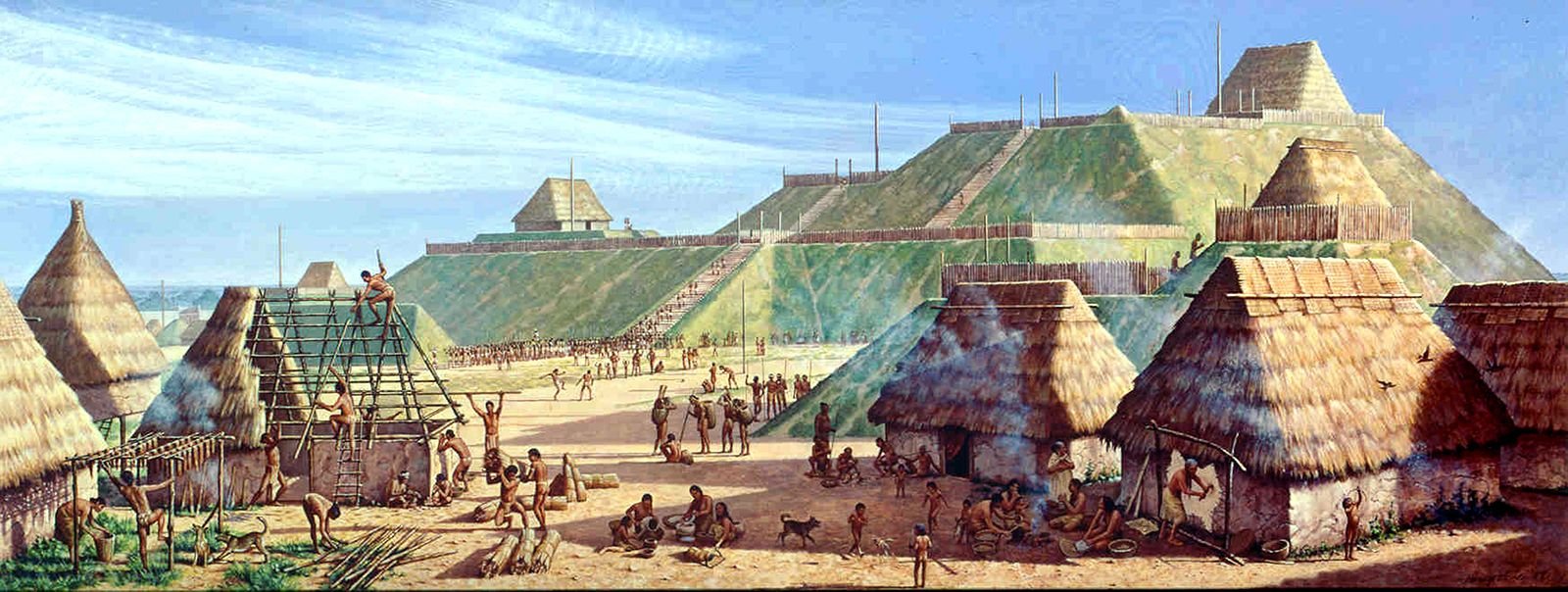
Long before European ships appeared on the shores of North America, long before New York, Mexico City, or Washington, D.C. existed, a vast city rose from the fertile lands near the Mississippi River. Its skyline was not defined by stone towers or steel skyscrapers but by enormous earthen mounds built by human hands. Thousands of people lived there. Traders arrived from distant regions. Religious ceremonies attracted crowds. Political leaders governed a complex society that stretched its influence across much of eastern North America.
This remarkable place was Cahokia.
Today, many people have never heard of it. Yet at its peak, Cahokia was one of the largest urban centers north of Mexico and one of the most impressive achievements in the history of Native North America. It flourished centuries before European contact and demonstrated a level of social organization, engineering skill, and cultural sophistication that challenged many outdated assumptions about Indigenous societies.
Then, mysteriously, the city declined. Its population dwindled. Its great plazas became empty. The bustling metropolis was eventually abandoned.
When Europeans later entered the region, Cahokia was already a silent landscape of grass-covered mounds. The people who had built the city were gone, leaving behind one of North America’s greatest archaeological mysteries.
The story of Cahokia is a story of ambition, innovation, spirituality, environmental challenges, and resilience. It is also a reminder that some of the most extraordinary chapters of human history can be forgotten for centuries before being rediscovered.
A Lost City Hidden in Plain Sight
Near present-day St. Louis lies one of the most important archaeological sites in North America: Cahokia Mounds State Historic Site.
At first glance, the site may seem unremarkable. Gentle hills rise from the landscape. Trees and grass cover much of the area. To modern eyes, these mounds might appear to be natural features.
But they are not.
Every mound was built by people carrying basket after basket of earth. Together, they represent one of the largest construction projects in pre-Columbian North America.
Archaeologists estimate that millions of cubic feet of soil were moved without metal tools, wheeled vehicles, or draft animals.
The sheer scale of the accomplishment is astonishing.
For centuries, however, few people understood what these mounds truly represented.
The World Before Cahokia
To understand Cahokia, it is important to appreciate the world in which it emerged.
North America before European contact was home to hundreds of cultures and societies. These communities spoke different languages, practiced diverse traditions, and adapted to a wide range of environments.
Some lived as hunter-gatherers. Others practiced agriculture. Some formed small villages, while others developed large regional centers.
By around 800 CE, farming had become increasingly important in many parts of eastern North America. The cultivation of maize, or corn, allowed populations to grow and communities to become more permanent.
Agricultural productivity created opportunities for social and political development.
Out of this changing world, Cahokia emerged.
The Rise of a Metropolis
Around 1050 CE, something extraordinary happened.
The population of the region surrounding Cahokia increased dramatically. People from nearby settlements appear to have moved into the growing urban center.
Archaeologists sometimes refer to this event as the “Big Bang” of Cahokia because of the speed and scale of the transformation.
What had previously been a collection of villages became a thriving city.
New neighborhoods appeared.
Massive public construction projects began.
Ceremonial spaces expanded.
Political institutions grew more complex.
Within a relatively short period, Cahokia became the dominant center of what archaeologists call the Mississippian cultural tradition.
The city’s growth was one of the most remarkable urban developments in pre-Columbian North America.
The Geography of Opportunity
Cahokia’s location contributed significantly to its success.
The city stood near the confluence of major river systems, including the Mississippi, Missouri, and Illinois Rivers.
These waterways functioned as natural highways.
People, goods, ideas, and cultural influences moved along the rivers.
The surrounding floodplains were exceptionally fertile, supporting large-scale agriculture.
Abundant resources from forests, rivers, and wetlands further enhanced the region’s productivity.
The location gave Cahokia access to trade networks extending across vast distances.
Communities from hundreds of miles away could connect through the city.
This strategic position helped transform Cahokia into an economic and political powerhouse.
The Population Boom
Estimating the population of ancient cities is challenging, but most researchers agree that Cahokia was enormous for its time.
At its height, between approximately 1050 and 1200 CE, the city may have contained between ten thousand and twenty thousand residents, with some estimates suggesting even larger numbers for the broader metropolitan area.
To put this into perspective, many European cities of the same period were comparable in size.
For a time, Cahokia may have been the largest urban center north of Mexico.
The city was not merely a ceremonial site. It was a living, breathing metropolis filled with homes, workshops, public spaces, markets, and religious structures.
Thousands of people woke each morning to work, trade, build, worship, and raise families.
Building a City from Earth
One of the most remarkable aspects of Cahokia is its architecture.
Unlike civilizations that built with stone, Cahokians primarily used earth, wood, and thatch.
The city’s defining features were its earthen mounds.
Workers carried soil in baskets and gradually shaped enormous platforms rising above the surrounding landscape.
Some mounds served as foundations for temples or elite residences.
Others functioned as burial sites or ceremonial locations.
The largest mound dwarfs all the others.
Known as Monks Mound, it remains the largest prehistoric earthen structure in North America.
Standing approximately one hundred feet tall and covering more than fourteen acres, Monks Mound required an immense labor investment.
Even today, it dominates the landscape.
Its construction demonstrates remarkable organizational capabilities and the ability to mobilize large numbers of workers.
Monks Mound and Political Power
Monks Mound was far more than an impressive engineering achievement.
It symbolized authority.
Archaeologists believe important political and religious structures stood atop the mound.
Leaders likely used the elevated platform to reinforce their status.
From the summit, they could oversee large public gatherings in the plazas below.
The mound physically separated elite spaces from everyday life.
This separation may have reflected social hierarchy within Cahokian society.
The ability to organize such monumental construction suggests the presence of powerful institutions capable of directing labor and resources on a massive scale.
The Grand Plaza
At the heart of Cahokia stretched a vast open space known as the Grand Plaza.
This area covered dozens of acres and served as the city’s central gathering place.
Large public events likely occurred here.
Religious ceremonies, political gatherings, festivals, and community activities may have drawn thousands of participants.
The plaza required significant maintenance.
Workers leveled the ground and managed the landscape to create an impressive public space.
Standing in the plaza during Cahokia’s peak would have been a breathtaking experience.
Earthen mounds rose in multiple directions. Wooden structures lined portions of the city. Crowds filled the open spaces.
The scale of the urban environment would have communicated power and importance to visitors.
Daily Life in Cahokia
While monumental structures often attract attention, most residents experienced Cahokia through everyday activities.
Families lived in houses constructed from wooden poles and woven materials covered with clay.
Children played in neighborhoods clustered around public spaces.
Farmers cultivated crops in nearby fields.
Craftspeople produced tools, pottery, ornaments, and ceremonial objects.
Hunters and fishers supplemented agricultural production with wild resources.
The city bustled with activity.
Cooking fires filled the air with smoke and familiar scents.
People carried goods through streets and pathways.
Conversations echoed across plazas and neighborhoods.
Like all cities, Cahokia was shaped not only by leaders and monuments but by ordinary people whose daily efforts sustained the community.
Agriculture and Food Production
The foundation of Cahokia’s success was agriculture.
Corn played a central role in the city’s economy and food supply.
Large-scale maize cultivation supported population growth and enabled urban development.
Additional crops included beans, squash, sunflower, and various native plants.
The fertile floodplain soils provided favorable growing conditions.
Agricultural surplus allowed some individuals to specialize in activities beyond food production.
As a result, social complexity increased.
Leaders, artisans, religious specialists, and traders could devote more time to their roles because farmers produced enough food to support the broader population.
Agriculture transformed Cahokia from a regional settlement into a major urban center.
A Hub of Trade and Exchange
Cahokia occupied a central position within extensive trade networks.
Archaeologists have discovered materials originating from distant regions.
Copper arrived from the Great Lakes.
Marine shells came from the Gulf Coast.
Exotic stones traveled from faraway quarries.
These materials were transformed into ornaments, ceremonial objects, and symbols of status.
Trade involved more than goods.
Ideas, religious beliefs, artistic styles, and cultural practices also moved across networks connecting diverse communities.
Cahokia became a crossroads where different peoples interacted and exchanged knowledge.
Its influence extended far beyond the city’s boundaries.
Religion and the Sacred Landscape
Religion appears to have played a central role in Cahokian society.
Many mounds likely served ceremonial functions.
Certain structures were aligned with astronomical events.
Symbols found in art suggest connections between the natural world, spiritual beliefs, and political authority.
Like many ancient cultures, Cahokians probably viewed the landscape as deeply sacred.
The movement of the Sun, the cycles of seasons, and the rhythms of nature likely held profound significance.
Religious ceremonies may have reinforced social cohesion and legitimized leadership.
Although much remains unknown, archaeology reveals a society in which spirituality was woven into public life.
Woodhenge and the Sky
One of Cahokia’s most fascinating features is a structure often called Woodhenge.
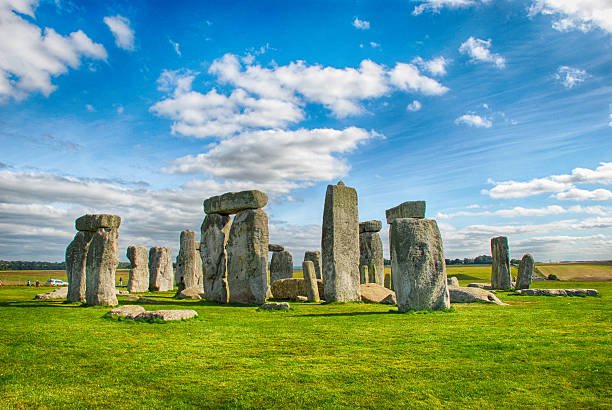
Unlike England’s famous Stonehenge, this monument consisted of large wooden posts arranged in circular patterns.
Archaeologists believe Woodhenge functioned as a solar calendar.
The positions of certain posts align with sunrise locations during solstices and equinoxes.
Such alignments would have helped track seasonal changes important for agriculture and ceremonial activities.
Woodhenge demonstrates sophisticated astronomical knowledge.
It also highlights the importance of connecting earthly activities with celestial events.
For Cahokians, the sky was not merely a backdrop but an integral part of understanding the world.
Social Structure and Leadership
Cahokia was not an egalitarian society.
Archaeological evidence suggests the existence of social hierarchy.
Certain individuals enjoyed higher status than others.
Elite residences occupied prominent locations.
Some burials contained valuable objects unavailable to most people.
Large construction projects imply centralized authority capable of organizing labor.
Leaders may have combined political and religious roles.
Their authority likely depended on maintaining social stability, overseeing ceremonies, and managing resources.
Yet the exact nature of Cahokia’s government remains uncertain.
Unlike civilizations that left written records, Cahokia communicated through oral traditions and material culture.
As a result, many aspects of leadership remain open to interpretation.
Art and Symbolism
The people of Cahokia created rich artistic traditions.
Archaeologists have discovered carved stone figures, decorated pottery, shell ornaments, and intricate ceremonial objects.
Many artifacts contain symbolic imagery.
Birds, serpents, celestial motifs, and human figures appear repeatedly.
These symbols likely carried religious and political meanings.
Art helped communicate beliefs, reinforce identity, and express connections between the human and spiritual worlds.
The creativity visible in Cahokian artifacts reveals a society with complex intellectual and cultural traditions.
The Mystery of Human Sacrifice
Some of the most debated discoveries at Cahokia involve evidence suggesting ritual sacrifice.
Excavations at certain burial mounds revealed unusual burial patterns.
In some cases, multiple individuals were interred together under circumstances that appear ceremonial.
Archaeologists continue to study these findings carefully.
Interpretations remain complex and sometimes controversial.
The evidence suggests that ritual practices may have played a role in maintaining social and religious systems.
However, researchers emphasize the importance of avoiding sensationalism and recognizing that many details remain uncertain.
Understanding ancient societies requires careful examination of evidence rather than assumptions based on modern perspectives.
Environmental Challenges
No city exists independently of its environment.
As Cahokia expanded, its residents altered the landscape.
Forests were cleared for construction and agriculture.
Population growth increased demand for resources.
Environmental pressures may have gradually accumulated.
Researchers have identified evidence of flooding events, changing climate conditions, and ecological stress during portions of Cahokia’s history.
These factors may have affected agricultural productivity and living conditions.
Urban success often creates new challenges.
The very growth that made Cahokia powerful may also have contributed to vulnerabilities that emerged later.
The Beginning of Decline
Around the thirteenth century, signs of change began to appear.
Construction activity slowed.
Population levels decreased.
Certain neighborhoods were abandoned.
Public spaces received less maintenance.
The reasons remain one of North America’s great archaeological mysteries.
No single explanation fully accounts for Cahokia’s decline.
Instead, researchers believe multiple factors likely interacted.
Environmental stress, political instability, resource depletion, social tensions, changing trade networks, and climatic fluctuations may all have played roles.
The process appears to have unfolded over generations rather than occurring as a sudden catastrophe.
Climate and Uncertainty
Climate may have contributed significantly to Cahokia’s challenges.
Studies suggest periods of drought affected portions of North America during the centuries surrounding Cahokia’s decline.
Agricultural societies depend heavily on reliable weather patterns.
Even relatively modest climatic changes can influence crop production and food security.
Repeated harvest failures could create economic difficulties, social unrest, and population movement.
Although climate alone probably does not explain Cahokia’s abandonment, it may have intensified existing pressures.
The city’s fate reminds us how deeply human societies remain connected to environmental conditions.
Social and Political Transformation
Large, complex societies often face internal challenges.
Maintaining authority over growing populations requires effective institutions.
Political conflicts can emerge.
Economic inequalities may generate tensions.
Religious systems can evolve.
Some researchers believe Cahokia experienced significant social transformations during its later centuries.
Leadership structures may have weakened.
Traditional institutions may have lost influence.
Communities might have become less willing to support large public projects.
Such changes could gradually undermine urban cohesion.
Without written records, the details remain uncertain, but social dynamics likely played an important role.
The Final Abandonment
By approximately 1350 CE, Cahokia had largely been abandoned.
The great plazas stood empty.
The mounds remained, but the bustling city that once surrounded them was gone.
People did not disappear entirely.
Descendant Indigenous communities continued to live throughout the broader region.
What vanished was the urban center itself.
The reasons behind the final abandonment remain debated.
Perhaps environmental challenges became overwhelming.
Perhaps political systems collapsed.
Perhaps populations dispersed into smaller communities better suited to changing conditions.
Most likely, multiple factors combined over time.
The disappearance of Cahokia was not a single event but a gradual transformation.
When Europeans Arrived
Centuries later, European explorers entered the Mississippi Valley.
By then, Cahokia’s golden age belonged to the distant past.
The massive mounds remained visible, but their original builders were no longer present.
Many Europeans failed to understand the significance of what they saw.
Some even doubted that Native peoples had constructed the earthworks.
These assumptions reflected deep misunderstandings and prejudices rather than evidence.
Over time, archaeology would reveal the truth.
The mounds were indeed the achievements of Indigenous North Americans.
Recognizing this fact transformed understanding of the continent’s history.
Rediscovering Cahokia
Scientific investigation of Cahokia accelerated during the nineteenth and twentieth centuries.
Archaeologists mapped mounds, conducted excavations, and analyzed artifacts.
Each discovery revealed a more complex picture.
The site emerged as evidence of a sophisticated urban society with far-reaching influence.
Researchers learned about its population, economy, religious practices, and environmental context.
Cahokia challenged outdated narratives that underestimated the complexity of Indigenous civilizations.
The city became one of the most important archaeological sites in North America.
Cahokia’s Legacy
Today, Cahokia stands as a powerful reminder of Indigenous achievement.
Its builders created monumental architecture, managed extensive trade networks, developed complex political systems, and supported large urban populations.
Their accomplishments rivaled those of many societies around the world.
Yet for centuries, their story remained largely forgotten.
Recovering Cahokia’s history helps correct misconceptions about North America’s past.
It reveals a continent rich with innovation, diversity, and cultural complexity long before European colonization.
The legacy of Cahokia belongs not only to archaeology but also to the living Indigenous communities connected to this broader heritage.
Why Cahokia Still Matters
The story of Cahokia resonates because it feels both familiar and mysterious.
Like modern cities, it experienced growth, prosperity, innovation, and decline.
Its residents faced challenges involving resources, environment, politics, and social change.
Its rise demonstrates what human cooperation can achieve.
Its decline reminds us that even great urban centers are not permanent.
Cities emerge, evolve, and sometimes disappear.
The earthworks of Cahokia continue to stand because they embody a remarkable chapter of human history.
They invite us to imagine crowded plazas, bustling markets, sacred ceremonies, and ambitious leaders shaping a city that once dominated the Mississippi Valley.
Conclusion
Cahokia was one of the most extraordinary cities ever built in North America. Rising from the fertile lands near the Mississippi River, it became a thriving metropolis whose influence stretched across vast regions. Its people constructed enormous earthen monuments, developed extensive trade networks, cultivated productive agricultural systems, and created a vibrant cultural and spiritual center.
For centuries, Cahokia flourished. Then, through a complex combination of environmental pressures, social transformations, and changing circumstances, the city gradually declined and was eventually abandoned.
Although the people who built Cahokia left no written records, the mounds they created continue to tell their story. They testify to human ingenuity, ambition, and resilience. They remind us that great civilizations have existed in many forms and in many places, often in regions overlooked by traditional historical narratives.
Today, the silent mounds of Cahokia stand as monuments not only to a lost city but also to a forgotten chapter of human achievement. They challenge us to look beyond familiar histories and recognize the richness of the worlds that existed long before modern nations were born. In doing so, Cahokia continues to speak across the centuries, ensuring that its remarkable story is no longer forgotten.