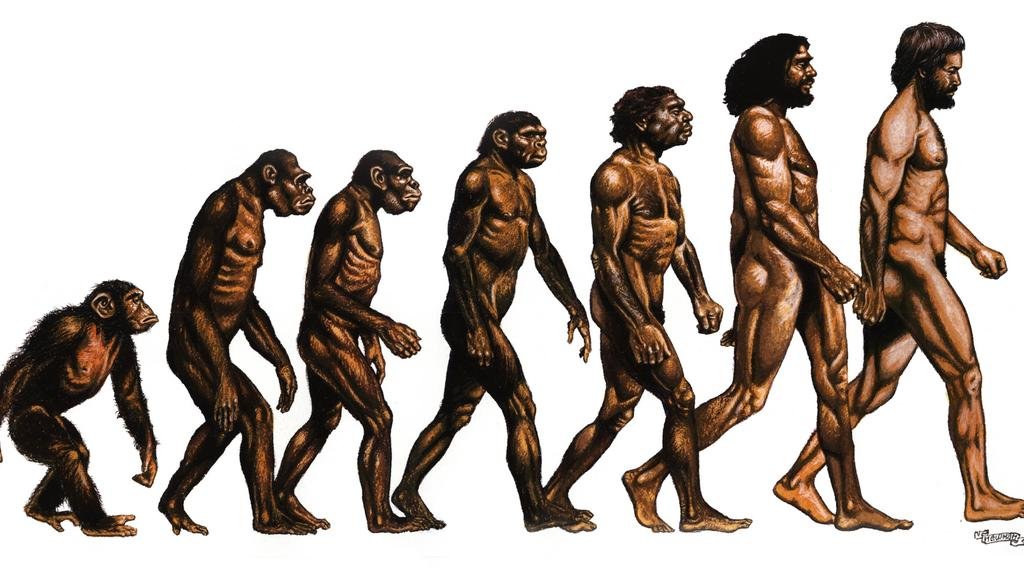
There is a story carved deep within the dust of time, one that begins long before we ever dreamed, spoke, or stood upright. It’s the story of how we became us—how a simple lineage of apes wandering through African forests transformed into a species capable of building cities, composing symphonies, and reaching for the stars.
This is not just a story of biology; it’s a story of survival, adaptation, and imagination. Every bone fossilized in ancient soil, every gene carried in our blood, whispers a fragment of the journey. Together, they form a mosaic of transformation that spans millions of years—a saga that stretches from primitive mammals scurrying beneath dinosaurs to modern humans gazing back at their own origins.
Understanding human evolution is not simply about identifying ancestors or naming species. It is about visualizing the incredible dance of chance, change, and intelligence that shaped who we are. The story of humanity is not linear—it’s a branching tree, full of dead ends, survivors, and extraordinary experiments of nature. And somehow, against all odds, one branch learned to ask the question: Where did we come from?
When We Were Not Yet Human
Long before anything remotely resembling a human existed, the Earth was ruled by giants. For over 160 million years, dinosaurs dominated the land, sky, and sea. But when a catastrophic asteroid struck 66 million years ago, the world reset. From the ashes of that extinction, mammals—small, warm-blooded, and adaptable—began to flourish.
Among these early mammals were our distant ancestors: small, tree-dwelling creatures that survived by hiding, climbing, and adapting. They were primates—the group that would eventually give rise to lemurs, monkeys, apes, and humans.
The earliest primates appeared around 60 million years ago, and their key innovation was vision. Their eyes moved to the front of their faces, allowing depth perception—vital for judging distances in trees. They also developed grasping hands and feet, with nails instead of claws, perfect for navigating branches and manipulating food.
They were not yet “human,” not even close, but they carried the blueprint: curiosity, adaptability, and intelligence. Evolution had begun to experiment with a new model of survival—not the biggest or the strongest, but the cleverest.
The Rise of the Great Apes
By about 25 million years ago, primates had diversified. Some stayed small and lived like squirrels; others grew larger, stronger, and more social. Out of this evolutionary experimentation came the great apes—gorillas, chimpanzees, orangutans, and our own ancestors.
Africa, lush and teeming with forests, became their cradle. The early apes learned cooperation, communication, and complex emotions. Their social groups required empathy and memory. They could recognize individuals, form alliances, and share care for their young. The seeds of human behavior—love, jealousy, grief, and cooperation—were already present in these ancient apes.
Around 7 million years ago, something profound happened. The Earth’s climate began to shift, and Africa’s forests started to thin. Grasslands expanded. Trees became scarcer. For the first time, some apes faced a challenge they couldn’t solve by simply climbing. They had to venture into the open, upright and alert.
From this environmental change emerged a revolutionary adaptation: walking on two legs.
The First Step: When We Stood Tall
Imagine the African savanna seven million years ago—heat shimmering over dry plains, predators lurking in the tall grass. For an ape accustomed to the trees, this new world was perilous. Yet some among them adapted, gradually evolving a posture that allowed them to stand upright and move efficiently on two legs.
This ability—bipedalism—was the first defining step toward humanity. It freed the hands for carrying, tool use, and gesturing. It also elevated the eyes, allowing early humans to scan the horizon for food and danger.
The earliest known potential human ancestor is Sahelanthropus tchadensis, discovered in Chad and dated to around 7 million years ago. Its skull shows a mix of ape-like and human-like traits, with a flatter face and hints of upright posture. Close in time was Orrorin tugenensis, whose thigh bones suggest it too could walk on two legs.
But it was Australopithecus afarensis, living between 3.9 and 2.9 million years ago, that truly mastered walking upright. The famous fossil “Lucy,” discovered in Ethiopia, belongs to this species. Lucy was small—about 1.1 meters tall—but she walked confidently on two legs, her hips and spine showing a perfect blend of balance and strength.
She could climb when needed but spent much of her time on the ground, a pioneer in a new way of life that would change the planet forever.
The Hands That Changed Everything
Standing upright did more than just transform locomotion—it freed the hands. And in evolution’s grand story, hands are where intelligence begins to take shape.
Early australopithecines used their hands not just for climbing but for manipulating the world around them. Eventually, some of their descendants learned to make tools. Around 2.6 million years ago, on the plains of Africa, a species known as Homo habilis—literally “handy man”—began shaping stones to cut meat and crack bones.
This simple act marked a revolution. The first stone tools were crude flakes, but they represented something new: the ability to imagine a function and shape matter to serve that purpose. For the first time, thought had reached beyond the body.
With tools came new opportunities. Early humans could butcher carcasses, scrape hides, and dig roots. Their diet expanded, and with it, their brains began to grow. Larger brains demanded more energy, and meat provided it. The feedback loop between diet, intelligence, and cooperation was set in motion.
From that point on, the evolution of humanity became a story of brains, culture, and imagination.
The Fire Within: Homo erectus and the Dawn of Exploration
Around 1.9 million years ago, a new species emerged that looked strikingly like us: Homo erectus, the “upright man.” With longer legs, shorter arms, and a more human-like body, Homo erectus was built for endurance. This was the first human to truly leave the forests and stride across the open world.
Homo erectus was the great traveler of prehistory. Fossils of this species have been found across Africa, the Middle East, India, China, and Indonesia. They were the first to leave Africa, spreading across continents and adapting to diverse environments.
Their most transformative achievement, however, was the control of fire. Evidence from sites like Wonderwerk Cave in South Africa suggests Homo erectus used fire nearly a million years ago. Fire changed everything—it provided warmth, light, protection, and a means to cook food. Cooking made nutrients more accessible, which may have further fueled brain growth.
Imagine the first fires burning in the darkness—a small group of humans gathered around the flickering flames, sharing warmth and perhaps the first stories. Fire extended the day, warded off fear, and created community. It was the birth of civilization’s soul.
The Brain That Dreamed: The Rise of Homo heidelbergensis
As time passed, evolution continued its slow, relentless shaping. Around 700,000 years ago, another species, Homo heidelbergensis, emerged from Homo erectus. With a larger brain and more advanced tools, this species began to show behaviors that hint at emotion and cooperation on a deeper level.
They hunted in groups, using wooden spears to bring down large prey. They built shelters and may have cared for their injured or elderly. Their communication was likely more sophisticated, and they probably understood the power of working together.
From Homo heidelbergensis branched two paths—one leading to the Neanderthals in Europe and the other leading to modern humans in Africa. The stage was set for the final chapters of the human story.
The Neanderthals: Strength and Spirit in the Cold
In Europe, where ice sheets advanced and retreated over millennia, the Neanderthals evolved to survive the cold. Homo neanderthalensis had stocky bodies, broad noses, and powerful limbs. Their brains were as large as ours—sometimes even larger.
For hundreds of thousands of years, Neanderthals thrived across Europe and western Asia. They hunted mammoths, used fire, crafted tools, and made clothing. They buried their dead and may have created art. They were not brutes but complex, intelligent beings with emotions and communities.
For decades, humans viewed Neanderthals as primitive “cousins.” But modern research has revealed how close we truly were. Genetic studies show that humans and Neanderthals interbred—so much so that every non-African person alive today carries a small percentage of Neanderthal DNA.
Their extinction around 40,000 years ago remains a mystery. Climate change, competition, and assimilation into modern human populations all played a role. Yet in a very real sense, Neanderthals never fully vanished—they live on within us.
The Birth of Our Kind: Homo sapiens
Meanwhile, in Africa, another lineage of Homo heidelbergensis evolved differently. Around 300,000 years ago, the first anatomically modern humans—Homo sapiens—appeared.
We were slender, agile, and astonishingly intelligent. Our skulls were rounded, our faces flat, and our brains complexly wired for abstract thought. But what truly set us apart was not just anatomy—it was imagination.
Homo sapiens began to dream, to symbolize, to create meaning. We painted, carved, and sang. We learned not only to make tools but to pass knowledge through generations. Culture was born.
Some of the earliest evidence of symbolic behavior comes from Africa: shell beads used as jewelry 100,000 years ago, ochre pigment for body painting, and intricate stone tools that reveal planning and innovation.
Our ancestors were becoming something entirely new—a species defined not only by survival but by story.
Out of Africa: The Great Human Migration
Around 70,000 years ago, humans began the journey that would change the planet. Driven by curiosity, necessity, or both, small groups of Homo sapiens left Africa, following coastlines, rivers, and open plains.
This migration was slow but unstoppable. Over thousands of years, humans spread across the Middle East, Asia, and eventually into Europe, encountering and sometimes interbreeding with other human species along the way.
By 50,000 years ago, humans had reached Australia. By 20,000 years ago, they had crossed icy land bridges into the Americas. Within just a few tens of thousands of years—a blink of an eye in evolutionary time—Homo sapiens had become a global species.
Wherever they went, they adapted. They invented new tools, created art, and learned to live in every environment on Earth—from deserts to glaciers. The planet, once indifferent to their presence, now began to feel their influence.
The Dawn of the Mind
One of the greatest mysteries of human evolution is not physical but mental. At some point between 100,000 and 40,000 years ago, human creativity exploded.
Caves in France and Spain bear the handprints and paintings of early humans—bison, horses, mammoths, drawn with astonishing realism and beauty. In Africa, engraved shells and symbolic carvings suggest abstract thought. Humans began to adorn themselves, craft instruments, and bury their dead with care.
This was the “Great Leap Forward”—a revolution not of bones, but of minds. Language likely blossomed during this time, enabling complex storytelling and collective memory. With language, humans could share ideas, imagine futures, and build cultures.
For the first time, a species could conceive of its own existence. We began to ask questions about the world, the stars, and ourselves.
The Age of Innovation
By 12,000 years ago, humans had colonized every continent except Antarctica. They hunted, gathered, and thrived. But a new transformation was on the horizon—the birth of civilization.
The shift from foraging to farming began around 10,000 BCE in the Fertile Crescent. Humans learned to domesticate plants and animals, to stay in one place, and to build permanent communities. Agriculture created abundance, which led to specialization, trade, and art.
With settled life came cities, writing, and organized religion. From Sumer to Egypt, from the Indus Valley to China, human societies grew increasingly complex. The Neolithic Revolution was not just technological—it was psychological. It changed how we saw time, nature, and each other.
Evolution had crafted a species capable not only of surviving but of reshaping its world.
The Price of Progress
The story of human evolution is also a story of consequences. The same intelligence that built civilization also built weapons. The same curiosity that sent us to the Moon also drove us to alter our planet’s climate.
We are the first species able to understand our origins—and the first capable of threatening our own survival. Yet this awareness is also our greatest strength. To know where we came from is to understand how fragile and precious our existence is.
Every moment of progress—every city, song, and scientific discovery—stands on the shoulders of ancestors who learned to stand upright, wield tools, and dream.
We Are All Cousins of the Same Story
It is tempting to think of human evolution as a ladder, with each rung leading inevitably to us. But that’s not how evolution works. It’s a branching tree, full of experiments, relatives, and lost possibilities. We are just one surviving twig of a once-great forest of human species.
Our closest living relatives, chimpanzees and bonobos, share about 98.8% of our DNA. The difference between them and us is not a separate creation—it’s a few million years of adaptation. In every gesture, every spark of curiosity, every act of kindness, we echo the evolutionary journey of countless beings who came before us.
The Story Continues
Evolution never ends. Even now, the human body and mind are still changing. Our immune systems adapt, our brains evolve with technology, and our societies reshape the way natural selection acts.
In the distant future, humanity may diverge again—some remaining on Earth, others venturing into space. Perhaps one day, new species will evolve from us, just as we evolved from those who came before.
And maybe, in some far-off time, those future beings will look back—through fossils, data, or memory—and wonder who their ancestors were. They will find our bones, our cities, our stories, and they will know: once, long ago, we too were dreamers, searching for where we began.
The Mirror of Our Origins
To trace the path of human evolution is to gaze into a mirror that reflects not only our past but our potential. It is a story of transformation so profound that it borders on the miraculous. From trembling primates in the African dawn to the builders of spacecraft and thinkers of philosophy, our journey has been one of constant reinvention.
We are not separate from nature—we are nature, made self-aware. The same forces that shaped us still shape the world. The same struggles that forged our ancestors—hunger, curiosity, cooperation, and hope—still drive us today.
Every heartbeat carries the rhythm of millions of years. Every thought carries the spark of those who first dared to imagine fire, tools, and gods. We are the latest chapter in an unfinished book, the living continuation of an ancient dream.
The Eternal Question
How did humans become human? The answer lies in every fossil, every gene, and every spark of imagination. We became human not only through biology, but through wonder.
Our evolution was never just about survival—it was about discovery. About learning to see patterns in stars, to tell stories around campfires, to turn the chaos of existence into meaning.
We became human when we learned to look up, to ask why, and to dream of what could be. And in that eternal quest—of thought, of spirit, of connection—the story of evolution becomes not just a history of life, but the poetry of being alive.
For in the vast, unfolding timeline of the universe, the moment we opened our eyes to understand ourselves was the moment the cosmos itself began to know its own name.