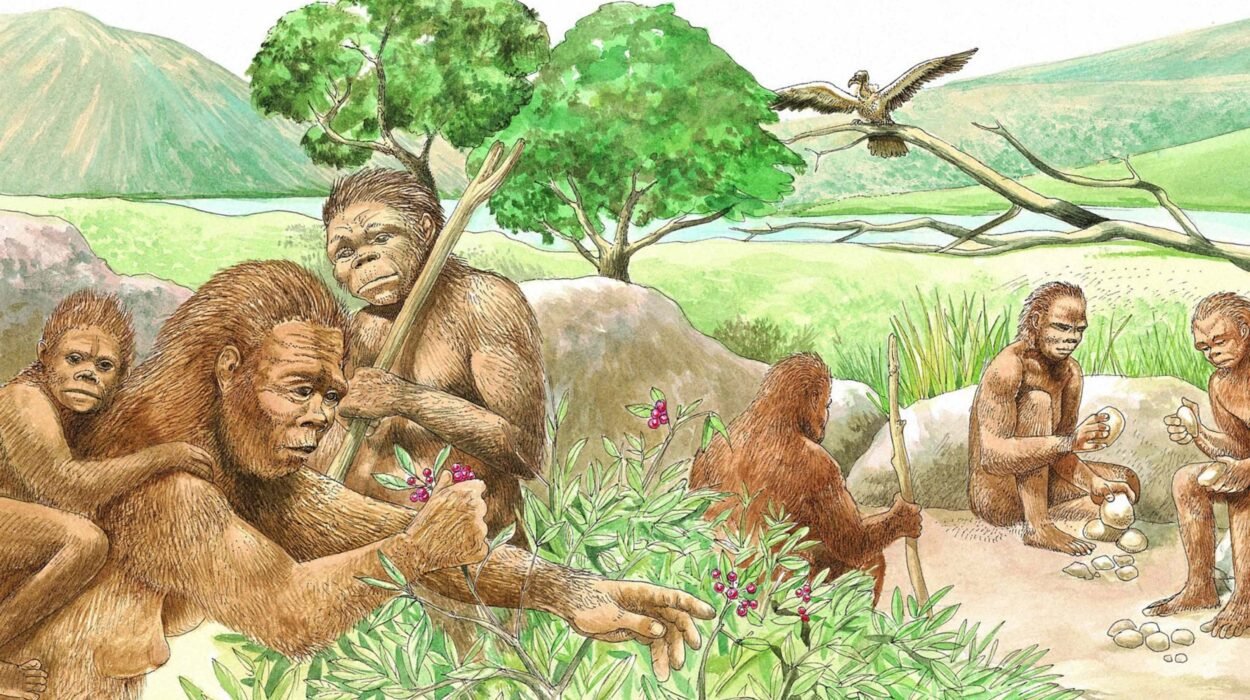
If you trace your family tree back through your parents, grandparents, great-grandparents, and thousands of generations before them, the branches eventually merge into the earliest humans. Continue traveling backward through time, and humans become earlier mammals. Those mammals become ancient reptiles. Reptiles trace their ancestry to fish. Fish lead to simple multicellular creatures, and those creatures ultimately point toward tiny single-celled organisms that lived billions of years ago.
Keep going even further.
Eventually, the trail reaches a place where biology meets mystery.
At some point on the young Earth, something extraordinary happened. Matter that had never been alive somehow became the first living system. Molecules began to organize themselves. Chemical reactions grew more complex. Information started to be stored and copied. Tiny structures developed the ability to reproduce and evolve.
Life had begun.
Exactly how this happened remains one of the greatest unanswered questions in science.
Unlike the extinction of dinosaurs or the construction of ancient pyramids, there were no witnesses to the origin of life. No fossils record the very first living cell. No rock preserves the exact moment when chemistry crossed the invisible boundary into biology.
Scientists know that life exists. They know that every organism on Earth shares a common ancestry. They understand much about evolution after life appeared.
But the question that comes before evolution—the question of how life itself began—is still being explored.
Today, researchers from biology, chemistry, geology, astronomy, and physics work together to solve this remarkable mystery. They recreate conditions on the early Earth, study ancient rocks, investigate deep-sea environments, analyze meteorites, and even search other planets for clues.
Every discovery brings us a little closer.
Yet the origin of life remains one of the most fascinating scientific puzzles humanity has ever faced.
Why the Origin of Life Is So Difficult to Understand
At first glance, life seems ordinary.
Birds fly through the sky. Trees grow in forests. Fish swim beneath the ocean. Bacteria thrive in soil, inside our bodies, and even in boiling hot springs.
Life appears everywhere.
But if we step back and ask what life actually is, the answer becomes surprisingly complex.
Living organisms grow, reproduce, respond to their environment, use energy, repair themselves, and pass genetic information to future generations.
None of these abilities exists in ordinary rocks or water.
A grain of sand does not reproduce.
A crystal may grow, but it does not evolve.
A flame spreads, but it does not store hereditary information.
Life combines many remarkable properties into one integrated system.
Understanding how such a system emerged naturally from nonliving chemistry is an enormous scientific challenge.
The difficulty becomes even greater because the evidence is incredibly ancient.
Earth formed about 4.54 billion years ago.
The earliest widely accepted evidence of life dates to at least 3.5 billion years ago, and some researchers argue for evidence even earlier.
That means the crucial transition happened more than three and a half billion years in the past.
Time has erased most direct evidence.
Scientists must reconstruct the story using tiny clues preserved in ancient rocks, laboratory experiments, and the laws of chemistry.
The Earth Before Life
To understand life’s beginning, we must first imagine Earth before anything lived.
It was a dramatically different world.
There were no forests.
No flowers.
No birds.
No insects.
No animals.
No oxygen-rich atmosphere.
Instead, the young Earth was hot, geologically active, and frequently struck by asteroids.
Volcanoes erupted across the landscape.
The atmosphere probably contained carbon dioxide, nitrogen, water vapor, and smaller amounts of other gases.
Lightning flashed through thick clouds.
Rain fell onto newly formed continents.
Oceans gradually accumulated.
Despite appearing hostile by modern standards, this environment contained something incredibly important.
Energy.
Lightning.
Volcanic heat.
Ultraviolet sunlight.
Hydrothermal systems.
Chemical reactions require energy, and early Earth offered abundant sources.
These energetic conditions allowed increasingly complex molecules to form over millions of years.
Somewhere within this chemical world, the foundations of biology emerged.
What Makes Something Alive?
Before asking how life began, scientists first ask another question.
What exactly counts as life?
There is surprisingly no universally accepted definition.
Most biologists describe life as a system capable of metabolism, growth, reproduction, evolution, and maintaining internal organization.
Three features are especially important.
First, living systems contain information.
In modern organisms, DNA stores instructions for building and maintaining cells.
Second, living systems use energy.
Every cell constantly performs chemical reactions powered by energy.
Third, living systems reproduce.
Copies are never perfect.
Small changes occur.
Natural selection then acts on these variations.
Evolution begins.
The challenge is understanding how these three features—information, metabolism, and reproduction—first appeared together.
Did one come before the others?
Or did they develop simultaneously?
Scientists continue investigating this profound question.
The Building Blocks of Life
Life may appear extraordinarily complicated, but its basic ingredients are surprisingly common.
Nearly all living organisms are built primarily from six elements.
Carbon.
Hydrogen.
Oxygen.
Nitrogen.
Phosphorus.
Sulfur.
These elements combine into molecules such as amino acids, sugars, lipids, and nucleotides.
Proteins are assembled from amino acids.
DNA and RNA are built from nucleotides.
Cell membranes form from lipids.
Remarkably, many of these molecules can form naturally without life.
Scientists have discovered organic molecules in meteorites.
Astronomers detect complex carbon-containing molecules drifting through interstellar clouds.
Chemistry naturally produces many of life’s ingredients.
The mystery is not where the ingredients came from.
The mystery is how they organized themselves into living systems.
The Famous Miller-Urey Experiment
In 1953, two American researchers performed one of the most famous experiments in biology.
They wanted to know whether life’s building blocks could arise naturally under early Earth conditions.
Their apparatus contained water, gases thought to resemble the ancient atmosphere, and electrical sparks representing lightning.
After several days, something remarkable happened.
The liquid turned reddish brown.
Chemical analysis revealed amino acids.
These molecules are essential building blocks of proteins.
The experiment demonstrated that simple chemicals could naturally produce biologically important molecules.
Although scientists now think Earth’s early atmosphere differed somewhat from the one used in the experiment, the basic conclusion remains important.
Organic molecules can arise through natural chemical processes.
Many later experiments have expanded upon this work, producing an even wider variety of life’s molecular ingredients.
RNA: A Remarkable Molecule
Among modern scientific ideas, the RNA World hypothesis has become one of the leading explanations for life’s beginning.
Today, living organisms rely on both DNA and proteins.
DNA stores information.
Proteins perform most chemical work.
This creates an apparent chicken-and-egg problem.
DNA requires proteins to function.
Proteins require DNA to be produced.
Which came first?
RNA offers a possible solution.
Unlike DNA, RNA can both store information and perform certain chemical reactions.
Some RNA molecules even act as enzymes.
Scientists call these catalytic RNAs ribozymes.
This remarkable dual ability suggests RNA may have played a central role before DNA and proteins became dominant.
In an RNA World, early self-copying RNA molecules gradually evolved greater complexity through natural selection.
Eventually, DNA replaced RNA as the primary information-storage molecule because DNA is more stable.
Proteins gradually became the main catalysts because they are more chemically versatile.
Although many questions remain, the RNA World hypothesis provides an elegant framework for understanding early evolution.
Could Life Have Begun at Deep-Sea Vents?
One intriguing possibility shifts the scene away from the shoreline.
Deep beneath the ocean, hydrothermal vents release hot, mineral-rich water from Earth’s interior.
These remarkable environments support thriving ecosystems despite complete darkness.
Instead of sunlight, organisms obtain energy from chemical reactions.
Some researchers propose that similar environments hosted the origin of life.
Hydrothermal vents provide several advantages.
They contain abundant chemical energy.
Minerals can act as catalysts.
Tiny pores within rocks naturally concentrate molecules that might otherwise remain too diluted.
Temperature differences create energy gradients.
These conditions may have encouraged increasingly complex chemistry.
Some experiments demonstrate that hydrothermal minerals can promote reactions relevant to biology.
Whether life actually began at these vents remains uncertain, but they remain among the strongest candidates.
The Importance of Cell Membranes
Even the simplest living cell requires boundaries.
Without membranes, useful molecules would simply drift away.
Modern cell membranes consist mainly of lipid molecules.
Remarkably, certain lipids naturally assemble into tiny spheres when placed in water.
These microscopic bubbles resemble primitive cells.
Scientists call them protocells.
Protocells cannot truly reproduce like modern cells.
Yet they demonstrate an important principle.
Complex biological structures sometimes emerge spontaneously through ordinary chemistry.
If early genetic molecules became trapped inside primitive membranes, natural selection could begin favoring more successful combinations.
The marriage of information and containment may have represented a critical milestone in life’s origin.
The First True Cells
Eventually, chemistry gave rise to biology.
At some point, primitive molecular systems acquired reliable self-replication, energy processing, and heredity.
The first true cells appeared.
No one knows exactly what they looked like.
They were almost certainly microscopic.
They probably lacked many features found in modern organisms.
Yet they possessed the essential ability to reproduce while passing information to their descendants.
Once this threshold was crossed, evolution took over.
Natural selection became the dominant force shaping life.
From that moment onward, biological complexity gradually increased over billions of years.
The Last Universal Common Ancestor
Every living organism shares certain remarkable similarities.
All known life uses DNA.
All organisms rely upon nearly identical genetic codes.
Cells use the same twenty standard amino acids.
Energy often involves the molecule ATP.
These shared characteristics suggest every organism alive today descends from a common ancestral population.
Scientists call this ancestor LUCA—the Last Universal Common Ancestor.
LUCA was not the first living organism.
Earlier life almost certainly existed.
Instead, LUCA represents the most recent organism from which every modern species ultimately descended.
Studying LUCA provides valuable clues about early life.
Although many details remain uncertain, researchers believe LUCA already possessed surprisingly sophisticated cellular machinery.
This suggests life evolved considerably before LUCA appeared.
Did Life Begin More Than Once?
One fascinating possibility is that life originated multiple times.
Perhaps several independent chemical systems emerged.
If so, why does only one survive today?
Competition offers a likely explanation.
Once one lineage developed greater efficiency, it may have outcompeted all alternatives.
Modern biology would then represent the sole surviving branch of a once-diverse early biological world.
No evidence currently confirms multiple origins.
Yet the possibility reminds scientists that early Earth may have hosted far more chemical experimentation than we can now observe.
Life From Space?
Another famous hypothesis suggests that life—or at least some of its ingredients—came from space.
This idea is known as panspermia.
Meteorites regularly strike Earth.
Some contain amino acids and other organic molecules.
Comets carry water and carbon-rich compounds.
Could microorganisms survive journeys through space?
Experiments show certain microbes tolerate surprisingly harsh conditions, including vacuum, radiation, and extreme cold.
However, panspermia does not solve the ultimate mystery.
Even if life arrived from elsewhere, scientists must still explain how it originated on another world.
Instead, the hypothesis shifts the location rather than answering the fundamental question.
Evolution Takes Over
Once the first living systems appeared, evolution transformed Earth.
Tiny mutations accumulated generation after generation.
Natural selection favored organisms better adapted to their environments.
Simple cells diversified.
Photosynthesis evolved.
Oxygen entered the atmosphere.
Complex cells appeared.
Multicellular organisms emerged.
Eventually came plants, fungi, animals, dinosaurs, mammals, and humans.
The astonishing diversity of life today traces back to those earliest microscopic ancestors.
Everything alive shares that ancient connection.
Every whale.
Every oak tree.
Every butterfly.
Every bacterium.
Every person.
Searching for Life Beyond Earth
Understanding life’s origin has become even more important because scientists now search for life elsewhere.
Mars once possessed rivers and lakes.
Several icy moons, including Europa and Enceladus, hide oceans beneath frozen surfaces.
Thousands of planets orbit distant stars.
If life emerged relatively easily on Earth, perhaps it exists throughout the universe.
Finding even simple microbes elsewhere would revolutionize science.
It would demonstrate that biology is not unique to Earth.
On the other hand, if life proves extraordinarily rare, our own existence becomes even more remarkable.
Either discovery would profoundly change humanity’s understanding of its place in the cosmos.
Why We Still Don’t Have the Final Answer
Despite remarkable progress, scientists have not yet solved the origin of life.
Several reasons explain this.
The evidence is ancient.
The earliest rocks have been altered by geological processes.
Laboratory experiments simplify conditions that lasted millions of years.
Many competing hypotheses remain plausible.
Perhaps several mechanisms worked together.
Life may not have emerged through one dramatic event.
Instead, countless small chemical innovations may have accumulated gradually until biology finally appeared.
The origin of life was likely a process rather than a single moment.
Modern Research
Today’s origin-of-life research combines numerous scientific disciplines.
Chemists investigate self-assembling molecules.
Biologists study RNA and primitive cells.
Geologists reconstruct early Earth environments.
Astronomers analyze organic chemistry in space.
Planetary scientists investigate Mars and icy moons.
Computer simulations model ancient chemical networks.
Each field contributes another piece of the puzzle.
No single experiment will probably reveal the complete answer.
Instead, progress comes gradually as evidence accumulates.
Why This Mystery Matters
Some people wonder why scientists devote so much effort to studying events billions of years ago.
The answer reaches far beyond curiosity.
Understanding life’s origin helps explain our deepest biological roots.
It improves our search for extraterrestrial life.
It advances chemistry, biology, and planetary science.
It may even inspire new technologies based upon self-organizing molecular systems.
Most importantly, it addresses one of humanity’s oldest questions.
Where did we come from?
Every culture has asked it.
Science approaches the question differently from mythology or philosophy.
Rather than relying upon tradition, science seeks evidence.
Each experiment narrows possibilities.
Each discovery brings greater understanding.
Conclusion
The origin of life remains one of science’s greatest unsolved mysteries, standing at the boundary between chemistry and biology, between a lifeless planet and one filled with astonishing diversity. Researchers know that Earth formed about 4.54 billion years ago and that life appeared surprisingly early in its history, yet the precise pathway from simple molecules to the first living cells is still unknown.
Modern science has revealed many remarkable clues. Organic molecules can form naturally. RNA may have served as both genetic material and catalyst. Hydrothermal vents, shallow pools, volcanic environments, and mineral surfaces all offer plausible settings for early chemistry. Primitive cell-like structures can arise spontaneously from simple lipids. Every new discovery strengthens the idea that life’s emergence was governed by natural physical and chemical processes rather than impossible chance alone.
Even so, important questions remain unanswered. Which environment hosted the first self-replicating molecules? Did life begin only once or many times? What was the first genetic system? How did metabolism, membranes, and heredity become integrated into the earliest cells? These mysteries continue to inspire scientists around the world.
Perhaps the most profound realization is that every living organism on Earth—from towering redwood trees and giant blue whales to tiny bacteria and every human being—shares a common ancestry stretching back billions of years. Every heartbeat, every leaf, every bird’s song, and every breath is connected to that ancient beginning.
One day, future discoveries may finally reveal exactly how life emerged from nonliving matter. Scientists may recreate the crucial steps in laboratories or discover evidence on another world that confirms their theories. Until then, the origin of life remains one of humanity’s most fascinating scientific frontiers—a reminder that even after centuries of exploration, our own beginning is still one of the universe’s greatest mysteries.