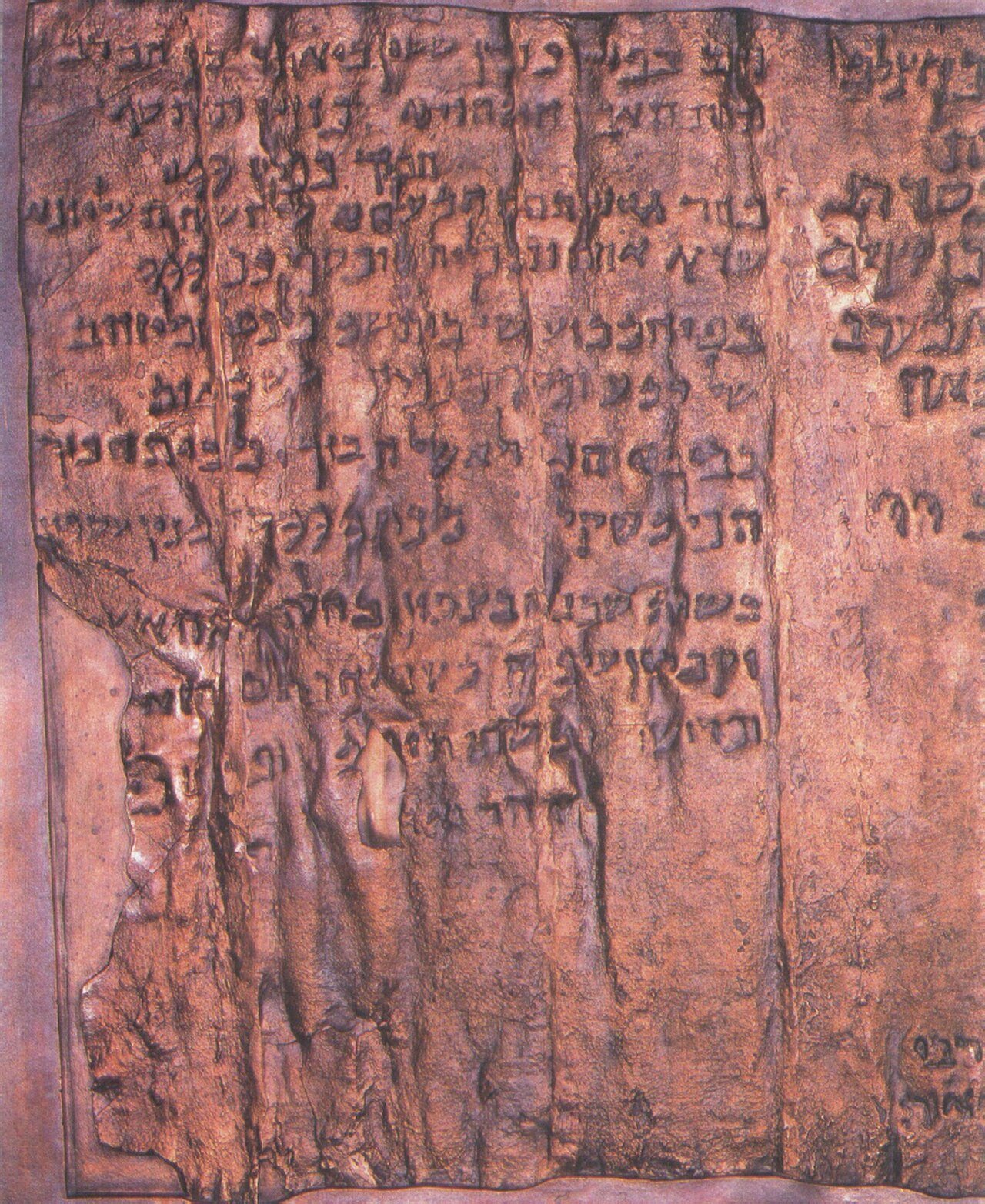
Among the many ancient discoveries that have transformed our understanding of history, few are as mysterious—or as tantalizing—as the Copper Scroll. Unlike fragile manuscripts written on parchment or papyrus, this remarkable document was engraved onto thin sheets of copper. Instead of preserving religious teachings, poetry, or historical accounts, it appears to contain something far more extraordinary: a list of hidden treasures.
For more than seventy years, archaeologists, historians, treasure hunters, and biblical scholars have debated the meaning of this enigmatic artifact. Does it record the locations of real treasure hidden somewhere around ancient Jerusalem? Were the riches ever recovered? Or is the Copper Scroll simply a symbolic document whose true purpose has been misunderstood?
No one knows for certain. That uncertainty has made the Copper Scroll one of archaeology’s greatest enduring mysteries.
The Discovery in a Desert Cave
The story begins in 1952 in the arid cliffs overlooking the northwestern shore of the Dead Sea. Archaeologists and local Bedouin were searching caves in what is now the West Bank, an area famous for one of the twentieth century’s most important archaeological discoveries: the Dead Sea Scrolls.
The Dead Sea Scrolls are a collection of hundreds of ancient Jewish manuscripts dating from approximately the third century BCE to the first century CE. They include biblical texts, religious writings, legal documents, commentaries, hymns, and community rules associated with a Jewish sect that lived near the settlement of Qumran.
During excavations in Cave 3, researchers uncovered something completely unexpected.
Instead of a leather scroll, they found two tightly corroded rolls of copper.
At first, archaeologists did not even know what the object contained. Years of corrosion had fused the metal together, making it impossible to unroll without destroying it.
The discovery immediately stood apart from every other Dead Sea Scroll.
Why Was It Made of Copper?
Ancient documents were almost always written on papyrus, parchment, or occasionally pottery shards. Copper was expensive, heavy, and extremely difficult to engrave.
Creating a copper scroll required immense effort.
Thin sheets of nearly pure copper were hammered into shape, and each line of text was carefully carved into the metal using sharp tools before the sheets were rolled up.
This unusual choice of material raises an obvious question.
Why use copper?
Many scholars believe the answer lies in permanence.
If the information recorded on the scroll was considered especially important, engraving it into metal would protect it far better than ink on animal skin.
Ironically, although the copper survived nearly two thousand years, corrosion almost prevented anyone from reading it.
Opening the Scroll
For several years, no one knew how to examine the scroll safely.
Finally, in 1955, experts at the University of Manchester in England developed an innovative solution.
Instead of attempting to unroll the fragile metal, engineers carefully cut the scroll into narrow strips using a precision saw.
Although the procedure sounds drastic, it allowed researchers to preserve the engraved text while finally making it readable.
Once translated, the contents astonished scholars.
The Copper Scroll was unlike anything anyone had expected.
A List of Hidden Treasures
Rather than containing prayers or scripture, the scroll describes dozens of locations where enormous quantities of treasure were supposedly hidden.
The text repeatedly gives instructions similar to this pattern:
At a particular place…
Near a certain landmark…
Beneath a specific structure…
A quantity of gold or silver is buried.
Again and again, the scroll lists caches of wealth.
According to the text, these treasures include gold, silver, valuable vessels, priestly objects, and sacred offerings.
When all the amounts mentioned are added together, the total becomes astonishing.
Modern estimates vary because the ancient units of measurement are not always certain, but the scroll appears to describe many tens of tons of precious metals.
If taken literally, it would represent one of the largest treasure hoards ever recorded in the ancient world.
The Language of the Scroll
The Copper Scroll is written primarily in Hebrew, but its language differs noticeably from that of many other Dead Sea Scrolls.
Instead of poetic or theological writing, its style is practical and direct.
It resembles an inventory or set of instructions.
Many passages mention wells, tunnels, pools, cisterns, stairways, valleys, ruins, and other landmarks.
Some locations may refer to places around ancient Jerusalem.
Others appear connected to the Judean Desert.
Unfortunately, many of these landmarks have changed dramatically or disappeared over the centuries, making them extremely difficult to identify today.
Could the Treasure Be Real?
This is the central mystery.
Some historians believe the Copper Scroll records genuine treasure hidden before Jerusalem fell to the Romans in 70 CE.
During the First Jewish Revolt against Roman rule, Jerusalem was besieged and eventually destroyed.
The magnificent Second Temple, the religious center of Judaism, was burned.
Many scholars suggest that priests or other officials may have hidden valuable temple treasures before the city’s destruction.
If so, the Copper Scroll could represent a record intended to help trusted individuals recover them later.
This theory explains why the document focuses entirely on treasure rather than religion.
It also fits the historical reality that valuable objects were often concealed during wars.
However, evidence remains inconclusive.
The Treasure of the Second Temple?
One of the most popular theories connects the scroll with the wealth of the Second Temple.
The temple contained valuable gold and silver objects used in worship.
Historical sources describe sacred vessels, ceremonial equipment, and large financial offerings stored there.
After Jerusalem’s capture, Roman forces carried away many treasures.
The famous Arch of Titus in Rome, completed after the Roman victory, depicts Roman soldiers carrying objects traditionally identified as treasures from the Jerusalem Temple, including the great seven-branched menorah.
Because some temple treasures clearly survived long enough to be taken by the Romans, scholars debate whether additional valuables could have been hidden elsewhere before the city’s fall.
The Copper Scroll may—or may not—refer to such hidden deposits.
There is currently no archaeological evidence proving this connection.
Could the Treasure Belong to the Qumran Community?
Another theory suggests the treasure belonged not to the Temple but to the Jewish community associated with Qumran.
The people who preserved the Dead Sea Scrolls may have hidden their possessions before Roman armies reached the region.
Yet this explanation also raises questions.
The treasure described in the Copper Scroll seems far greater than the wealth that archaeologists believe the relatively small Qumran settlement possessed.
Most researchers therefore doubt that such enormous riches could have belonged solely to that community.
A Symbolic Document?
Not everyone believes the scroll describes actual treasure.
Some scholars argue that it may be symbolic.
Ancient religious literature sometimes uses treasure as a metaphor for spiritual blessings or divine promises.
Others suggest the Copper Scroll could represent an idealized inventory rather than a practical map.
Still others think it may preserve records copied from an earlier source that no longer survives.
Because no treasure has been conclusively linked to the scroll, symbolic interpretations continue to attract support.
The Problem with the Locations
One reason the mystery remains unsolved is that many location descriptions are frustratingly vague.
The scroll refers to landmarks that were probably familiar to people living nearly two thousand years ago.
Today, however, landscapes have changed dramatically.
Cities have expanded.
Roads have disappeared.
Buildings have collapsed.
Earthquakes have altered terrain.
Ancient place names have been forgotten.
Even if the instructions were perfectly accurate when written, identifying the intended locations today is extraordinarily difficult.
The Search for the Treasure
Ever since the scroll was translated, numerous expeditions have attempted to locate the hidden riches.
Some searches have focused on ancient Jerusalem.
Others have explored the Judean Desert.
Still others have investigated caves, cisterns, tunnels, and archaeological sites mentioned in the text.
Despite decades of searching, none has produced convincing evidence that the listed treasures have been found.
Occasionally, sensational claims appear in books, documentaries, or the media.
None has been accepted by mainstream archaeology as confirmation of the Copper Scroll’s treasure.
The mystery therefore remains unsolved.
Archaeology Versus Treasure Hunting
The Copper Scroll occupies an unusual place between archaeology and popular imagination.
Treasure hunters often see it as an ancient map leading to unimaginable riches.
Archaeologists approach it differently.
For researchers, the greatest value lies not in finding gold but in understanding history.
The scroll offers insight into the political turmoil of first-century Judea, the preservation of important documents, and the beliefs of ancient Jewish communities.
Even if no treasure is ever found, the Copper Scroll remains an invaluable historical artifact.
Its scientific importance does not depend on the existence of buried gold.
Dating the Copper Scroll
Determining the scroll’s exact date has been challenging.
Most scholars place it sometime during the late Second Temple period, likely around the first century CE.
This estimate is based on its writing style, language, archaeological context, and comparison with other Dead Sea Scrolls.
The copper itself cannot simply be dated by methods such as radiocarbon dating because metals contain no organic carbon suitable for that technique.
Instead, researchers rely on historical and archaeological evidence surrounding the discovery.
Although some debate continues, most experts agree that the Copper Scroll belongs to roughly the same historical era as many other Dead Sea Scrolls.
What Does the Scroll Actually Say?
The Copper Scroll does not tell a continuous story.
Instead, it reads like an inventory.
Each entry identifies a place and the quantity of treasure supposedly hidden there.
Some entries mention gold.
Others mention silver.
Several refer to priestly objects or offerings.
The document even appears to include a reference suggesting that additional information existed in another record, although no such companion document has ever been found.
If one once existed, it has been lost.
Scientific Studies of the Scroll
Modern technology has allowed researchers to examine the Copper Scroll in ways impossible when it was first discovered.
High-resolution photography has revealed faint inscriptions.
Digital imaging has improved damaged sections.
Advanced conservation techniques have slowed further corrosion.
Metallurgical studies have examined the composition of the copper and manufacturing methods.
Linguistic analysis continues to refine translations of difficult passages.
Although these studies have greatly improved understanding of the artifact itself, they have not resolved its greatest mystery.
The locations remain uncertain.
The Dead Sea Scrolls and the Copper Scroll
Although the Copper Scroll is usually grouped with the Dead Sea Scrolls, it differs dramatically from them.
Most Dead Sea Scrolls contain religious writings copied with ink onto parchment.
They preserve biblical books, legal texts, hymns, commentaries, and community regulations.
The Copper Scroll, by contrast, contains no theology, no scripture, and no commentary.
Its unique material, unusual writing style, and focus on hidden valuables make it unlike every other known Dead Sea Scroll.
This uniqueness has fueled continuing debate about why it was created.
Legends and Popular Culture
The mystery of hidden treasure naturally captures the imagination.
The Copper Scroll has inspired novels, documentaries, films, television programs, and speculative books.
Some stories connect it with lost Temple treasures.
Others imagine secret societies guarding ancient riches.
A few even claim links to legendary artifacts such as the Ark of the Covenant.
These ideas make entertaining fiction but should not be confused with established historical evidence.
To date, there is no credible archaeological evidence connecting the Copper Scroll to the Ark of the Covenant or other legendary relics.
Separating evidence from speculation remains essential.
Why the Mystery Endures
Many archaeological mysteries eventually fade as new discoveries provide answers.
The Copper Scroll has resisted that process.
Every important question remains open.
Were the treasures real?
Were they hidden successfully?
Did someone recover them long ago?
Were the listed places misunderstood?
Was the scroll symbolic all along?
Each possibility has supporters, yet none has been conclusively demonstrated.
This uncertainty keeps scholars returning to the scroll generation after generation.
Lessons Beyond Treasure
Perhaps the Copper Scroll’s greatest treasure is not gold at all.
It offers a rare glimpse into one of history’s most turbulent periods, when political conflict, war, and uncertainty shaped the lives of ordinary people.
It reminds us that ancient civilizations carefully preserved what they valued most—whether sacred writings, historical memory, or perhaps even hidden wealth.
The scroll also illustrates the importance of scientific archaeology.
Careful excavation, conservation, translation, historical analysis, and interdisciplinary research have allowed this remarkable artifact to reveal far more than it ever could through treasure hunting alone.
Each new study brings us closer to understanding the people who created it.
An Unsolved Enigma
The Copper Scroll remains one of archaeology’s greatest unanswered questions. Unlike mythical tales of lost cities or legendary riches, this mystery is grounded in a real artifact—an engraved copper document discovered in a cave beside the Dead Sea and preserved for nearly two millennia.
Whether it records an immense hidden fortune, an inventory from a vanished age, or a symbolic message whose meaning has been lost, no one can yet say with certainty.
Perhaps the treasures were found centuries ago. Perhaps they still lie buried beneath forgotten ruins around ancient Jerusalem. Or perhaps the greatest discovery waiting to be made is not a cache of gold but a deeper understanding of the remarkable people who left behind one of history’s most fascinating puzzles.
Until convincing evidence emerges, the Copper Scroll will continue to occupy a unique place where archaeology, history, science, and human curiosity meet—a silent copper witness to a mystery that has endured for almost two thousand years.