Few mysteries in history have captured the human imagination quite like the lost treasures of the Knights Templar. For more than seven centuries, stories of hidden gold, sacred relics, secret documents, and vanished wealth have inspired treasure hunters, historians, adventurers, and storytellers alike. Entire books have been written about these legendary riches. Countless expeditions have searched for them. Some believe they lie buried beneath ancient castles. Others think they were hidden in remote caves, secret tunnels, or forgotten islands. A few even claim that the treasure was never material wealth at all.
The mystery is fascinating because it combines real history with enduring legend. Unlike many famous treasure stories that are purely fictional, the Knights Templar were very real. They became one of the wealthiest and most powerful organizations in medieval Europe. They owned castles, farms, ports, ships, and vast amounts of money. Then, almost suddenly, their order was destroyed.
When the Templars fell, something strange happened. Much of their wealth seemed to disappear.
That disappearance created one of history’s greatest treasure mysteries.
Did the Templars secretly move their riches before their enemies could seize them? Were priceless relics hidden away in unknown locations? Did sacred objects disappear forever? Or has the entire treasure story been exaggerated by centuries of mythmaking?
To understand the mystery, we must first understand the remarkable rise of the Knights Templar themselves.
The Birth of the Knights Templar
The story begins in the years following the First Crusade.
In 1099, Christian forces captured Jerusalem after a long and bloody campaign. Pilgrims from Europe soon began traveling to the Holy Land to visit sites associated with the life of Jesus Christ.
The journey, however, was dangerous.
Travelers faced bandits, hostile groups, disease, and harsh conditions. Roads were often unsafe, especially for those carrying money or valuable possessions.
Around 1119, a small group of knights decided to create an organization dedicated to protecting these pilgrims.
Their leader was a French nobleman named Hugues de Payens.
The new group became known as the Poor Fellow-Soldiers of Christ and of the Temple of Solomon. Eventually, they became famous simply as the Knights Templar.
The name came from their headquarters in Jerusalem, which was believed to be located near the site of the ancient Temple of Solomon.
At first, the order was small and relatively poor.
That would not last.
How the Templars Became Rich
The Knights Templar quickly gained support throughout Europe.
People admired their mission. Kings, nobles, and wealthy families donated money, land, livestock, and buildings.
The Catholic Church granted them special privileges. They answered directly to the Pope rather than local rulers. This independence helped them expand rapidly.
As decades passed, the Templars developed a network that stretched across Europe and the Middle East.
They owned thousands of properties.
They managed farms, vineyards, mills, and trading operations.
They also pioneered financial services that resembled early banking.
A pilgrim could deposit money in one Templar location and withdraw it elsewhere during their journey. This reduced the risk of theft and made long-distance travel safer.
Over time, the order accumulated immense wealth.
By the thirteenth century, the Templars had become one of the most influential organizations in the medieval world.
Their success, however, would eventually make them powerful enemies.
The Fall of the Templars
The beginning of the end came during the reign of Philip IV of France.
Philip faced serious financial problems.
Wars had drained his treasury, and he owed large debts.
The Templars possessed enormous resources and considerable independence. Their wealth was difficult for any ambitious ruler to ignore.
On Friday, October 13, 1307, Philip launched a coordinated operation against the order.
Across France, Templar members were arrested.
Many were accused of heresy, blasphemy, corruption, and other crimes.
Historians generally agree that many of these accusations were either exaggerated or entirely fabricated.
Under torture, some prisoners confessed to shocking charges.
These confessions helped justify further actions against the order.
Eventually, pressure from Philip led Pope Clement V to dissolve the Knights Templar.
Their properties were seized.
Their leaders were imprisoned.
Their organization was destroyed.
Yet amid all this chaos, an extraordinary mystery emerged.
Where had their treasure gone?
The Missing Fleet
One of the most famous legends concerns the Templar fleet.
At the time of their arrest, the Templars maintained ships in several ports.
According to some accounts, a number of vessels disappeared shortly before or during the crackdown.
The most famous stories center on the Templar port of La Rochelle.
This important Atlantic harbor served as a major Templar center.
Some historians note that records indicate ships were active there before the arrests.
The legend claims that a fleet sailed away carrying treasure, documents, and sacred relics before Philip’s agents could seize them.
If true, this would explain why so much wealth appeared to vanish.
However, evidence remains limited.
Historical records from the period are incomplete, and many details remain uncertain.
Nevertheless, the image of ships slipping into the darkness with priceless cargo continues to fuel speculation.
What Kind of Treasure Did the Templars Possess?
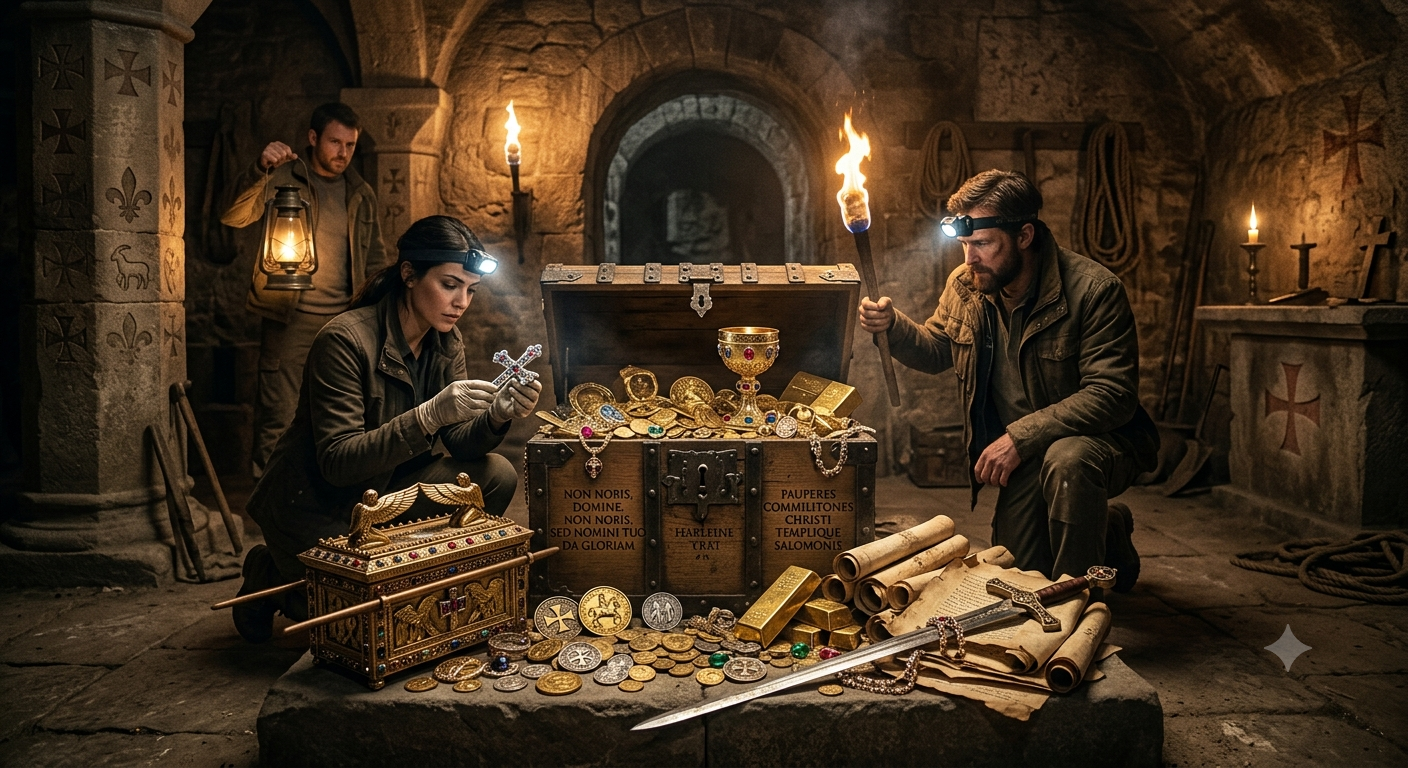
When people hear the word “treasure,” they often imagine chests overflowing with gold coins and sparkling jewels.
The reality may have been far more complex.
The Templars certainly possessed money, silver, gold, and valuable property.
But their most important assets may have included documents, contracts, records, and financial agreements.
In the medieval world, information could be just as valuable as precious metals.
The order also controlled sacred objects, religious relics, and ceremonial items.
Some legends claim they possessed artifacts connected to biblical history.
Others suggest they discovered extraordinary treasures during their years in Jerusalem.
Whether any of these stories are true remains one of history’s great unanswered questions.
The Temple of Solomon Connection
From the beginning, the Templars were associated with the site traditionally linked to the ancient Temple of Solomon.
Because of this connection, many legends suggest they conducted excavations beneath Jerusalem.
Some stories claim they discovered hidden chambers.
Others suggest they found ancient manuscripts, sacred relics, or lost treasures from biblical times.
These ideas have inspired endless speculation.
Unfortunately, reliable evidence is scarce.
The historical record does not clearly document what the Templars may or may not have uncovered.
Yet the possibility continues to fascinate researchers.
If the Templars found something important beneath Jerusalem, it could explain both their rapid rise and the mysteries that surrounded them for centuries afterward.
The Legend of the Holy Grail
Perhaps no artifact is more closely linked to the Knights Templar than the Holy Grail.
The Grail, traditionally associated with the cup used by Jesus at the Last Supper, became one of medieval Europe’s most famous legends.
Over time, storytellers began connecting the Templars to Grail traditions.
Some claimed the knights discovered the sacred relic during their time in the Holy Land.
Others suggested they secretly protected it.
These ideas became especially popular in modern books and films.
However, historians emphasize that there is no direct evidence linking the Templars to the Holy Grail.
Most connections emerged centuries after the order’s destruction.
Still, the legend persists because it combines two powerful mysteries into one.
The world’s most famous lost relic and history’s most famous missing treasure seem almost destined to become linked in popular imagination.
The Ark of the Covenant Theory
Another legendary treasure supposedly connected to the Templars is the Ark of the Covenant.
According to the Hebrew Bible, the Ark contained sacred objects associated with Moses and the Israelites.
Its ultimate fate remains unknown.
Because the Ark disappeared from history long ago, numerous theories have attempted to explain what happened to it.
Some speculate that the Templars discovered it beneath Jerusalem.
Others claim they transported it to Europe.
These stories have appeared in novels, documentaries, and treasure-hunting theories.
Yet no credible historical evidence supports the claim.
The Ark remains one of history’s greatest mysteries, and its connection to the Templars remains purely speculative.
Secret Documents and Hidden Knowledge
Not all Templar treasure stories focus on physical wealth.
Some suggest the order possessed extraordinary knowledge.
According to these theories, the knights discovered ancient manuscripts or secret teachings during their time in the Holy Land.
These documents supposedly contained information capable of changing history.
Various legends claim the Templars learned forgotten scientific principles, hidden religious truths, or lost historical records.
Such ideas are intriguing but difficult to verify.
Most historians view these stories with skepticism.
Nevertheless, the notion of hidden knowledge appeals strongly to the human imagination.
The idea that a secret archive exists somewhere, waiting to reveal long-lost truths, is difficult to resist.
The Treasure of Rennes-le-Château
One of the most famous treasure mysteries in France centers on the village of Rennes-le-Château.
In the nineteenth century, a local priest named Bérenger Saunière suddenly appeared to acquire unusual wealth.
This led to speculation that he had discovered hidden treasure.
Eventually, theories emerged connecting the village to the Knights Templar.
Some claimed Templar gold was buried there.
Others suggested secret documents had been hidden beneath the church.
Despite extensive investigation, no convincing evidence has ever confirmed these claims.
Yet Rennes-le-Château remains one of the most famous locations associated with Templar treasure legends.
Scotland and the Templar Escape
Scotland occupies a special place in Templar mythology.
At the time of the order’s suppression, Scotland was politically complicated.
Because of conflicts with England, papal authority was less effective there than elsewhere.
Some legends suggest fleeing Templars found refuge in Scotland.
According to these stories, they carried treasure, relics, and important records with them.
Over time, these tales became intertwined with Scottish castles, secret tunnels, and mysterious symbols.
The famous chapel known as Rosslyn Chapel is often linked to such theories.
Its elaborate carvings and unusual history have inspired countless speculations.
While historians find little evidence for many of the more dramatic claims, the connection between Scotland and Templar legends remains enduringly popular.
The Portuguese Connection
Unlike some countries, Portugal treated the Templars relatively favorably after the order’s dissolution.
Instead of completely destroying the organization, Portuguese authorities helped create a successor group known as the Order of Christ.
Many former Templars joined this new institution.
As a result, some researchers believe portions of Templar wealth may have survived through this transition.
Rather than disappearing, certain assets could have been transferred legally into new hands.
This possibility is far less dramatic than tales of buried treasure, but it may be closer to historical reality.
Sometimes treasure does not vanish.
Sometimes it simply changes ownership.
Templar Treasure in the New World?
One of the most ambitious theories claims that Templar ships crossed the Atlantic long before Columbus.
According to this idea, the missing fleet carried treasure to North America.
Supporters point to various carvings, symbols, and legends that they believe indicate pre-Columbian European contact.
Most professional historians remain unconvinced.
There is currently no strong evidence that the Templars reached the Americas.
Nevertheless, the theory continues to attract attention.
The possibility of medieval treasure hidden somewhere in the vast landscapes of North America is an irresistible idea for many enthusiasts.
Why Treasure Hunters Remain Fascinated
The mystery of Templar treasure persists because it contains all the ingredients of a perfect historical puzzle.
There is real wealth.
There is sudden disappearance.
There are incomplete records.
There are secretive organizations.
There are dramatic arrests.
There are unexplained gaps in the story.
Unlike many treasure legends, the basic historical framework is genuine.
The Knights Templar truly existed.
They truly became wealthy.
They truly faced destruction.
And questions truly remain about what happened to all their assets.
This combination of fact and mystery keeps the story alive.
Separating Myth from Reality
When examining Templar treasure stories, it is important to distinguish between evidence and speculation.
Historians know the order possessed considerable wealth.
They know properties were confiscated after the arrests.
They know some assets were transferred to other organizations.
They know records from the period are incomplete.
Beyond these facts, certainty becomes more difficult.
Claims involving the Holy Grail, the Ark of the Covenant, secret bloodlines, hidden world-changing documents, and lost continents often rely on assumptions rather than evidence.
That does not mean such stories are worthless.
Legends can reveal much about cultural hopes, fears, and imagination.
But historical investigation requires careful evaluation of sources.
The most exciting story is not always the most accurate one.
The Psychological Power of Lost Treasure
The enduring appeal of Templar treasure says something important about human nature.
People love unfinished stories.
They love mysteries without clear answers.
Lost treasure combines adventure, hope, danger, and possibility.
The treasure may be hidden anywhere.
It may be discovered tomorrow.
It may change history.
These possibilities keep people engaged generation after generation.
The Templar mystery is especially powerful because it involves more than money.
It also involves secrets.
People are often more fascinated by hidden knowledge than by gold.
A chest of coins is exciting.
A hidden truth capable of reshaping history is irresistible.
Archaeological Searches and Modern Investigations
Over the years, numerous archaeological investigations have explored sites connected to the Templars.
Researchers have examined castles, churches, tunnels, caves, and former Templar properties.
Occasionally, discoveries provide new insights into the daily lives of the knights.
Artifacts, coins, and architectural remains help historians understand how the order operated.
However, no investigation has uncovered a legendary lost treasure capable of solving the mystery once and for all.
This absence of definitive evidence only deepens the intrigue.
Each failed search leaves room for another theory.
Each unanswered question inspires a new expedition.
The Templars in Popular Culture
Modern films, novels, television series, and video games have transformed the Knights Templar into cultural icons.
Sometimes they appear as noble guardians of sacred relics.
Sometimes they are portrayed as secret keepers protecting ancient truths.
Sometimes they become villains controlling hidden conspiracies.
These portrayals often blend history with fantasy.
While entertaining, they can create misconceptions about the real Templars.
Yet they also keep public interest alive.
Many people first encounter Templar history through fiction before exploring the historical record.
In this way, the legends continue to introduce new generations to a fascinating chapter of medieval history.
What Probably Happened to the Treasure?
The most likely explanation may also be the least dramatic.
Much of the Templars’ wealth probably did not disappear at all.
Properties were seized.
Assets were transferred.
Money was distributed.
Some resources may have been hidden temporarily during the crisis.
Others may have been lost through corruption, theft, or poor record-keeping.
A portion of wealth undoubtedly vanished into the complexities of medieval politics.
This explanation lacks the excitement of secret caves filled with gold.
Yet history often unfolds through ordinary processes rather than spectacular mysteries.
Still, the incomplete nature of surviving records ensures that questions remain.
And where questions remain, legends thrive.
The Legacy of the Lost Treasure
Whether the treasure still exists or not, the legend has become a treasure in its own right.
For more than seven hundred years, the mystery has inspired exploration, scholarship, storytelling, and imagination.
The search has led people to ancient castles, forgotten churches, remote islands, and hidden tunnels.
It has encouraged historians to study medieval records and archaeologists to investigate long-abandoned sites.
Most importantly, it has kept the story of the Knights Templar alive long after the order itself disappeared.
The treasure may never be found.
Yet the quest continues.
Conclusion
The lost treasures of the Knights Templar remain one of history’s greatest mysteries. The Templars were real, powerful, and wealthy. Their sudden downfall in the early fourteenth century created circumstances perfectly suited for legends to emerge. As their organization collapsed, stories spread about vanished gold, sacred relics, secret documents, and hidden knowledge.
Over the centuries, these stories grew larger and more elaborate. The Holy Grail, the Ark of the Covenant, mysterious manuscripts, hidden vaults, and lost fleets all became part of the legend. Some theories contain small kernels of historical possibility. Others belong more to the realm of imagination than evidence.
What makes the mystery endure is not merely the prospect of finding treasure. It is the possibility that something important remains undiscovered. A forgotten document, a hidden chamber, or an overlooked clue could potentially change what we know about the past.
For now, the truth remains elusive.
Perhaps the treasure was scattered long ago. Perhaps portions of it still lie hidden somewhere beneath stone floors, inside forgotten caves, or deep within unexplored archives. Or perhaps the greatest treasure left by the Knights Templar is the mystery itself—a story so compelling that it continues to inspire curiosity, wonder, and adventure more than seven centuries after the order vanished from history.
As long as unanswered questions remain, the search for the lost treasures of the Knights Templar will continue, inviting each new generation to wonder whether one of history’s greatest secrets is still waiting to be uncovered.