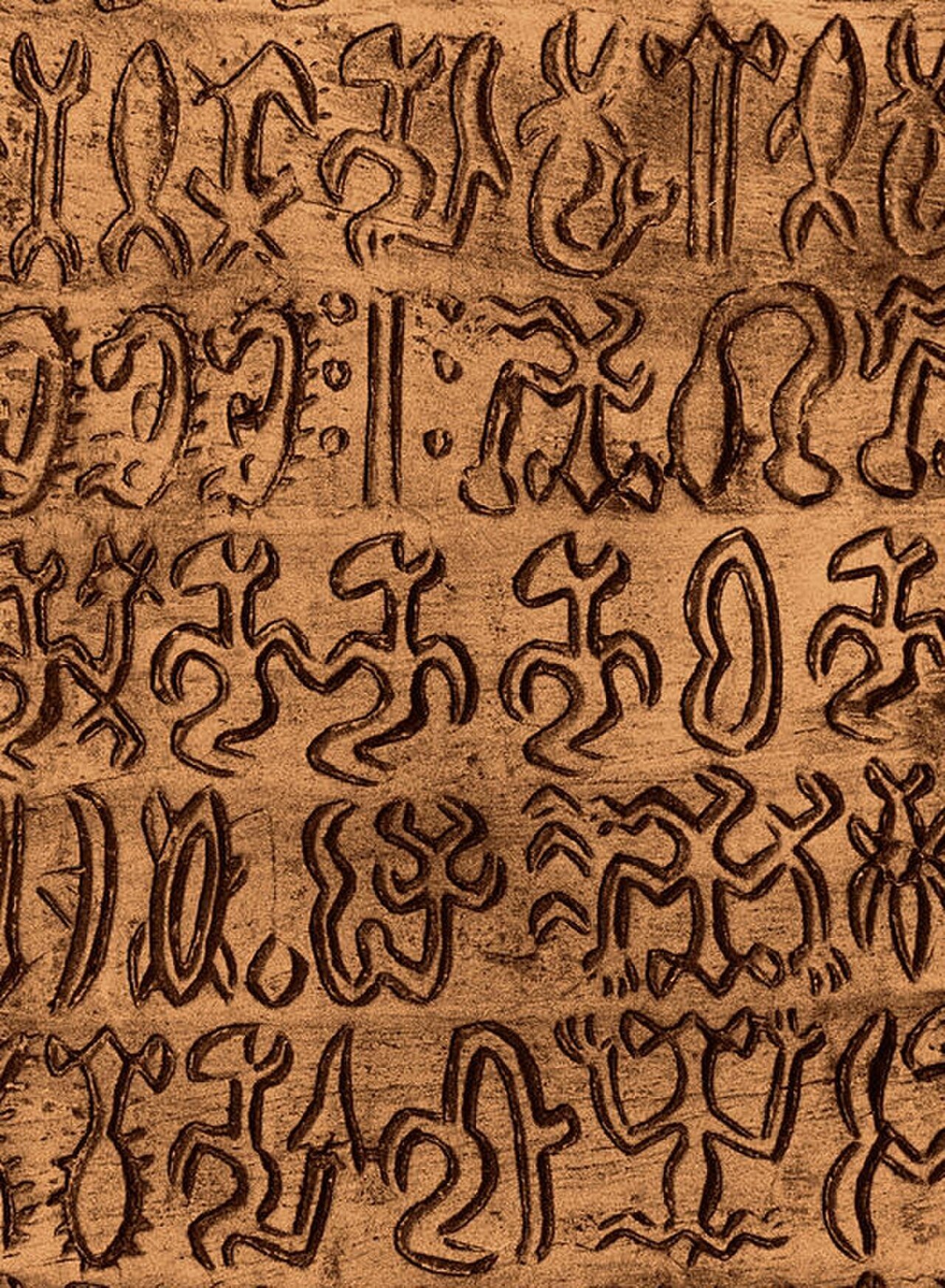
Imagine holding a small wooden tablet covered with hundreds of tiny carved figures. Birds stand beside fish. Human-like faces gaze outward. Strange geometric shapes weave between animals and symbols that seem to tell a forgotten story. Every line appears carefully carved by skilled hands, yet no one alive can read a single sentence. The people who once understood these symbols are gone, and with them vanished one of humanity’s greatest linguistic mysteries.
This is the story of Rongorongo, one of the world’s most mysterious writing systems.
For more than a century, linguists, archaeologists, historians, and computer scientists have tried to unlock its meaning. They have counted its symbols, compared its patterns, searched for hidden grammar, and tested countless theories. Despite all these efforts, Rongorongo remains undeciphered. It is one of the few known scripts in human history that has resisted every serious attempt at translation.
The mystery is made even more fascinating because Rongorongo comes from one of the most isolated inhabited places on Earth—Easter Island, known to its Indigenous people as Rapa Nui. Thousands of kilometers from the nearest continent, this small volcanic island became home to a remarkable civilization famous for creating the enormous stone statues called moai. Yet alongside these towering monuments, the people of Rapa Nui may also have developed a unique system of writing unlike any other in Polynesia.
Whether Rongorongo truly represents a complete writing system or something else entirely remains one of archaeology’s greatest unanswered questions.
A Remote Island in the Middle of the Pacific
Easter Island lies in the southeastern Pacific Ocean, about 3,700 kilometers (2,300 miles) west of Chile. It is one of the most isolated inhabited islands in the world. Long before European explorers arrived, Polynesian voyagers crossed vast stretches of ocean using remarkable navigational skills to settle the island.
Archaeological evidence suggests that Polynesian settlers reached Rapa Nui sometime between the twelfth and thirteenth centuries, although researchers continue to refine the exact dates. These settlers brought crops, domestic animals, traditions, religious beliefs, and an impressive understanding of seafaring.
Over the following centuries, they developed a unique culture that produced one of history’s most recognizable archaeological landscapes. Hundreds of giant stone statues, known as moai, were carved from volcanic rock and placed on ceremonial platforms around the island.
These statues became symbols of ancestral authority and spiritual power.
But while the moai attracted worldwide attention, another remarkable achievement remained hidden for centuries—the mysterious carved script now known as Rongorongo.
The Discovery of Rongorongo
Europeans first encountered Easter Island in 1722 when Dutch explorer Jacob Roggeveen arrived on Easter Sunday, giving the island its European name.
Early visitors described the island’s people, their traditions, and the impressive moai statues. Surprisingly, however, none of the earliest European accounts clearly mention the wooden tablets covered in strange carvings.
The first detailed reports of Rongorongo appeared much later, during the nineteenth century.
Missionaries living on the island learned that certain wooden tablets carried mysterious symbols. Local traditions suggested that these carvings possessed special importance and that only trained individuals knew how to recite or interpret them.
Unfortunately, by the time scholars recognized the potential significance of these tablets, much of the traditional knowledge surrounding them had already disappeared.
What Does “Rongorongo” Mean?
The word “Rongorongo” comes from the Rapa Nui language.
It is often translated as “to recite,” “to chant,” or “to proclaim.” The repetition in the word reflects a grammatical feature common in Polynesian languages, emphasizing the action.
Interestingly, the name does not necessarily mean “writing.”
Instead, it hints at an important possibility: the carved symbols may have been closely connected to oral tradition rather than functioning exactly like modern written language.
This distinction lies at the heart of ongoing debates among researchers.
The Appearance of the Script
At first glance, Rongorongo resembles no other known writing system.
Its symbols are beautifully carved into wooden tablets, staffs, ceremonial objects, and fragments of wood.
Researchers have identified hundreds of individual signs.
Many represent recognizable objects.
Birds appear frequently.
Fish are common.
Human figures stand with raised arms.
Faces, turtles, insects, plants, stars, crescents, paddles, and geometric designs fill the carvings.
Some symbols combine multiple elements into intricate forms.
Others appear highly abstract.
Each figure was carefully engraved using sharp obsidian flakes or shark teeth, demonstrating remarkable craftsmanship.
The carvings are both artistic and systematic, suggesting they followed established conventions rather than being random decorations.
An Unusual Way of Reading
One of Rongorongo’s most remarkable features is the direction in which it is read.
The text follows a pattern called reverse boustrophedon.
The term comes from an ancient Greek expression meaning “as the ox turns” while plowing a field.
In ordinary boustrophedon writing, one line runs left to right, while the next runs right to left.
Rongorongo is even more unusual.
The reader begins at one corner of the tablet.
After completing a line, the tablet is turned upside down before reading the next line.
As a result, every alternate line appears inverted.
This unique arrangement has fascinated linguists because very few writing systems in history use such an orientation.
How Many Tablets Exist?
Only a small number of authentic Rongorongo objects survive today.
Approximately two dozen wooden artifacts are generally accepted as genuine, although not all are complete.
Some are beautifully preserved.
Others have suffered severe damage from weathering, insects, fire, or age.
Many contain missing sections where the wood has broken away.
Because the surviving collection is so small, researchers possess only a limited amount of text to analyze.
For comparison, ancient Egyptian hieroglyphs survive on thousands of monuments and papyrus documents.
Mesopotamian cuneiform appears on hundreds of thousands of clay tablets.
Rongorongo survives in only a tiny handful of fragile artifacts.
This scarcity greatly complicates attempts at decipherment.
Was Rongorongo Really a Writing System?
This question remains one of the greatest debates in the study of Rongorongo.
Some scholars argue that it represents a genuine writing system capable of recording spoken language.
Others believe it functioned as a mnemonic device.
A mnemonic system helps trained individuals remember long oral traditions rather than recording every word directly.
Many cultures have preserved vast amounts of knowledge without conventional writing.
Songs, chants, stories, and genealogies were memorized and transmitted orally across generations.
Some researchers suggest Rongorongo may have served as visual prompts for expert reciters rather than complete written texts.
Others point to repeated symbol patterns that resemble grammatical structures found in true writing systems.
The available evidence has not yet resolved this debate.
The Tragic Loss of Knowledge
Perhaps the greatest obstacle to deciphering Rongorongo is the disappearance of the people who understood it.
During the nineteenth century, Rapa Nui experienced catastrophic population decline.
Introduced diseases devastated the island’s inhabitants.
Peruvian slave raids in the 1860s captured many islanders, including religious leaders and knowledgeable elders.
Missionary activities also transformed traditional culture, leading to the abandonment of many older practices.
As the population collapsed, specialized knowledge disappeared.
If experts once knew how to read Rongorongo, their knowledge appears to have died with them.
Unlike Egyptian hieroglyphs, no bilingual inscription equivalent to the Rosetta Stone has ever been found.
Without living readers or parallel translations, decipherment becomes extraordinarily difficult.
The Search for Hidden Patterns
Although nobody can read Rongorongo, researchers have discovered intriguing regularities.
Certain symbols appear far more often than others.
Some combinations repeat many times.
Specific signs consistently appear near the beginnings or endings of sequences.
These patterns suggest that the carvings follow structured rules rather than random artistic decoration.
Computer analysis has strengthened this observation.
Statistical studies indicate that Rongorongo possesses characteristics expected in organized communication systems.
The frequency of symbols resembles natural language more closely than random sequences.
However, these statistical patterns alone cannot reveal meaning.
Knowing that a symbol appears frequently does not tell researchers what it represents.
Could Rongorongo Record Genealogies?
One possibility is that the tablets preserved royal genealogies.
Genealogy held enormous importance throughout Polynesia.
Remembering ancestral lineages established social status, political authority, and connections to sacred ancestors.
Some repeating patterns in Rongorongo might represent names or family relationships.
Yet no direct evidence confirms this interpretation.
Without understanding the symbols themselves, researchers cannot identify specific individuals or family trees.
Was It Connected to Religion?
Many scholars suspect that Rongorongo served religious purposes.
The surviving tablets were treated with considerable respect.
Historical accounts describe knowledgeable individuals chanting while handling them.
Some researchers believe the carvings preserved sacred rituals, ceremonial calendars, myths, or prayers.
Others suggest they recorded seasonal festivals or astronomical observations important for agriculture and religion.
Again, these ideas remain plausible rather than proven.
Astronomy and the Calendar
Ancient cultures often observed the sky with remarkable precision.
The movements of the Sun, Moon, planets, and stars helped determine planting seasons, religious festivals, and navigation.
Some researchers believe certain Rongorongo texts may relate to lunar calendars.
One famous artifact known as the Mamari Tablet contains sequences that some scholars interpret as a lunar calendar.
The repeated patterns appear consistent with the changing phases of the Moon.
Although this interpretation has attracted significant interest, it is not universally accepted.
Alternative explanations remain possible.
Why Decipherment Is So Difficult
Deciphering an unknown script requires several key ingredients.
Researchers ideally need large amounts of text.
They need knowledge of the underlying language.
They benefit enormously from bilingual inscriptions.
They also require confidence that the symbols actually represent language rather than symbolic art.
Rongorongo lacks nearly all these advantages.
The surviving texts are few.
Many are damaged.
No bilingual translation exists.
The original readers disappeared long ago.
Even the exact language represented remains uncertain, although it almost certainly relates to the Rapa Nui language.
Every missing piece makes decipherment exponentially harder.
Scientific Approaches to the Mystery
Modern technology has transformed the study of Rongorongo.
High-resolution photography reveals carvings invisible to the naked eye.
Three-dimensional laser scanning captures microscopic details of engraving techniques.
Digital imaging helps reconstruct damaged symbols.
Computer algorithms analyze repeating patterns and compare them with known writing systems.
Machine learning has recently joined these efforts, searching for statistical relationships too subtle for human observers.
Meanwhile, archaeologists continue investigating the historical context in which the tablets were created.
Linguists compare Rongorongo with Polynesian languages.
Anthropologists study traditional oral culture.
Together, these disciplines provide new insights even without complete decipherment.
Did Writing Develop Independently on Easter Island?
If Rongorongo truly represents a complete writing system, it raises an extraordinary question.
Did writing develop independently on Easter Island?
Throughout history, writing emerged only a handful of times.
The earliest known writing systems developed in Mesopotamia, Egypt, China, and Mesoamerica through independent invention.
Most other writing systems ultimately descended from these earlier traditions.
Easter Island’s extreme isolation makes Rongorongo particularly fascinating.
Some researchers suggest that islanders independently created their own script.
Others argue that European contact may have inspired its development after writing was first observed on visiting ships.
Current evidence has not conclusively resolved this debate.
Determining the age of the surviving wooden tablets is challenging because wood can remain in use for many years before being carved.
The Cultural Importance of Rongorongo
Whether or not it is eventually deciphered, Rongorongo remains a priceless part of Rapa Nui heritage.
It reflects the creativity, intelligence, and cultural richness of the island’s people.
For many descendants of the original inhabitants, the tablets represent a connection to ancestral knowledge lost through colonial disruption, disease, and slavery.
Modern preservation efforts seek not only to understand the script but also to protect this important cultural legacy.
Museums carefully conserve surviving tablets under controlled conditions to prevent further deterioration.
Digital archives make high-quality images available to researchers around the world.
What We Can Say with Confidence
Despite many unanswered questions, some conclusions are well supported by evidence.
The surviving Rongorongo tablets are authentic historical artifacts.
Their symbols were intentionally organized according to consistent conventions.
The carvings display remarkable craftsmanship.
The script, or symbolic system, was important within traditional Rapa Nui society.
Knowledge of its interpretation disappeared during the nineteenth century.
Beyond these points, many questions remain open.
Researchers continue debating whether Rongorongo records full language, serves as a mnemonic device, or represents another form of symbolic communication.
Could the Mystery One Day Be Solved?
History has shown that seemingly impossible puzzles can eventually yield to careful research.
Ancient Egyptian hieroglyphs remained unreadable for centuries until the discovery of the Rosetta Stone.
The cuneiform script of Mesopotamia was also once mysterious.
Linear B, the script of Bronze Age Greece, resisted decipherment until the twentieth century.
These successes inspire hope.
Perhaps another Rongorongo tablet still lies undiscovered.
Perhaps forgotten historical documents will emerge from museum collections.
Perhaps advances in artificial intelligence will identify patterns previously overlooked.
Or perhaps enough evidence has already vanished that complete decipherment will never be possible.
No one knows.
A Window into a Lost World
The mystery of Rongorongo is about far more than unread symbols carved into old pieces of wood. It is the story of a culture that flourished in extraordinary isolation, created monumental architecture, navigated the vast Pacific Ocean, and left behind one of history’s most intriguing intellectual achievements.
Every surviving tablet is a silent voice from the past. Its carvings were made by real people whose names have been forgotten but whose craftsmanship still speaks across centuries. They carved these symbols believing someone would understand them. Today, we can admire their beauty, trace their patterns, and appreciate their complexity, yet their true meaning remains just beyond our reach.
Perhaps that is why Rongorongo continues to fascinate the world. It reminds us that history still holds secrets. Even in an age of satellites, artificial intelligence, and advanced archaeology, there are mysteries that resist easy answers. Somewhere within those elegant rows of birds, faces, fish, and geometric signs lies a message that has waited generations to be heard again.
Until that day comes, Rongorongo remains one of humanity’s greatest unsolved puzzles—a lost language from one of the most remote islands on Earth, inviting every new generation to continue the search for its forgotten voice.