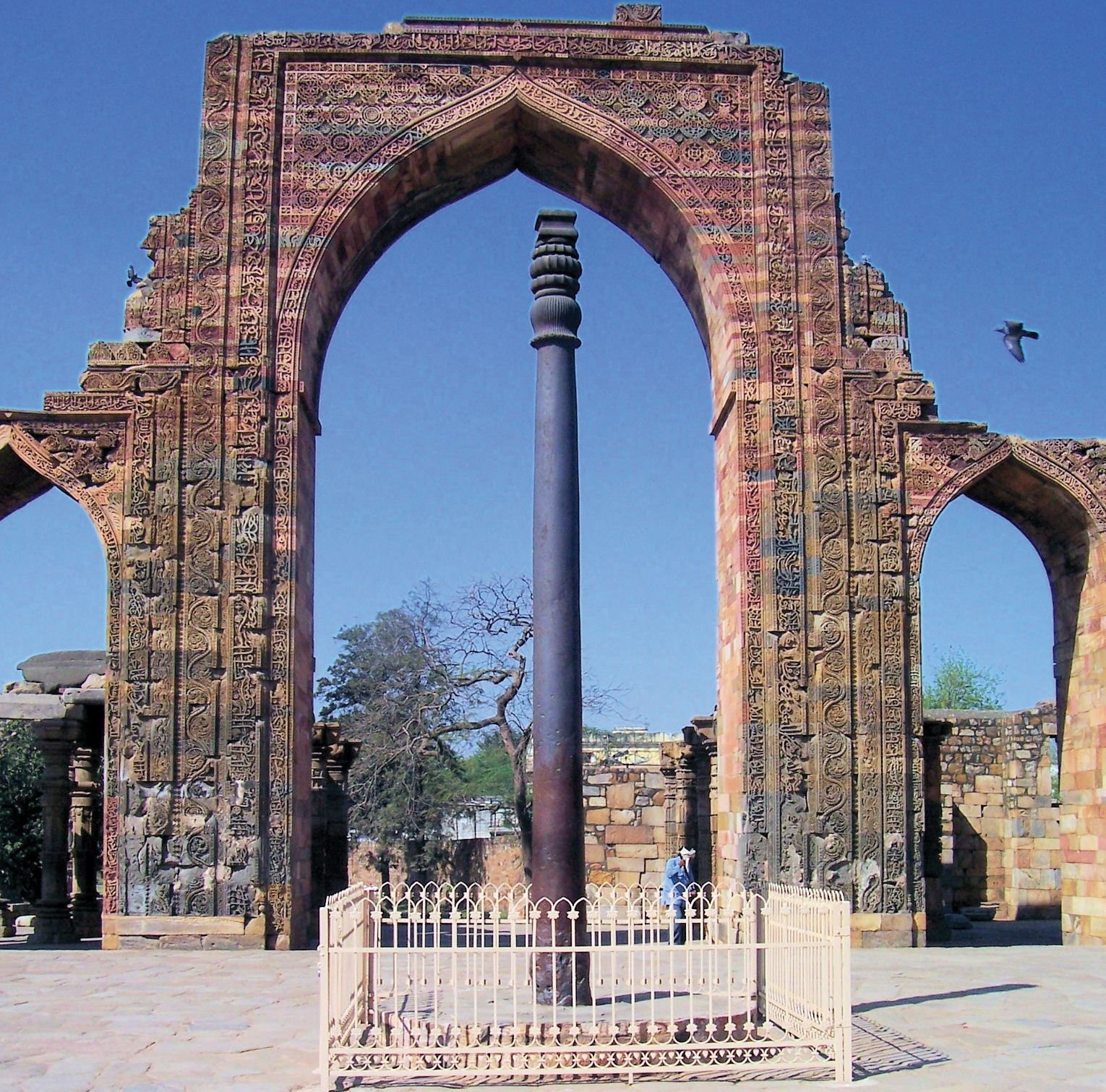
Few ancient objects inspire as much curiosity as the Iron Pillar of Delhi. Standing quietly in the heart of India’s capital, this towering column has survived more than sixteen centuries with remarkably little corrosion. While iron objects of similar age usually crumble into flakes of rust, this massive pillar has remained astonishingly well preserved, challenging generations of historians, archaeologists, metallurgists, and materials scientists.
To many visitors, the pillar seems almost magical. How could ancient blacksmiths create such a large iron monument long before modern blast furnaces, stainless steel, or industrial metallurgy existed? Did they accidentally discover a secret that modern science forgot? Was it protected by supernatural powers, as old legends claimed? Or does science provide a more satisfying explanation?
The real story is even more fascinating than the myths. The Iron Pillar is not evidence of lost alien technology or forgotten magic. Instead, it is a remarkable achievement of ancient Indian metallurgy, demonstrating the extraordinary skill of craftspeople who worked with iron more than 1,600 years ago. Its resistance to rust is the result of a unique combination of craftsmanship, chemistry, climate, and time.
The pillar reminds us that ancient civilizations often possessed sophisticated technological knowledge that modern people sometimes underestimate.
A Monument That Has Stood Through Empires
The Iron Pillar stands within the Qutb complex in Delhi, one of India’s most important historical sites. Around it rise magnificent medieval monuments, including the famous Qutb Minar, attracting millions of visitors every year.
The pillar itself is impressive even before its scientific importance is considered. It rises more than seven meters (about 23 feet) above the ground and weighs over six metric tons. Its smooth surface, elegant proportions, and ancient inscriptions immediately reveal that this was not an ordinary metal object but a monument created with great care and purpose.
What makes it extraordinary is not simply its age but its condition. After centuries of exposure to rain, humidity, heat, cold, dust, and pollution, it shows only limited corrosion over most of its surface.
For an iron object exposed outdoors for more than sixteen centuries, this is exceptional.
The Gupta Empire and an Age of Innovation
Most scholars believe the Iron Pillar was created during the reign of the powerful Gupta Empire, often regarded as one of the golden ages of ancient India.
The Gupta period, which flourished between the fourth and sixth centuries CE, witnessed remarkable achievements in mathematics, astronomy, literature, medicine, architecture, and metallurgy.
Many historians attribute the pillar to the reign of the emperor Chandragupta II, who ruled during the late fourth and early fifth centuries. An inscription on the pillar praises a king named “Chandra,” and most experts identify this ruler as Chandragupta II, although some scholarly debate continues.
If this identification is correct, the pillar was created around the early fifth century, making it approximately 1,600 years old.
The Story Written in Stone and Iron
One of the pillar’s most valuable features is its Sanskrit inscription, written in the ancient Brahmi script.
The inscription celebrates a victorious king and praises his military achievements, courage, and devotion to the Hindu god Vishnu.
Rather than serving as a simple engineering project, the pillar appears to have been a religious monument associated with a temple dedicated to Vishnu. Scholars believe that a statue or symbolic representation of the deity may once have crowned the top of the pillar, although this has long since disappeared.
The inscription not only helps historians estimate the pillar’s age but also provides a glimpse into the political and religious world of ancient India.
Was the Pillar Always in Delhi?
Interestingly, many historians believe the Iron Pillar was not originally erected where it stands today.
Evidence suggests that it may have first stood at a temple complex in central India, possibly near present-day Udayagiri in the state of Madhya Pradesh.
Centuries later, the pillar was likely transported to Delhi, perhaps during the rule of Anangpal Tomar in the eleventh century.
Moving a six-ton iron monument across long distances without modern machinery would itself have been an extraordinary engineering achievement.
Although historians continue to debate the exact details of its relocation, there is broad agreement that the pillar’s present location is probably not its original home.
Ancient Blacksmiths Achieved the Impossible
To modern eyes, producing such a massive iron pillar may seem routine. In reality, creating it during the fifth century was an astonishing technological accomplishment.
Unlike modern steel production, ancient Indian metallurgists did not have blast furnaces capable of melting enormous quantities of iron into a single mold.
Instead, they used bloomery furnaces.
These furnaces produced spongy masses of iron mixed with slag rather than fully molten metal.
Blacksmiths repeatedly heated these iron blooms and hammered them to remove impurities. Smaller pieces were then forge-welded together under intense heat to create increasingly larger masses.
Eventually, numerous large iron sections were joined to form the enormous pillar.
This required exceptional craftsmanship.
Each weld had to be strong enough to hold thousands of kilograms of metal together while maintaining the pillar’s shape and structural integrity.
Modern metallurgists regard this as one of the finest examples of ancient forge welding ever discovered.
Why Iron Normally Rusts
To appreciate why the pillar is so remarkable, it helps to understand what rust actually is.
Iron naturally reacts with oxygen and moisture.
When exposed to air and water over time, iron atoms combine with oxygen to form iron oxides, commonly known as rust.
Rust is not like a protective paint coating.
Instead, it is porous and flaky.
Once rust forms, it often exposes fresh iron beneath it, allowing corrosion to continue deeper into the object.
This process eventually weakens iron structures.
Ancient iron tools, weapons, and buildings have largely disappeared because rust gradually consumed them over centuries.
So why did the Iron Pillar survive?
The Long-Standing Mystery
For generations, travelers and scholars struggled to explain the pillar’s remarkable preservation.
Before modern scientific studies, many imaginative explanations emerged.
Some believed divine blessings protected it.
Others suggested that ancient craftsmen possessed secret formulas now lost forever.
Legends even claimed the metal came from heaven.
In more recent decades, pseudoscientific theories proposed extraterrestrial involvement or forgotten advanced civilizations.
These ideas captured public imagination but lacked evidence.
Scientists chose a different path.
Instead of searching for supernatural explanations, they carefully studied the pillar’s chemistry, structure, manufacturing methods, and surrounding environment.
Their findings gradually solved much of the mystery.
The Secret Lies in the Iron Itself
One of the most important discoveries concerns the pillar’s chemical composition.
Unlike modern steel, the Iron Pillar contains relatively high amounts of phosphorus and very little sulfur or manganese.
This unusual composition resulted partly from the ancient smelting methods used by Indian ironworkers.
Modern blast furnaces remove much of the phosphorus from iron.
Ancient bloomery furnaces did not.
For centuries, this difference seemed unimportant.
Scientists later realized it was crucial.
The phosphorus helped promote the formation of an extremely thin protective layer on the pillar’s surface.
Rather than allowing ordinary rust to spread deeply, this protective film slowed further corrosion.
In effect, the pillar gradually developed its own natural shield.
The Protective Layer That Took Centuries to Form
The protective coating is extraordinarily thin—far thinner than a sheet of paper.
Yet it performs an important function.
Researchers have identified complex iron compounds within this layer that create a stable barrier between the underlying metal and the environment.
One important component is a hydrated iron hydrogen phosphate compound that developed slowly over hundreds of years.
Instead of flaking away like ordinary rust, this protective layer adheres tightly to the metal beneath it.
As a result, oxygen and moisture have much greater difficulty reaching fresh iron.
Corrosion continues at an extremely slow rate.
The pillar did not emerge from the forge already protected.
Its shield formed naturally through a long interaction between the iron’s chemistry and the surrounding environment.
The Climate Also Played a Role
The chemistry of the metal is only part of the explanation.
Delhi’s climate contributed as well.
Although the region experiences seasonal monsoon rains, it also has long dry periods.
The alternating wet and dry conditions helped stabilize the protective surface layer.
If the pillar had spent centuries in a constantly wet coastal environment with high salt concentrations, corrosion might have progressed much more rapidly.
Environmental conditions and metallurgy worked together.
Neither factor alone completely explains the pillar’s preservation.
Slag Inclusions Helped Shape the Surface
Ancient bloomery iron differs from modern steel in another important way.
It contains numerous tiny particles of slag trapped inside the metal.
Modern engineers usually consider slag an impurity.
In the Iron Pillar, however, these microscopic inclusions contributed to the chemical reactions that produced the protective surface film.
Rather than weakening the monument significantly, the slag became part of the slow corrosion process that ultimately created greater stability.
This is one of the reasons scientists often describe the pillar as an accidental masterpiece of ancient metallurgy.
Its remarkable durability emerged from the interaction of several different factors rather than a single magical ingredient.
Not Completely Rust-Free
Despite its reputation, the Iron Pillar is not entirely free of rust.
This is an important scientific point.
Close examination reveals localized corrosion in some areas.
Certain portions have experienced greater weathering than others.
Damage caused by human contact has also affected parts of the surface over the centuries.
For many years, visitors believed touching or embracing the pillar brought good luck. Millions of hands repeatedly deposited sweat, oils, and salts onto the metal, accelerating corrosion in frequently touched areas.
Today, protective barriers prevent direct contact to help preserve the monument.
So while the pillar is remarkably corrosion-resistant, it is not immune to rust.
Scientific Research Solves the Puzzle
Throughout the twentieth and twenty-first centuries, researchers from India and around the world conducted increasingly sophisticated analyses of the pillar.
Using microscopy, chemical analysis, X-ray techniques, and metallurgical studies, scientists reached a broad consensus.
The pillar’s corrosion resistance results from several interacting factors.
Its high phosphorus content, low sulfur concentration, ancient forging methods, slag inclusions, protective passive film, and favorable environmental conditions all contributed.
No single factor alone explains the phenomenon.
The mystery turned out to be more complex—and more interesting—than any simple answer.
Could Modern Engineers Reproduce It?
In theory, yes.
Modern metallurgists understand the chemical principles behind the pillar’s corrosion resistance.
However, reproducing the exact combination of ancient materials, bloomery techniques, forge welding methods, and centuries-long natural weathering would be difficult.
Modern industry generally prioritizes different kinds of steel optimized for strength, flexibility, or cost rather than exactly replicating ancient wrought iron.
The Iron Pillar remains unique because it represents a specific technological tradition that developed under historical conditions unlike those of modern manufacturing.
Myths That Refuse to Disappear
Like many famous archaeological discoveries, the Iron Pillar has attracted numerous myths.
Some claim modern science cannot explain it.
Others insist it is made of stainless steel.
Still others argue it proves the existence of an unknown lost civilization possessing advanced technology.
Scientific evidence does not support these claims.
Researchers understand much of the pillar’s metallurgy, even though details continue to be refined.
The monument is not stainless steel in the modern sense.
Its resistance to corrosion arises from well-understood chemical and metallurgical processes rather than impossible technology.
Ironically, the real scientific explanation is every bit as remarkable as the myths.
Ancient Indian blacksmiths achieved something extraordinary using the knowledge and techniques available in their own time.
A Masterpiece of Ancient Engineering
The Iron Pillar demonstrates that sophisticated engineering existed long before modern factories.
Its creators possessed deep practical knowledge of ore selection, furnace operation, forging, welding, and large-scale metalworking.
Although they almost certainly did not understand atomic chemistry or electrochemical corrosion, centuries of accumulated craftsmanship enabled them to produce a monument of astonishing quality.
Many technological achievements throughout history emerged not from formal scientific theories but from generations of skilled artisans refining their techniques through observation and experience.
The Iron Pillar stands as one of the finest examples of this tradition.
What the Pillar Teaches Us Today
The Iron Pillar is more than an archaeological curiosity.
It reminds us that ancient civilizations often achieved levels of technical sophistication that surprise modern observers.
It also illustrates an important lesson about science itself.
Extraordinary objects do not require supernatural explanations.
Careful investigation, evidence, experimentation, and open-minded inquiry often reveal that nature is even more fascinating than mythology.
The pillar’s remarkable preservation is not the result of magic but of chemistry unfolding over sixteen centuries.
It is a story in which metallurgy, environmental science, archaeology, history, and materials engineering come together to explain one of humanity’s most enduring technological achievements.
A Silent Witness Across the Centuries
Empires have risen and fallen around the Iron Pillar. Kings who commissioned it disappeared into history. Religions evolved, cities expanded, and generations passed beneath its shadow. Yet the pillar still stands, quietly resisting the slow work of time.
It has witnessed invasions, dynasties, colonial rule, independence, and the growth of one of the world’s largest modern cities. Throughout all those centuries, its iron surface has continued to tell the same story—a story not of mystery beyond explanation, but of remarkable human ingenuity.
The Iron Pillar of Delhi remains one of the world’s greatest surviving examples of ancient metallurgy. It is a monument to the creativity of craftsmen whose names are lost to history but whose work continues to inspire scientists today. Every visitor who gazes upon it sees more than a column of iron. They see proof that human curiosity, patience, and skill can create something capable of defying expectations for more than sixteen hundred years.