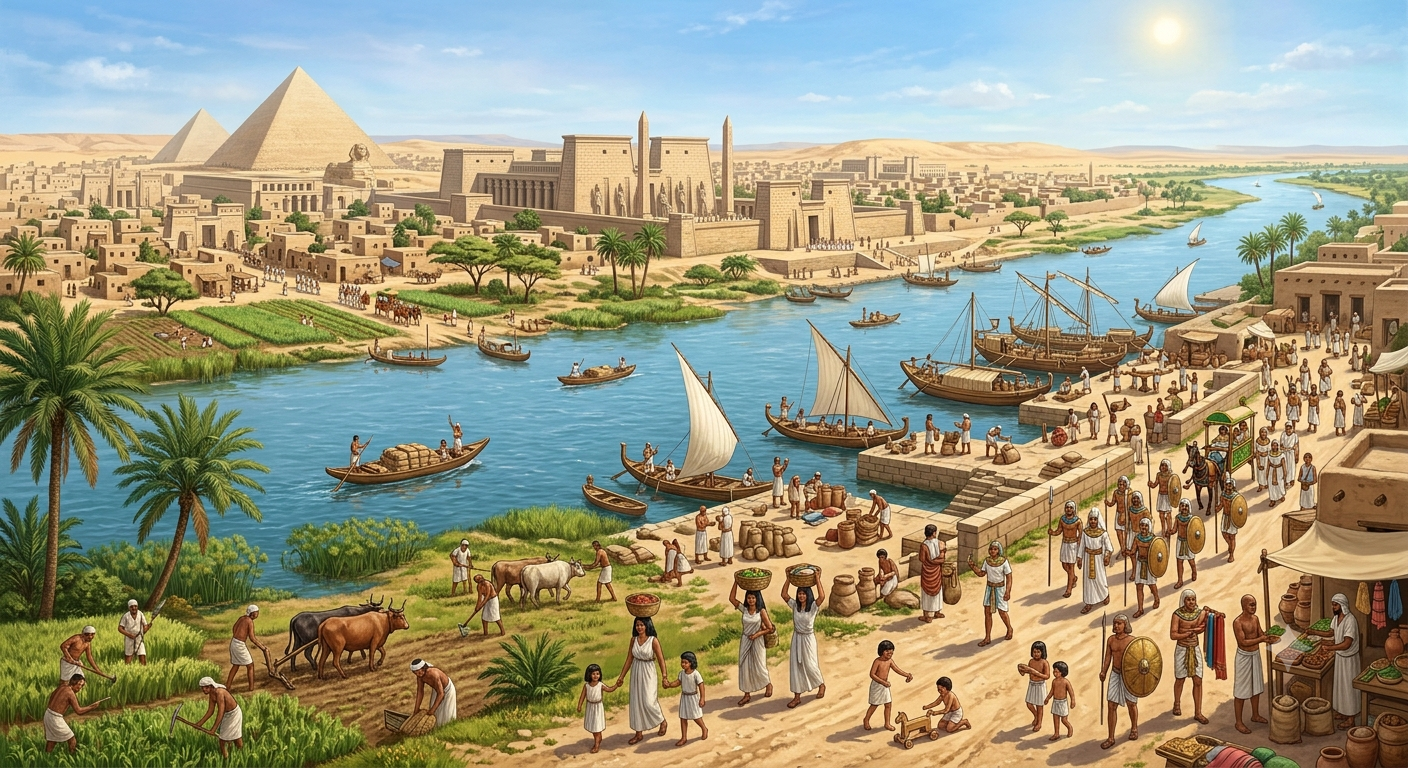
When most people imagine ancient Egypt, they picture towering pyramids, glittering golden treasures, mighty pharaohs, and mysterious tombs hidden beneath the desert sands. It is an image filled with kings, queens, priests, and monumental architecture. Yet these extraordinary monuments were built by a civilization whose true foundation was not its rulers, but its ordinary people.
For every pharaoh whose name has survived for thousands of years, there were millions of farmers, fishermen, craftsmen, bakers, weavers, laborers, and merchants whose names have long been forgotten. They tilled the fertile fields along the Nile, baked bread for their families, built homes from mud bricks, raised children, worshipped the gods, and worked hard to make each day a success.
Their lives were not filled with luxury, but they were rich with tradition, family, faith, and an intimate connection with the natural world. Through archaeology, ancient writings, artwork, and excavated villages, historians have pieced together a remarkably detailed picture of what everyday life was really like.
Let us step back more than three thousand years and experience a typical day through the eyes of an ordinary Egyptian.
The Nile Was the Heart of Everything
No feature shaped ancient Egyptian life more than the Nile River.
Running through an otherwise harsh desert landscape, the Nile transformed Egypt into one of the world’s earliest great civilizations. Every year, seasonal floods spread nutrient-rich silt across the riverbanks, creating fertile farmland capable of producing abundant harvests.
For ordinary people, the Nile was much more than a river.
It provided drinking water, fish, transportation, fertile soil, reeds for construction, clay for pottery, and the means to irrigate crops. Nearly every village was located close to its banks because life away from the river was extremely difficult.
The ancient Greek historian Herodotus famously called Egypt “the gift of the Nile,” and modern archaeology strongly supports this observation.
Without the Nile, ancient Egypt could never have existed.
A Village Awakens Before Sunrise
Long before the first rays of sunlight reached the horizon, families were already stirring.
Roosters crowed across the village. Dogs barked. Donkeys brayed while waiting to be loaded with supplies. Smoke began rising from cooking fires as women prepared the morning meal.
Most people rose early because daylight was precious. Without electric lighting, work depended entirely on the Sun.
Children helped fetch water from nearby wells or directly from the Nile. Older family members checked animals, gathered firewood, or prepared farming tools before heading into the fields.
The day had barely begun, yet everyone already had responsibilities.
Homes Built from the Earth
Unlike the magnificent stone temples that still stand today, the homes of ordinary Egyptians were usually built from sun-dried mud bricks.
These bricks were made by mixing Nile mud with straw before shaping them into blocks and leaving them to dry in the hot Egyptian sun.
Mud brick was inexpensive, widely available, and surprisingly effective at keeping homes cool during scorching summer days.
A typical house might contain only a few rooms surrounding a small courtyard.
Roofs were flat and often served as extra living space, especially during warm evenings.
Inside, furniture was simple.
Families slept on woven mats or wooden beds if they were wealthy enough to own them. Clay jars stored grain and water, while baskets held vegetables, fruit, and household supplies.
Although modest by modern standards, these homes were practical and well adapted to Egypt’s climate.
Breakfast Was Simple but Filling
The first meal of the day was usually straightforward.
Bread formed the foundation of nearly every meal in ancient Egypt.
Made primarily from emmer wheat or barley, bread came in many shapes and textures. Archaeologists have discovered numerous types of ancient Egyptian bread preserved in tombs and settlements.
Alongside bread, people might eat onions, dates, figs, or beans.
Beer was also an everyday drink—not because people wanted to become intoxicated, but because ancient Egyptian beer was nutritious and often safer to consume than untreated water. It contained relatively low levels of alcohol compared to many modern beers and provided calories as well as hydration.
Breakfast provided the energy needed for a long day’s labor.
Farming Dominated Daily Life
Most Egyptians were farmers.
Their lives followed the agricultural calendar rather than political events or royal ceremonies.
The year was divided into seasons based largely on the Nile’s behavior.
After the floodwaters receded, farmers planted crops into the rich black soil.
During the growing season, they irrigated fields using canals, ditches, and simple water-lifting devices that became more common in later periods.
Harvest time demanded enormous effort.
Entire families worked together to cut grain using flint-bladed sickles, gather bundles, thresh crops, and store food for the coming months.
Every successful harvest meant survival.
Every failed harvest threatened famine.
The Fields Were Full of Life
Walking through the countryside, one would find fields of wheat, barley, flax, vegetables, and fruit trees.
Farmers also raised cattle, sheep, goats, pigs, ducks, and geese.
Oxen helped plow fields, while donkeys transported goods between villages.
The sounds of birds filled the air.
The buzzing of insects accompanied workers as they labored beneath the Egyptian sun.
Although the work was physically demanding, generations of experience allowed farming communities to manage the land with impressive skill.
Women Worked Alongside Men
Women played essential roles in Egyptian society.
While many managed household duties, they also participated in farming, food preparation, weaving, spinning flax into linen, caring for livestock, raising children, and trading goods in local markets.
Ancient Egyptian women generally possessed more legal rights than women in many other ancient civilizations.
They could own property, inherit wealth, enter contracts, initiate divorce under certain circumstances, and conduct business.
The exact experiences of women varied according to wealth, location, and historical period, but archaeological and written evidence shows that their contributions were fundamental to family life and the economy.
Children Learned by Watching
Formal education was unavailable for most children.
Instead, learning happened naturally through daily life.
Young boys often followed their fathers into the fields or workshops.
Girls learned household management, weaving, cooking, and childcare from mothers and older relatives.
Children also found time to play.
Excavations have uncovered dolls, balls made of leather or reeds, toy animals, spinning tops, and simple board games.
Their games remind us that childhood has always included curiosity, imagination, and laughter.
Bread and Beer Sustained a Civilization
If one food symbolized ancient Egypt, it was bread.
If one drink symbolized daily life, it was beer.
Bread accompanied nearly every meal.
Beer was consumed by adults and children alike in different forms and strengths.
The ancient Egyptian diet also included vegetables such as onions, garlic, lettuce, cucumbers, lentils, and beans.
Dates, figs, grapes, and pomegranates added sweetness to meals.
Fish from the Nile supplied valuable protein.
Meat from cattle, sheep, or goats was less common for ordinary families and was usually reserved for festivals or special occasions.
Honey served as the principal sweetener because sugar was unknown.
Although simple, this diet provided many essential nutrients.
Clothing Was Designed for the Heat
Egypt’s hot climate influenced clothing choices.
Most garments were made from linen, a fabric woven from flax plants.
Linen was lightweight, breathable, and comfortable during intense summer temperatures.
Men often wore short kilts, while women commonly wore long linen dresses.
Children frequently wore little or no clothing until they were older because of the heat.
Sandals made from papyrus reeds or leather protected feet, although many people walked barefoot.
Jewelry was surprisingly common.
Even ordinary people wore necklaces, bracelets, rings, and amulets whenever possible.
These ornaments were valued not only for decoration but also for their religious significance.
Skilled Craftsmen Filled the Villages and Cities
Not everyone worked in agriculture.
Ancient Egypt depended on thousands of skilled craftsmen.
Potters shaped clay into jars, bowls, and storage vessels.
Carpenters built furniture, boats, and household tools.
Stoneworkers carved statues and building blocks.
Metalworkers fashioned tools, knives, jewelry, and farming equipment.
Weavers produced linen cloth.
Papyrus makers transformed reeds into one of history’s earliest writing materials.
These professions required years of experience, and many skills passed from parents to children.
Markets Were Full of Activity
Markets brought communities together.
Farmers exchanged grain for pottery.
Fishermen traded fresh catches for vegetables.
Craftsmen sold tools, baskets, cloth, and furniture.
Merchants arrived carrying goods from distant regions, including incense, precious stones, exotic woods, and luxury items unavailable locally.
The marketplace buzzed with conversation.
People shared news, discussed harvests, arranged marriages, and caught up with neighbors.
For many villagers, market days broke the routine of agricultural work.
Religion Was Part of Everyday Life
Religion touched nearly every aspect of Egyptian life.
The gods were believed to influence the Nile’s floods, successful harvests, health, childbirth, and protection from danger.
Families often kept small household shrines where they prayed or left offerings.
People honored gods such as Ra, Osiris, Isis, Hathor, Horus, and Amun, although local deities also played important roles.
The concept of Ma’at, representing truth, balance, justice, and cosmic order, guided Egyptian society.
Living according to Ma’at meant behaving honestly, respecting others, and maintaining harmony.
Religion was not separate from daily life—it was woven into it.
Respect for the Dead
Ancient Egyptians are famous for their elaborate burial customs.
While only the wealthiest individuals could afford grand tombs and elaborate mummification, ordinary people also believed deeply in an afterlife.
Families buried loved ones with personal belongings, food, pottery, and protective amulets whenever possible.
They believed that preserving the body and honoring the dead helped ensure continued existence after death.
This belief influenced art, architecture, and family traditions for thousands of years.
Building Egypt’s Greatest Monuments
One of history’s most enduring myths is that the pyramids were built by enslaved people.
Modern archaeological evidence paints a different picture.
Excavations near the pyramids at Giza have uncovered workers’ villages containing houses, bakeries, breweries, medical facilities, and cemeteries.
These findings indicate that many pyramid builders were organized laborers who received food, shelter, and medical care while working on royal construction projects.
Some workers were skilled craftsmen employed year-round, while others were seasonal laborers who contributed during periods when farming was impossible because the Nile had flooded the fields.
Building the pyramids was still extraordinarily demanding work, but it was not carried out by masses of chained slaves as often portrayed in popular culture.
Scribes Were Highly Respected
Most ordinary Egyptians could not read or write.
Writing required specialized education.
Scribes occupied an important place in society because they recorded taxes, legal agreements, government records, religious texts, and commercial transactions.
Their ability to read hieroglyphs and the more practical hieratic script opened opportunities beyond manual labor.
Many parents hoped their sons might become scribes because it offered social advancement and less physically demanding work.
Health and Medicine
Life expectancy in ancient Egypt was much shorter than today.
Injuries, infectious diseases, poor sanitation, and complications during childbirth posed constant risks.
Yet Egyptian medicine was remarkably advanced for its time.
Medical papyri describe surgical procedures, treatments for broken bones, wound care, herbal remedies, and observations of disease.
Doctors understood the importance of cleaning wounds and setting fractures.
Although many treatments combined practical medicine with religious beliefs, archaeological evidence shows that ancient Egyptian physicians possessed considerable anatomical knowledge gained through observation and experience.
Leisure Still Had a Place
Despite demanding workloads, people found opportunities to relax.
Music played an important role in celebrations.
Flutes, harps, drums, and rattles accompanied singing and dancing.
Families enjoyed storytelling during the evenings.
Board games such as Senet were especially popular and appear frequently in tomb paintings and archaeological discoveries.
Festivals honoring the gods brought communities together with food, music, religious ceremonies, and celebrations that interrupted the routine of work.
These occasions strengthened family and social bonds.
Evenings Along the Nile
As the Sun disappeared below the western horizon, the intense heat gradually faded.
Families returned home carrying tools from the fields.
Animals were fed and secured for the night.
The evening meal was shared together.
Oil lamps illuminated homes with soft, flickering light.
Children listened to stories told by grandparents.
Neighbors gathered to talk before darkness settled across the village.
Without artificial lighting, people usually went to sleep not long after sunset, preparing for another early morning.
How Archaeology Reveals Ordinary Lives
For centuries, historians focused mainly on pharaohs because monumental temples and royal tombs survived the passage of time.
Today, archaeology has shifted much of that attention toward ordinary people.
Excavations at workers’ villages, farming settlements, cemeteries, workshops, and ancient towns have uncovered homes, cooking pots, bread ovens, toys, clothing, jewelry, farming tools, animal bones, plant remains, and written records.
Scientific methods such as radiocarbon dating, residue analysis, stable isotope studies, pollen analysis, and ancient DNA research allow researchers to reconstruct diets, health, occupations, migration, and family relationships with increasing accuracy.
These discoveries remind us that history belongs not only to kings but also to the millions of ordinary individuals who sustained civilization every day.
The True Builders of Ancient Egypt
The greatness of ancient Egypt did not rest solely on its famous pharaohs or its monumental architecture. It rested upon countless ordinary people who woke before sunrise, tended fields nourished by the Nile, baked bread, raised children, crafted tools, built homes, worshipped their gods, and cared for one another.
Their lives were filled with hard work, but also with hope, celebration, family, and resilience. They faced floods and droughts, illness and uncertainty, yet they created communities that endured for thousands of years.
The pyramids may still dominate the Egyptian landscape, but they tell only part of the story. The real heart of ancient Egypt beat in its villages, echoed in the laughter of children playing beside the Nile, lived in the hands of farmers harvesting grain beneath the blazing sun, and survived in the quiet determination of ordinary families whose daily efforts made one of history’s greatest civilizations possible.
Their names may be lost, but their legacy remains woven into every stone, every field, and every remarkable achievement that continues to inspire the world today.