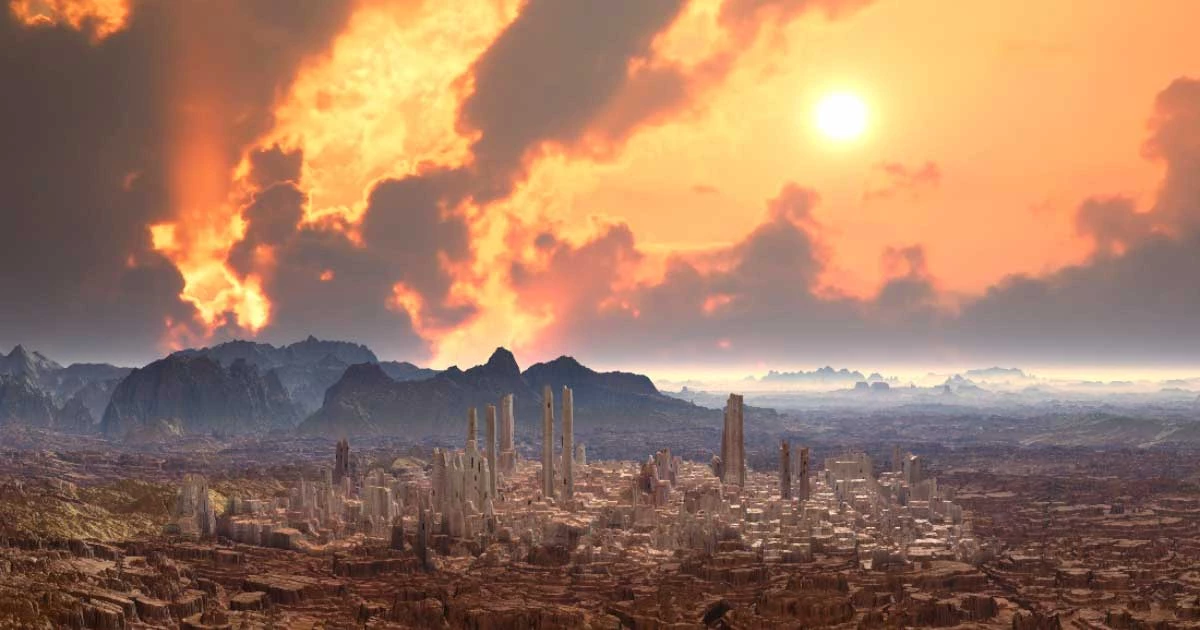
Few archaeological mysteries are as intriguing as the story of the Lost City of Kalahari. Unlike Atlantis, which supposedly vanished beneath the sea, or El Dorado, which was said to glitter with unimaginable gold, the Lost City of Kalahari is a mystery buried beneath endless dunes and vast stretches of African desert.
For more than a century, explorers, treasure hunters, historians, archaeologists, and adventurers have debated whether the city ever existed at all. Some believe it was a forgotten settlement built by an ancient civilization and later swallowed by shifting sands. Others argue it was nothing more than a natural rock formation misunderstood by excited travelers.
The mystery has inspired expeditions, books, newspaper headlines, and countless theories. Even today, no definitive evidence has solved the puzzle.
The story combines everything that makes a historical mystery irresistible: a remote desert, strange stone ruins, lost civilizations, vanished cultures, and the possibility that an important chapter of human history remains hidden beneath the sands of southern Africa.
The truth, however, is more complicated—and perhaps even more fascinating—than the legend itself.
Understanding the Kalahari Desert
To appreciate the mystery, it helps to understand the landscape where the legend was born.
The Kalahari Desert stretches across large portions of southern Africa, covering areas of modern-day Botswana, Namibia, and South Africa. Despite its name, the Kalahari is not a true desert everywhere. Some regions receive enough rainfall to support grasses, shrubs, and wildlife.
Yet much of the landscape remains harsh and unforgiving.
Red sand dunes stretch toward distant horizons. Temperatures can become extreme. Water is often scarce. Vast areas appear almost untouched by modern development.
The Kalahari possesses a unique beauty. Sunrises paint the dunes in brilliant shades of orange and gold. Acacia trees stand against endless skies. Lions, antelope, cheetahs, and other wildlife roam across the landscape.
At the same time, the environment can be deceptive.
Heat waves shimmer above the ground. Distances are difficult to judge. Rock formations appear and disappear in changing light. Mirages sometimes create convincing illusions.
Such conditions provide the perfect setting for legends to emerge.
The Explorer Who Started the Mystery
The modern story of the Lost City of Kalahari began in the late nineteenth century.
Its central figure was Canadian explorer and adventurer Guillermo Farini.
Farini was already known as a performer, entrepreneur, and traveler before his expedition into the Kalahari in 1885.
Accompanied by his son, Farini crossed sections of the desert and documented his journey. During the expedition, he claimed to have encountered something extraordinary.
According to his account, he discovered the remains of what appeared to be an ancient city.
Farini described seeing long rows of stone structures extending across the landscape. The formations appeared artificial rather than natural. He believed they resembled walls, roads, and ruined buildings.
To him, the site looked like the remnants of a lost civilization.
His observations would launch one of Africa’s most enduring archaeological mysteries.
Farini’s Description of the Ruins
Farini’s reports were remarkably detailed.
He described massive stone formations arranged in ways that seemed intentional. Some structures appeared to follow straight lines. Others seemed connected to one another.
The stones looked weathered and ancient.
Farini believed he was observing the remains of a large settlement that had existed long before European arrival in southern Africa.
He imagined an ancient city abandoned centuries earlier and gradually buried by shifting sands.
The explorer wrote enthusiastically about the discovery after returning from his journey. His descriptions captured public imagination.
Readers were fascinated.
How could a city exist in one of Africa’s most remote regions?
Who built it?
Why was it abandoned?
Why had nobody heard of it before?
These questions fueled excitement and speculation.
A Discovery That Captured the World’s Attention
The late nineteenth century was an era of exploration.
Large portions of Africa remained poorly documented by European explorers. Archaeological discoveries were transforming understanding of ancient civilizations around the world.
Egyptian monuments fascinated the public.
Mesopotamian ruins were revealing forgotten kingdoms.
Ancient cities were being uncovered in Asia and the Americas.
Against this backdrop, Farini’s discovery seemed entirely plausible.
Many people wondered whether southern Africa might also conceal unknown civilizations waiting to be rediscovered.
Newspapers reported the story.
Books discussed the possibility.
Explorers became eager to locate the mysterious ruins.
The Lost City of Kalahari quickly entered popular imagination.
The First Search Expeditions
After Farini publicized his discovery, numerous expeditions attempted to locate the city.
The challenge was enormous.
The Kalahari covers hundreds of thousands of square kilometers. Travel conditions were difficult. Navigation was often uncertain.
Farini’s descriptions of the location were not precise enough for future explorers to easily retrace his route.
Expeditions searched vast regions of desert.
Some travelers reported seeing unusual stone formations.
Others found nothing at all.
Year after year, search parties returned without definitive proof.
The city seemed to vanish as mysteriously as it had appeared.
This only deepened the legend.
A lost city that nobody could relocate sounded even more mysterious than one that had simply been discovered.
The Possibility of a Forgotten Civilization
For many years, some researchers considered the possibility that Farini had genuinely found ancient ruins.
Southern Africa possesses a rich archaeological history.
Long before European colonization, complex societies flourished across the region.
Powerful kingdoms emerged, traded goods over long distances, and built impressive settlements.
The most famous example is Great Zimbabwe.
Constructed between roughly the eleventh and fifteenth centuries, Great Zimbabwe includes massive stone walls and sophisticated architecture.
Its existence demonstrates that advanced stone-building traditions existed in southern Africa.
When Europeans first encountered Great Zimbabwe, many wrongly assumed local African societies could not have built such structures.
Modern archaeology proved otherwise.
This history encouraged some researchers to consider whether Farini’s city might represent another forgotten settlement.
The Challenge of Desert Archaeology
Searching for archaeological sites in deserts is notoriously difficult.
Sand constantly moves.
Wind reshapes landscapes.
Features visible one year may disappear the next.
Entire settlements can become buried beneath dunes.
In some cases, archaeological remains remain hidden for centuries before being exposed again by erosion.
The Sahara Desert contains numerous examples of ancient settlements and landscapes revealed only through modern research techniques.
Because of this, some investigators argued that Farini’s city might simply be buried beneath the Kalahari sands.
If true, locating it would require extensive exploration and perhaps considerable luck.
The Geological Explanation Emerges
As scientific understanding improved, many researchers began questioning Farini’s interpretation.
Geologists examined the types of rock formations found throughout the Kalahari.
They discovered that natural processes can create surprisingly artificial-looking structures.
Weathering, erosion, and geological fracturing sometimes produce formations resembling walls, roads, or foundations.
Certain rock ridges develop straight lines.
Others break into blocks that appear intentionally arranged.
From a distance, especially under unusual lighting conditions, these formations can look remarkably similar to human-made ruins.
This possibility offered a simpler explanation.
Perhaps Farini had genuinely seen something unusual.
But perhaps what he saw was not a city at all.
The Nature of Desert Illusions
Deserts are famous for creating visual illusions.
Heat causes light to bend in complex ways.
Mirages can make distant objects appear closer, larger, or differently shaped.
Rock formations may look like buildings.
Shadows can create the impression of walls and streets.
Human perception is especially vulnerable in unfamiliar environments.
The brain naturally seeks patterns.
When people encounter unusual landscapes, they often interpret them according to familiar experiences.
A line of rocks may resemble a wall.
A cluster of boulders may resemble ruins.
An isolated ridge may appear to be a fortress.
Many researchers suspect that this process contributed to the Lost City mystery.
Returning to Farini’s Route
Throughout the twentieth century, several expeditions attempted to reconstruct Farini’s original journey.
Researchers studied his journals, maps, photographs, and descriptions.
The goal was to identify exactly where he traveled and what he observed.
Some investigators concluded that Farini likely passed through regions containing unusual geological formations.
In particular, certain areas feature elongated rock ridges formed by natural processes.
These ridges can appear surprisingly architectural.
Viewed under specific conditions, they might easily be mistaken for ancient walls.
This interpretation gained increasing support among scientists.
The Importance of Farini’s Photographs
One of the most valuable pieces of evidence comes from photographs associated with Farini’s expedition.
Although photography in the nineteenth century was far less advanced than today, the images provide important clues.
Researchers have carefully examined these photographs.
Rather than revealing obvious archaeological ruins, the images appear consistent with natural rock formations.
The stones do not clearly display characteristics typically associated with human construction.
There are no unmistakable signs of masonry, carved blocks, or organized architecture.
While the photographs do not completely resolve the mystery, they support geological explanations more strongly than archaeological ones.
Could Farini Have Exaggerated?
Another possibility is that Farini unintentionally exaggerated what he saw.
Explorers often encounter exciting discoveries during difficult journeys.
Memories can become amplified over time.
Descriptions written after an expedition may emphasize dramatic aspects of an experience.
Farini was also a skilled showman and storyteller.
Creating public interest in his adventures may have encouraged colorful descriptions.
This does not necessarily mean he deliberately fabricated the discovery.
Rather, he may have sincerely believed he had found ruins while interpreting natural formations through the lens of excitement and expectation.
Human perception is rarely perfect.
Even experienced observers can make mistakes.
Ancient Human Activity in the Kalahari
Although evidence for the Lost City remains weak, the Kalahari does contain a rich human history.
People have lived in and around the region for thousands of years.
Archaeological discoveries reveal ancient campsites, stone tools, rock art, and evidence of long-term human occupation.
Indigenous communities developed sophisticated knowledge of the environment.
They understood seasonal water sources, plant resources, and animal behavior.
Their survival depended upon intimate familiarity with the landscape.
The Kalahari was never an empty wilderness.
It has been part of human history for millennia.
Recognizing this complexity is important because it reminds us that genuine archaeological discoveries in the region are entirely possible, even if Farini’s city remains unconfirmed.
The Role of Great Zimbabwe in the Debate
The discovery and study of Great Zimbabwe significantly influenced discussions about the Lost City.
Great Zimbabwe demonstrated that large stone settlements could exist in southern Africa.
The site contains impressive walls constructed without mortar, some reaching considerable heights.
When archaeologists confirmed its African origins, outdated assumptions about the continent’s history were challenged.
As a result, some researchers became more open to the possibility that additional archaeological sites might await discovery elsewhere.
However, Great Zimbabwe also highlighted an important difference.
Its ruins are unmistakably artificial.
The stonework displays clear signs of human construction.
In contrast, the alleged Kalahari ruins lack such definitive evidence.
The comparison ultimately weakened claims for the Lost City rather than strengthening them.
Twentieth-Century Expeditions
The twentieth century saw repeated efforts to settle the mystery.
Researchers, adventurers, and amateur explorers organized numerous expeditions.
Some hoped to find evidence supporting Farini’s claims.
Others sought to disprove them.
Despite advances in mapping and transportation, no expedition uncovered a city matching Farini’s description.
Occasionally, searchers reported unusual formations.
These reports generated temporary excitement.
Yet detailed investigation consistently failed to produce convincing archaeological evidence.
The pattern repeated again and again.
The city seemed always to remain just beyond reach.
Modern Technology Enters the Search
The arrival of modern technology transformed archaeological exploration.
Satellite imagery allowed researchers to examine vast regions from space.
Aerial surveys revealed hidden landscapes.
Geographic information systems improved mapping accuracy.
Ground-penetrating radar provided new ways to investigate buried features.
These tools revolutionized archaeology worldwide.
Lost cities were identified in dense jungles.
Ancient roads emerged beneath vegetation.
Previously unknown settlements appeared in remote regions.
Naturally, some researchers hoped modern technology would finally locate the Lost City of Kalahari.
Yet despite these advances, no evidence of a large buried city has emerged.
What Archaeologists Look For
Archaeologists do not identify ancient cities solely by walls or stone structures.
Human settlements leave many kinds of evidence.
Pottery fragments accumulate over time.
Tools are discarded.
Animal bones reveal dietary practices.
Fireplaces leave traces.
Burials provide cultural information.
Trade goods indicate connections with other regions.
Large settlements typically generate enormous amounts of archaeological material.
If a significant city once existed in the Kalahari, researchers would expect to find at least some of these indicators.
To date, no such evidence has been discovered in connection with Farini’s supposed ruins.
This absence remains one of the strongest arguments against the city hypothesis.
Why the Mystery Refuses to Die
Despite the lack of convincing evidence, the Lost City continues to fascinate.
Part of the appeal lies in uncertainty.
The mystery is not completely solved.
Although geological explanations are widely accepted, absolute proof remains elusive.
There is also the romance of exploration.
People are naturally drawn to stories about hidden places.
Lost cities represent forgotten worlds waiting to be rediscovered.
They promise adventure, discovery, and the possibility of rewriting history.
The Kalahari itself enhances the legend.
Its immense size and remote character create a sense that secrets could still be hidden beneath its sands.
Lessons About Human Curiosity
The Lost City story reveals something important about human nature.
People are explorers by instinct.
We seek mysteries.
We ask questions.
We imagine possibilities beyond what is immediately visible.
Many great discoveries began with stories that seemed unlikely.
Sometimes legends contain historical truths.
Sometimes they do not.
The challenge lies in investigating them carefully.
Science does not dismiss mysteries simply because they seem improbable.
Instead, it examines evidence, tests ideas, and follows facts wherever they lead.
The Lost City of Kalahari illustrates this process beautifully.
The Current Scientific View
Today, most archaeologists and geologists agree on a general conclusion.
The evidence strongly suggests that Farini observed natural rock formations rather than the ruins of a lost city.
Geological processes can explain the structures he described.
Repeated searches have failed to uncover archaeological evidence.
Modern investigations have not identified buried urban remains.
This consensus does not mean the mystery lacks value.
On the contrary, the story remains a fascinating case study in exploration, perception, and scientific investigation.
It demonstrates how easily natural landscapes can inspire legends.
It also shows how science gradually evaluates extraordinary claims through evidence and careful analysis.
A Desert Legend That Endures
Even if the Lost City never existed, its story remains remarkable.
For more than a century, it has inspired journeys across some of Africa’s most challenging landscapes.
It has encouraged research into archaeology, geology, and desert environments.
It has sparked countless conversations about forgotten civilizations and hidden histories.
The legend survives because it captures a timeless dream: the possibility that somewhere beyond the horizon lies a discovery waiting to change everything we know.
Conclusion
The mystery of the Lost City of Kalahari stands at the fascinating boundary between legend and science. Born from the observations of explorer Guillermo Farini in 1885, the story has inspired generations of adventurers, researchers, and dreamers. Reports of ancient stone ruins hidden within the Kalahari Desert created visions of a forgotten civilization swallowed by sand and time.
Yet more than a century of investigation has produced no convincing evidence that such a city ever existed. Geological studies suggest that the formations Farini observed were most likely natural rock structures shaped by erosion and weathering. Archaeological searches have failed to uncover the artifacts, buildings, or cultural remains expected from a substantial ancient settlement.
Still, the legend remains powerful.
The Lost City of Kalahari reminds us that exploration is not only about finding answers. It is also about asking questions. It reflects humanity’s enduring fascination with hidden worlds, vanished cultures, and mysteries waiting to be solved. Whether the city was real or merely a desert mirage, its story continues to inspire curiosity and wonder.
And perhaps that is why the legend survives. In the vast silence of the Kalahari, where red dunes stretch endlessly toward distant horizons, it is easy to imagine that somewhere beneath the shifting sands, history still holds secrets not yet revealed.