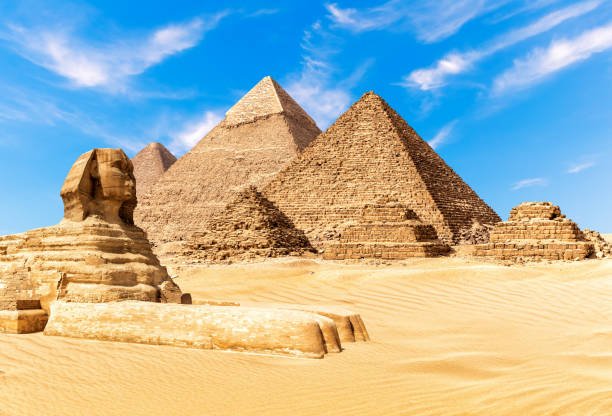
For more than 4,500 years, the Great Pyramid of Giza has stood silently on the edge of the Egyptian desert, watching civilizations rise and fall. It has survived wars, earthquakes, invasions, sandstorms, and the relentless passage of time. Millions of people have gazed at its enormous stone blocks and wondered the same thing: what secrets are still hidden inside?
The Great Pyramid is one of the most famous structures ever built. It is the last surviving wonder of the ancient world and perhaps the most mysterious monument humanity has ever created. Despite centuries of exploration, archaeologists have never completely understood its internal design. Hidden passages, sealed spaces, unexplained shafts, and strange architectural features have continued to raise questions.
For generations, treasure hunters, explorers, historians, and scientists suspected that undiscovered chambers might still exist deep within the pyramid. Some imagined hidden tombs filled with gold. Others dreamed of secret archives containing lost knowledge from ancient Egypt. A few even proposed fantastical theories involving aliens or forgotten civilizations.
Most of those dramatic ideas lacked evidence. Yet one possibility remained very real: there could indeed be unknown spaces hidden inside the Great Pyramid.
In recent years, modern technology finally allowed researchers to look inside the pyramid without dismantling a single stone. What they discovered was both exciting and mysterious. The findings confirmed that the Great Pyramid still holds secrets. But instead of providing all the answers, those discoveries created even more questions.
The story of the hidden chambers is not merely about ancient architecture. It is a story of curiosity, science, patience, and the enduring human desire to understand the past.
The Monument That Defied Time
The Great Pyramid was built during the reign of the Egyptian pharaoh Khufu around 2560 BCE.
When it was completed, it stood approximately 146 meters tall, making it the tallest human-made structure on Earth for nearly four thousand years.
The pyramid contains an estimated 2.3 million stone blocks. Some weigh several tons, while the largest blocks used inside the structure can weigh more than seventy tons.
Even today, archaeologists continue to debate certain aspects of its construction. Although researchers have developed strong theories about how the pyramid was built, the project remains one of the greatest engineering achievements in human history.
The structure dominates the Giza Plateau, where it stands alongside two other large pyramids and the famous Great Sphinx of Giza.
For centuries, visitors assumed the pyramid had already revealed its secrets. Yet the deeper researchers looked, the more mysteries emerged.
The Known Interior of the Great Pyramid
Unlike many Egyptian pyramids, the Great Pyramid contains a surprisingly complex internal structure.
Visitors who enter the pyramid encounter a series of corridors and chambers that appear carefully planned.
The Descending Passage leads downward into the bedrock beneath the pyramid. At the end lies the Subterranean Chamber, an unfinished room carved into the rock.
Another passage leads upward into the heart of the monument. This route reaches the Grand Gallery, one of the most impressive architectural spaces in the ancient world.
The Grand Gallery rises dramatically toward the King’s Chamber, a room constructed from enormous granite blocks. Inside stands an empty granite sarcophagus.
Below the King’s Chamber lies the Queen’s Chamber, another mysterious room whose purpose remains debated.
These spaces have been known for centuries. Yet archaeologists always suspected there might be more hidden beyond the visible chambers.
The pyramid simply seemed too complex to have revealed everything.
Early Searches for Secret Rooms
The search for hidden chambers began long before modern archaeology existed.
Ancient visitors explored the pyramid. Medieval travelers entered it. Later explorers mapped its corridors and chambers.
Throughout history, rumors circulated about secret rooms concealed behind walls.
Some explorers believed hidden treasures remained untouched.
Others suspected that the true burial chamber of Khufu had never been found.
The problem was obvious. Searching for hidden spaces usually required drilling, digging, or removing stones. Such methods risked damaging one of humanity’s most important monuments.
As a result, archaeologists faced a difficult challenge.
How could they look inside the pyramid without destroying it?
For centuries, no satisfactory solution existed.
A New Era of Archaeology
Everything changed with the development of modern scanning technologies.
Scientists began using methods that allowed them to investigate ancient structures without physically opening them.
Ground-penetrating radar, infrared thermography, laser mapping, and advanced computer modeling transformed archaeology.
Researchers could suddenly see things that previous generations never could.
The Great Pyramid became an ideal candidate for these new techniques.
Its enormous size and mysterious architecture made it one of the most exciting archaeological targets on Earth.
Scientists hoped that modern technology might finally reveal whether hidden chambers truly existed.
The results would exceed expectations.
The ScanPyramids Project
In 2015, an international team launched an ambitious scientific initiative known as the ScanPyramids project.
Their goal was simple yet revolutionary.
They wanted to investigate Egypt’s pyramids using non-invasive techniques.
Rather than drilling through walls or removing stones, they would scan the structures using advanced technology.
The project brought together experts in physics, engineering, architecture, and archaeology.
Their approach combined multiple methods, including infrared analysis and particle detection.
Most importantly, they employed a remarkable technique known as muon tomography.
This method would lead to one of the most important discoveries ever made inside the Great Pyramid.
The Science of Muons
At first glance, muon tomography sounds like science fiction.
In reality, it is based on fundamental physics.
Muons are tiny particles constantly produced when cosmic rays strike Earth’s atmosphere.
Billions of them pass through our bodies every day without causing harm.
These particles can penetrate stone, making them extremely useful for studying large structures.
When muons travel through solid material, some are absorbed while others continue moving.
By measuring how many muons pass through different areas, scientists can detect hidden voids.
Dense stone blocks block more particles.
Empty spaces allow more particles to pass through.
This creates a kind of X-ray image of massive structures.
The technique has been used to study volcanoes, geological formations, and archaeological sites.
For the Great Pyramid, it offered an unprecedented opportunity to search for hidden chambers.
The First Surprising Results
As researchers collected muon data, unusual patterns began appearing.
Certain areas inside the pyramid seemed to contain less stone than expected.
At first, scientists remained cautious.
Unexpected signals can sometimes result from measurement errors or natural variations in construction.
Additional observations were necessary.
More detectors were installed.
More data was gathered.
The mysterious signals persisted.
Something inside the pyramid was producing them.
The evidence increasingly suggested the existence of a previously unknown void.
The possibility that a major hidden space had remained undiscovered for more than four millennia captured worldwide attention.
Discovery of the Big Void
In 2017, researchers announced a groundbreaking discovery.
The data revealed a large hidden space located above the Grand Gallery.
This feature became known as the Big Void.
The void appeared to be at least thirty meters long.
Its exact shape remained uncertain, but it represented one of the most significant discoveries inside the pyramid since the nineteenth century.
The announcement made headlines around the world.
For decades, many experts had assumed the pyramid’s interior was largely understood.
Now evidence suggested that a substantial hidden space had escaped detection for thousands of years.
The finding confirmed what many had suspected.
The Great Pyramid still contained secrets.
Why the Discovery Was So Important
The discovery of the Big Void was not exciting merely because it was a hidden space.
Its significance lay in its size and location.
A void thirty meters long is not a tiny construction gap.
It represents a major architectural feature.
The chamber sits above the Grand Gallery, one of the pyramid’s most important internal structures.
This placement suggests that the void may have played a meaningful role in the monument’s design.
Yet researchers still do not know exactly what that role was.
Was it an undiscovered chamber?
A structural feature?
A symbolic architectural element?
A construction space?
Each possibility carries different implications for understanding how the pyramid was built.
What Does the Big Void Look Like?
One of the most frustrating aspects of the discovery is that scientists cannot yet directly enter the void.
The muon data reveals its existence but does not provide a complete visual image.
Researchers can estimate its dimensions and location, but many details remain uncertain.
The void may resemble another large corridor.
It could consist of multiple connected spaces.
It might contain architectural features unlike anything previously found inside the pyramid.
Until direct observations become possible, many questions will remain unanswered.
This uncertainty has fueled both scientific debate and public fascination.
What the Void Is Probably Not
Whenever a major archaeological discovery occurs, sensational theories quickly appear.
The Big Void was no exception.
Some people immediately claimed it contained hidden treasures.
Others suggested lost libraries, advanced technology, or evidence of forgotten civilizations.
Professional archaeologists remain skeptical of such ideas.
The available evidence does not support extraordinary claims.
There is currently no indication that the void contains treasure.
There is no evidence for secret knowledge hidden inside.
There is certainly no evidence for alien involvement.
Scientists prefer explanations grounded in known ancient Egyptian practices.
The real mystery is fascinating enough without adding unsupported speculation.
Understanding Ancient Egyptian Engineering
To appreciate the importance of hidden spaces, it helps to understand how Egyptian builders designed large structures.
The Great Pyramid is not simply a giant pile of stones.
It is a carefully engineered monument.
Ancient architects had to manage enormous loads created by millions of tons of stone.
Pressure distribution was a critical challenge.
In several areas of the pyramid, builders created relieving chambers designed to reduce stress on important rooms.
The King’s Chamber provides a famous example.
Above it are multiple chambers intended to redirect weight away from the ceiling.
Some researchers believe the Big Void could represent another structural feature designed to manage pressure.
If true, it would demonstrate an even greater level of engineering sophistication than previously recognized.
The Mystery of the Queen’s Chamber Shafts
The Big Void is not the only mystery inside the pyramid.
For decades, archaeologists have been fascinated by narrow shafts extending from the Queen’s Chamber.
These small passages were discovered in the nineteenth century.
Unlike ordinary corridors, they are too narrow for people to enter.
Their purpose remains uncertain.
Some scholars believe they had symbolic significance related to the pharaoh’s journey into the afterlife.
Others suspect practical functions during construction.
Robotic explorations have revealed small doors and hidden spaces within these shafts.
Each discovery has generated new questions.
The shafts demonstrate how much remains unknown about the pyramid’s interior.
Tiny Robots and Hidden Spaces
Because many passages are too small for humans, researchers increasingly rely on robotic technology.
Specialized robots equipped with cameras can travel through narrow openings.
These machines have explored spaces inaccessible to traditional investigators.
Robotic missions have produced remarkable images from deep inside the pyramid.
They have revealed hidden cavities, stone doors, and construction details never before seen.
The use of robotics represents a major shift in archaeology.
Rather than damaging ancient structures, scientists can now investigate them with minimal disturbance.
This approach has greatly expanded our ability to study the Great Pyramid.
The Newly Identified Corridor
In 2023, another exciting discovery emerged.
Researchers identified a hidden corridor near the pyramid’s northern entrance.
The corridor measured approximately nine meters long.
Unlike the Big Void, this space was directly observed using modern imaging techniques.
The discovery demonstrated once again that hidden spaces remain concealed within the monument.
The corridor’s purpose is still being investigated.
Some experts believe it may have helped distribute weight around the entrance.
Others suggest additional functions remain possible.
Regardless of its purpose, the finding reinforced an important lesson.
The Great Pyramid is not yet fully understood.
Why Hidden Chambers Matter
To some people, discovering empty spaces may seem less exciting than uncovering treasure.
For archaeologists, however, hidden chambers can be incredibly important.
Every new space provides information about how ancient builders thought.
Architecture reflects decisions.
Those decisions reveal intentions.
By understanding why a chamber exists, researchers gain insight into construction methods, religious beliefs, engineering principles, and cultural priorities.
A hidden chamber can transform historical understanding even if it contains nothing at all.
Sometimes an empty room tells a richer story than a room filled with artifacts.
The Dream of Khufu’s Lost Burial Chamber
One enduring theory suggests that Khufu’s actual burial chamber remains undiscovered.
The known King’s Chamber contains an empty sarcophagus.
No mummy was found there.
No obvious funerary treasures survived.
This absence has encouraged speculation.
Could another chamber exist somewhere deeper within the pyramid?
Could the pharaoh’s true resting place remain hidden?
Most Egyptologists consider this possibility unlikely but not impossible.
No evidence currently supports the existence of a secret royal tomb.
Yet the discovery of previously unknown spaces reminds researchers to remain open-minded.
The pyramid has surprised us before.
It may do so again.
Why Ancient Egypt Still Captivates Us
Part of the fascination surrounding hidden chambers comes from the broader appeal of ancient Egypt.
Egyptian civilization feels both familiar and mysterious.
Its people built cities, created art, practiced medicine, and developed complex systems of government.
Yet they also left behind monuments that seem almost timeless.
The pyramids inspire awe because they connect us directly to people who lived nearly fifty centuries ago.
Every new discovery makes that connection stronger.
When researchers uncover a hidden corridor or previously unknown void, they are not merely finding empty space.
They are opening another window into the minds of ancient builders.
The Challenges Ahead
Despite remarkable advances, investigating hidden spaces remains difficult.
The Great Pyramid is a protected archaeological treasure.
Any exploration must balance scientific curiosity with preservation.
Researchers cannot simply break through walls to satisfy curiosity.
Every action must be carefully planned and justified.
This cautious approach can be frustrating.
The world wants immediate answers.
Science often moves more slowly.
Yet preserving the monument is essential.
Future generations deserve the opportunity to study it as well.
Could More Chambers Still Exist?
One of the most exciting possibilities is that additional hidden spaces remain undiscovered.
The pyramid contains millions of stone blocks arranged in complex patterns.
Even advanced scanning technologies have limitations.
Smaller voids may still escape detection.
Certain regions remain difficult to investigate.
As technology improves, researchers may identify features invisible today.
History suggests caution before declaring the pyramid fully explored.
Again and again, discoveries have proven assumptions wrong.
The monument continues to reveal surprises.
Separating Mystery from Myth
The Great Pyramid has inspired countless myths.
Some involve lost civilizations.
Others involve supernatural powers or extraterrestrial builders.
Scientific discoveries sometimes become entangled with these claims.
It is important to distinguish evidence from speculation.
The hidden chambers discovered so far are genuine scientific findings.
They result from rigorous investigation and careful analysis.
The mysteries are real.
The evidence is real.
But the most extraordinary explanations often lack support.
The true story is compelling precisely because it relies on facts rather than fantasy.
Ancient Egyptians achieved remarkable things through human ingenuity, organization, and skill.
That achievement is extraordinary enough.
What We Have Really Found
So what have we actually found inside the Great Pyramid?
We have found evidence that hidden spaces exist.
We have discovered the massive Big Void above the Grand Gallery.
We have identified previously unknown corridors.
We have confirmed that parts of the pyramid remain unexplored.
We have gained new insights into ancient engineering.
Most importantly, we have learned that one of the world’s most studied monuments still contains secrets.
That realization is both humbling and inspiring.
Conclusion
The hidden chambers of the Great Pyramid remind us that history is never truly finished. Even after centuries of exploration, one of humanity’s most famous monuments continues to surprise us. Through technologies unimaginable to the ancient builders, modern scientists have revealed previously unknown spaces concealed within the pyramid’s stone heart.
The discovery of the Big Void and other hidden features has transformed our understanding of the monument. Yet these findings have not solved the mystery of the Great Pyramid. Instead, they have opened new chapters in a story that is still unfolding.
We do not yet know the exact purpose of every hidden space. We do not know whether more chambers remain undiscovered. We cannot say with certainty what future investigations will reveal.
What we do know is that the Great Pyramid remains one of the most extraordinary achievements in human history. It continues to challenge assumptions, inspire research, and capture imaginations across the globe.
More than 4,500 years after its construction, the Great Pyramid still guards its secrets. And somewhere within its vast network of stone passages and hidden voids, the next great discovery may already be waiting.