Few objects in human history have inspired as much fascination, devotion, skepticism, and scientific investigation as the Shroud of Turin.
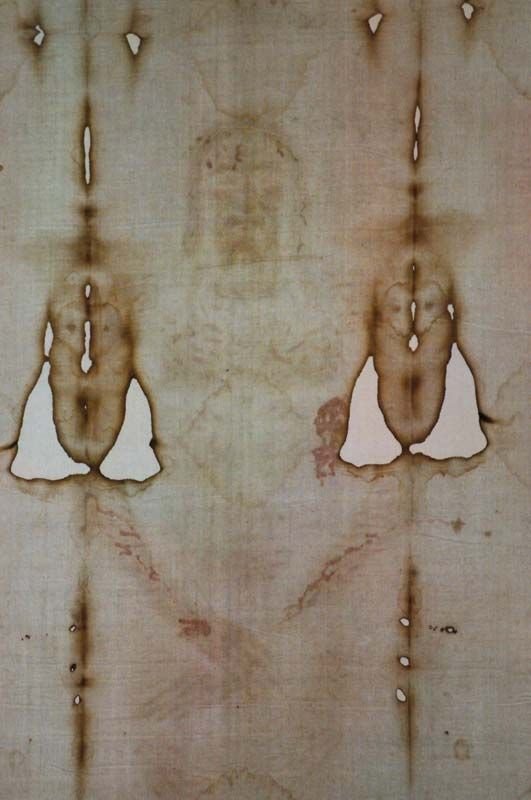
At first glance, it appears to be an ordinary piece of ancient linen—a long, yellowed cloth marked by age, stains, burns, and repairs. Yet a closer look reveals something extraordinary. Faintly visible across its surface is the image of a man bearing wounds remarkably similar to those described in the New Testament accounts of the crucifixion of Jesus Christ.
For millions of Christians, the Shroud is the authentic burial cloth that wrapped Jesus after his death before His resurrection. To them, it is not merely an archaeological artifact but one of the holiest relics in existence—a silent witness to one of history’s most significant events.
To many historians and scientists, however, the cloth presents a different mystery. Radiocarbon dating performed in 1988 suggested that the linen originated during the Middle Ages, centuries after the lifetime of Jesus. If correct, the Shroud could be one of history’s most remarkable religious creations rather than a relic from first-century Judea.
More than a century of scientific research has complicated the debate rather than settling it. Every major study seems to answer one question while raising several new ones. Chemists, physicists, textile experts, historians, forensic pathologists, archaeologists, imaging specialists, and theologians continue to examine the cloth, often reaching dramatically different conclusions.
Is the Shroud of Turin truly the burial garment of Jesus?
Or is it an ingenious medieval masterpiece unlike anything else ever created?
The answer remains one of history’s greatest unresolved mysteries.
What Is the Shroud of Turin?
The Shroud of Turin is a rectangular linen cloth measuring approximately 4.4 meters (14.5 feet) long and 1.1 meters (3.5 feet) wide.
Its most striking feature is the faint front-and-back image of a naked man with crossed hands, long hair, a beard, and numerous apparent injuries.
The image appears as though the body had been laid on one half of the cloth while the other half folded over the head and torso.
Visible wounds include marks on the wrists and feet resembling crucifixion injuries, numerous small punctures around the scalp suggestive of a crown of thorns, injuries consistent with scourging across the body, a large wound in the side, and bloodstains that appear to correspond with these injuries.
The cloth also bears evidence of centuries of wear. It contains water stains, burn holes from a fire that damaged it in 1532, patches added during later repairs, and countless signs of aging.
Today, the Shroud is preserved in the Cathedral of Saint John the Baptist in Turin, Italy, where it is kept under carefully controlled environmental conditions.
Why Is the Shroud Connected to Jesus?
The connection comes from descriptions found in the New Testament.
According to the Gospels, after Jesus died on the cross, His body was wrapped in linen cloth before being placed in a tomb.
The injuries visible on the Shroud correspond in several respects to crucifixion as described in the Gospels.
The figure appears to have suffered extensive scourging.
Blood appears around the scalp.
There are wounds in the wrists and feet.
A large side wound is visible.
Because of these similarities, believers have long proposed that the Shroud is the actual burial cloth mentioned in the biblical accounts.
However, the Bible does not describe any miraculous image appearing on the cloth itself.
The image is what makes the Shroud unique.
The Earliest Historical Record
One of the central questions surrounding the Shroud is its history.
Reliable historical documentation places the cloth in the mid-fourteenth century in Lirey, France, where it was displayed publicly by the French knight Geoffroi de Charny.
Before this point, the historical trail is uncertain.
Some researchers argue that the Shroud can be linked to earlier relics or historical references, including the Image of Edessa or other Byzantine objects, but these proposed connections remain debated and have not been universally accepted by historians.
The lack of an unbroken documentary record from the first century to the Middle Ages is one of the strongest arguments raised by skeptics.
Supporters counter that many ancient relics disappeared during periods of war, persecution, iconoclasm, and political instability.
The missing centuries remain one of the largest gaps in the Shroud’s story.
The Image That Should Not Exist
The Shroud’s greatest mystery is not its age.
It is the image itself.
Unlike ordinary paintings, the image possesses unusual characteristics.
The coloration affects only the outermost fibers of the linen.
There is no obvious evidence that pigments fully account for the body image, although traces of pigments have been reported in some studies and interpreted differently by different researchers.
The image has no clear brush strokes.
It is extremely faint.
Viewed closely, it almost disappears.
Viewed from several meters away, it becomes remarkably clear.
Even more surprising, the image behaves almost like a photographic negative.
The Discovery That Changed Everything
For centuries, observers simply saw a faint brown image.
Everything changed in 1898.
Italian amateur photographer Secondo Pia photographed the Shroud during a public exhibition.
When he developed the photographic negative, he experienced a startling surprise.
The negative revealed a detailed positive-looking portrait with remarkable clarity.
Features barely visible to the naked eye suddenly became vivid.
Muscles.
Facial expressions.
Bloodstains.
Hair.
The image seemed to function as though the cloth itself already contained a photographic negative centuries before photography existed.
The discovery transformed the Shroud from a religious relic into a scientific mystery.
Could Medieval Artists Have Created It?
If the Shroud is a forgery, someone created it.
But how?
This question has puzzled researchers for generations.
Medieval artists certainly possessed great skill.
However, reproducing the Shroud presents unusual challenges.
The image contains no obvious directional brush strokes.
It lacks significant pigment penetration into the fibers.
The coloration affects only a very thin layer on the surface of the linen fibers.
The shading appears related to the density of colored fibers rather than differences in pigment thickness.
Numerous experiments have attempted to recreate similar images using paint, heated sculptures, chemical reactions, rubbing techniques, powdered pigments, photography, and other methods.
Many have produced images resembling certain aspects of the Shroud.
None has replicated all of its observed characteristics simultaneously to the satisfaction of all researchers.
This does not prove supernatural origins.
Nor does it prove medieval authorship.
It simply illustrates the complexity of the artifact.
The 1978 Scientific Investigation
In 1978, one of the largest scientific examinations ever conducted on the Shroud took place.
A multidisciplinary group known as the Shroud of Turin Research Project (STURP) spent approximately five days studying the cloth using numerous non-destructive analytical techniques.
Researchers included physicists, chemists, engineers, image analysts, and other specialists.
Their investigations produced thousands of photographs and extensive measurements.
The team concluded that the body image was not readily explained as a conventional painting. They also reported that they did not identify sufficient evidence to classify the image as a typical artistic creation.
However, STURP did not determine how the image formed.
Their conclusion was straightforward.
The mechanism responsible remained unknown.
This finding continues to fuel debate today.
Blood or Paint?
The reddish stains visible on the cloth have received enormous attention.
Some researchers have interpreted them as genuine blood, citing chemical and microscopic analyses that detected components consistent with blood, including iron associated with hemoglobin and other blood-related compounds.
Other researchers argue that contamination, degradation over centuries, or methodological limitations complicate these interpretations. Some have also suggested that pigments or other materials may contribute to the appearance of the stains.
There is no universal agreement regarding every chemical finding.
Nevertheless, many studies distinguish the reddish stains from the body image itself, suggesting they may have formed through different processes.
The Forensic Evidence
Forensic pathologists have examined the injuries visible on the Shroud.
Many note that they are broadly consistent with Roman crucifixion practices known from archaeology and historical sources.
The wrist wounds correspond to locations that could support the weight of a crucified body.
The numerous scourge marks resemble injuries produced by Roman whips.
The side wound appears consistent with penetration by a spear-like weapon.
Blood flow patterns generally align with gravity acting on a suspended body.
Supporters argue that these details would have been unusually accurate for many medieval artists, given the limited anatomical knowledge of the period.
Critics caution that interpretations of the image are inherently uncertain and that artistic representations could also incorporate knowledge drawn from religious tradition.
The Radiocarbon Dating Controversy
Perhaps no scientific study has generated more debate than the radiocarbon dating performed in 1988.
Small samples were removed from one corner of the cloth and independently analyzed by laboratories in Oxford, Zurich, and Tucson.
The results were remarkably consistent.
The linen was dated to approximately AD 1260–1390.
If accurate, the Shroud originated during the medieval period.
The announcement made headlines worldwide.
Many considered the mystery solved.
Yet controversy soon followed.
Some researchers argued that the sampled area may not have represented the original cloth. They proposed that it could have contained later repairs or contamination from centuries of handling, smoke, microorganisms, or conservation treatments.
Others disputed these claims, maintaining that the dating was conducted according to accepted scientific standards and that contamination sufficient to shift the date by more than a millennium would be extremely difficult to demonstrate.
To date, no new full radiocarbon dating campaign has been carried out using fresh samples from multiple areas of the cloth.
As a result, debate over the 1988 results continues.
The Pollen Evidence
Some studies have reported pollen grains on the Shroud that are consistent with plants found in the Middle East as well as Europe.
Supporters argue that this could indicate the cloth spent time in regions associated with the life of Jesus before arriving in Europe.
However, pollen analysis has been criticized because the methods used, the possibility of contamination, and the chain of custody of some samples have all been questioned.
Consequently, pollen evidence alone cannot establish the Shroud’s origin.
The Weave of the Linen
Textile specialists have examined the linen itself.
The cloth is woven in a three-to-one herringbone twill pattern.
Such weaving techniques were known in antiquity but were relatively uncommon compared with simpler weaves.
Some researchers argue that the textile is compatible with ancient production.
Others note that similar weaving techniques also existed during the medieval period.
Therefore, the weave alone cannot determine the cloth’s age.
The Mystery of the Three-Dimensional Image
One of the Shroud’s most unusual characteristics emerged during image analysis in the 1970s.
When researchers processed photographs of the image using devices designed to interpret brightness as elevation, the Shroud produced a three-dimensional relief unlike ordinary photographs or paintings.
Although the effect does not represent a true three-dimensional map of a human body, image intensity correlates with distance in a way that differs from conventional artwork.
Exactly why this occurs remains uncertain.
Whatever created the image appears to have encoded information differently than ordinary paintings.
Could Heat Have Created the Image?
Some experiments suggest heat can discolor linen fibers in ways resembling parts of the Shroud image.
Hot statues pressed against cloth can create superficial coloration.
However, such methods generally produce distortions, deeper fiber damage, or different microscopic characteristics compared with the Shroud.
While heat-based mechanisms remain subjects of research, no experiment has reproduced all observed properties.
Chemical Explanations
Other scientists propose that chemical reactions involving carbohydrates, impurities on linen fibers, or gases released during decomposition might have generated the image.
These hypotheses are attractive because they rely on known natural processes.
However, they also face challenges.
Many do not fully explain the image’s resolution, superficial coloration, or other distinctive features.
Research continues.
Claims of Radiation
Some supporters of authenticity have suggested that an intense burst of radiant energy during the Resurrection formed the image.
This idea is often discussed in popular media.
However, there is currently no scientific evidence demonstrating that such an event occurred or that it produced the Shroud image.
Because the proposed mechanism cannot presently be tested directly, it remains a theological or speculative hypothesis rather than an established scientific explanation.
Science can study the cloth itself.
It cannot evaluate supernatural events.
Faith and Science
Perhaps the most fascinating aspect of the Shroud is how it exists at the intersection of science and faith.
Science asks measurable questions.
How old is the cloth?
What chemicals are present?
How was the image formed?
Can experiments reproduce it?
Faith asks different questions.
Does the Shroud strengthen belief?
Does it inspire reflection on the life and death of Jesus?
Could an authentic relic ever prove a religious event?
These are not identical questions.
Even if the Shroud were conclusively shown to date from the first century, it would not by itself prove that it wrapped Jesus specifically. Likewise, if it were conclusively shown to be medieval, that would not determine the truth or falsity of Christian beliefs, which do not depend on the authenticity of any single relic.
Understanding this distinction is essential.
Why the Mystery Endures
Many historical mysteries eventually disappear.
New evidence emerges.
Old questions are answered.
The Shroud has followed the opposite path.
Every technological advance reveals new details while exposing new uncertainties.
Better microscopes produce more questions.
Improved imaging reveals unexpected features.
New chemical analyses inspire competing interpretations.
Instead of narrowing the debate, scientific progress has often made the mystery more complex.
That is one reason public fascination has endured for more than a century.
Conclusion
The Shroud of Turin remains one of the most intensely studied artifacts ever examined. It occupies a unique place where archaeology, history, forensic science, chemistry, physics, theology, and human curiosity all converge.
Some evidence appears compatible with an ancient origin, while other evidence—most notably the published radiocarbon dating results from 1988—has pointed toward a medieval date. Both lines of evidence have been scrutinized extensively, and neither has ended the debate. As a result, there is no broad scientific consensus that the Shroud is definitively the burial cloth of Jesus, nor is there universal agreement that every question surrounding its origin has been resolved.
For believers, the Shroud may serve as a profound symbol of faith regardless of its ultimate age. For skeptics, it remains an extraordinary historical object deserving careful investigation. For scientists, it is an enduring puzzle that challenges analytical methods and invites further research.
Whether it is the authentic burial cloth of Jesus, an exceptional medieval creation, or something whose full story has yet to be uncovered, the Shroud of Turin continues to remind us that history still contains mysteries capable of inspiring wonder, debate, and the relentless pursuit of truth.