Some archaeological discoveries reveal their secrets almost immediately. A buried city may expose the lives of its former inhabitants. A royal tomb may identify the ruler who once rested within it. An ancient inscription may tell a story preserved across centuries.
Then there are discoveries like the Phaistos Disc.
More than a century after its discovery, this small clay object continues to resist every serious attempt to understand it. It has been examined by linguists, archaeologists, historians, cryptographers, and computer scientists. Countless theories have been proposed. Entire books have been written about it. Yet nobody can say with confidence what it means.
The Phaistos Disc is one of the most famous unsolved puzzles of the ancient world. Covered with strange symbols arranged in a spiral pattern, it appears to contain a message from a civilization that vanished thousands of years ago. The problem is that nobody knows how to read it.
The mystery is both frustrating and fascinating. Somewhere within those carefully impressed symbols may be a prayer, a law, a poem, a religious text, a calendar, a historical record, or something entirely unexpected. For more than a hundred years, scholars have searched for answers, only to find themselves facing more questions.
The Phaistos Disc remains one of humanity’s most enduring archaeological enigmas—a silent voice from antiquity that refuses to reveal its story.
The Discovery That Shocked Archaeology
The story begins in the summer of 1908 on the Mediterranean island of Crete.
At the time, archaeologists were intensely interested in uncovering the remains of the ancient Minoan civilization. This Bronze Age culture flourished on Crete long before classical Greece emerged. The Minoans built impressive palaces, created sophisticated art, and developed systems of writing that remain only partially understood today.
Italian archaeologist Luigi Pernier was excavating the ruins of the ancient palace complex at Phaistos when he made an extraordinary discovery.
Among the remains of a building near the palace, workers uncovered a circular clay disc unlike anything previously found.
At first glance, it seemed unusual but not necessarily revolutionary. As archaeologists examined it more closely, however, they realized they were looking at something entirely unique.
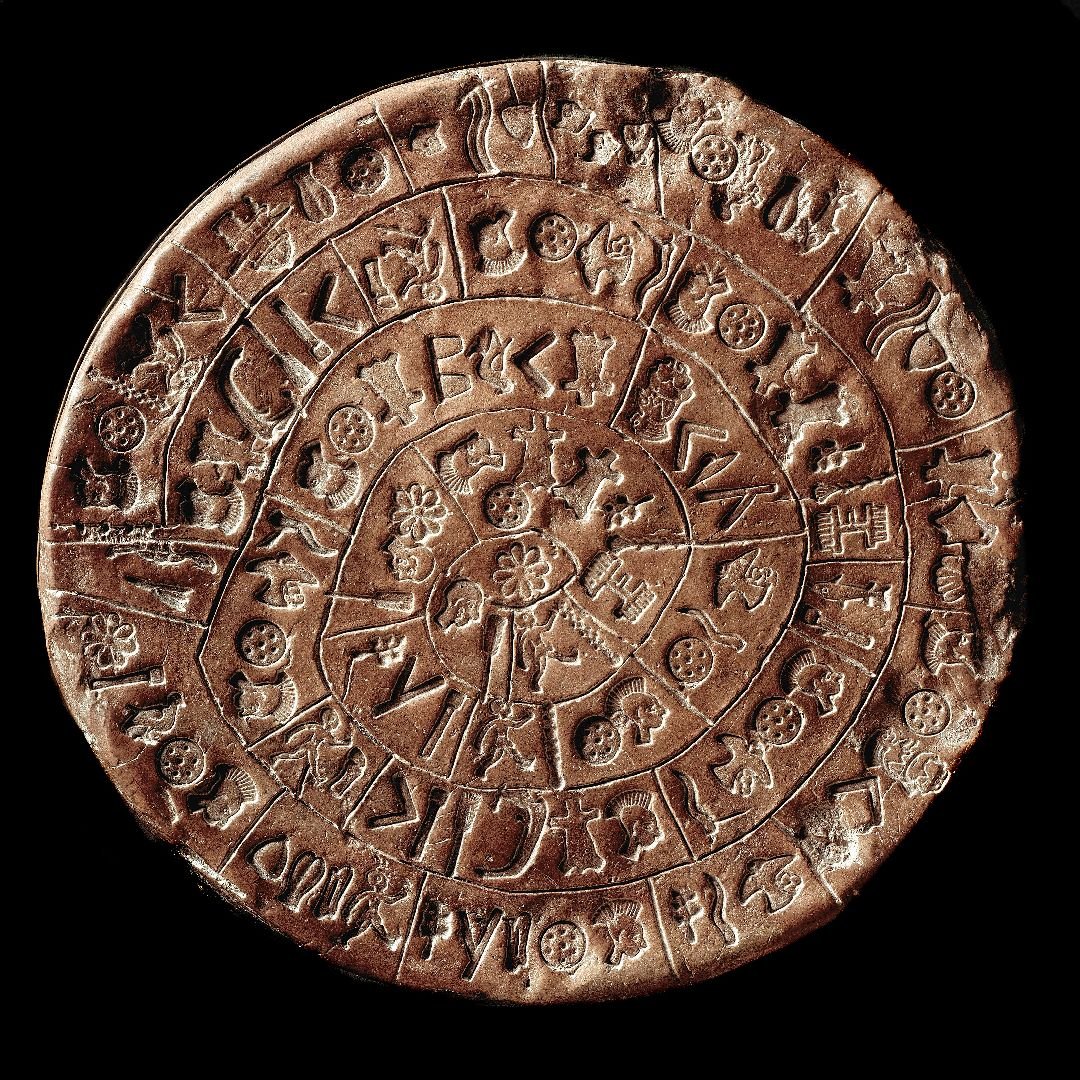
The disc was covered with symbols arranged in a spiral that wound inward toward the center. The signs were remarkably clear and carefully executed.
Even more surprising was the method used to create them.
Instead of being scratched by hand into wet clay, the symbols had been impressed using individual stamps.
This made the Phaistos Disc one of the oldest known examples of a form of printing technology.
Thousands of years before Gutenberg’s printing press transformed Europe, someone on Bronze Age Crete had apparently used reusable stamps to create written text.
The implications were astonishing.
What Exactly Is the Phaistos Disc?
The Phaistos Disc is a circular object made of fired clay.
It measures approximately 16 centimeters, or about 6 inches, in diameter. Both sides are covered with symbols arranged in a spiral pattern that begins near the outer edge and winds inward.
The disc contains a total of 241 individual impressions made from 45 distinct signs.
These signs depict a variety of images.
Some resemble human heads. Others appear to represent animals, tools, plants, weapons, or architectural features.
The symbols are grouped into sections separated by vertical lines, suggesting that the text may be divided into words, phrases, or sentences.
Both sides of the disc contain writing.
Archaeologists commonly refer to them as Side A and Side B.
The symbols were impressed into soft clay before the disc was fired, preserving them for thousands of years.
Remarkably, the object survived in excellent condition.
Today, scholars can study nearly every symbol with clarity.
Yet despite this preservation, understanding the message has proven extraordinarily difficult.
The Civilization Behind the Disc
To appreciate the mystery of the Phaistos Disc, it helps to understand the civilization that likely created it.
The Minoans flourished on Crete during the Bronze Age, roughly between 3000 and 1450 BCE.
Named after the legendary King Minos of Greek mythology, the civilization was unknown to modern history until archaeological excavations began uncovering its remains in the late nineteenth and early twentieth centuries.
The Minoans built impressive palaces at locations such as Knossos, Phaistos, Malia, and Zakros.
These were not merely royal residences. They served as administrative, economic, and religious centers.
Minoan art reveals a society deeply connected to the sea. Their frescoes depict dolphins, fish, ships, and lively scenes of human activity.
Unlike many contemporary civilizations, Minoan artwork often appears vibrant and energetic rather than dominated by images of warfare.
The Minoans developed writing systems, engaged in long-distance trade, and achieved remarkable levels of cultural sophistication.
Yet much about them remains mysterious.
Their language is still largely undeciphered.
Their religious beliefs are not fully understood.
The Phaistos Disc emerged from this enigmatic world.
Why the Disc Is So Difficult to Decipher
Many ancient scripts have eventually been deciphered.
Egyptian hieroglyphs yielded their secrets through the Rosetta Stone.
Cuneiform inscriptions were gradually decoded through comparative analysis.
Even Linear B, a script found on Crete, was deciphered in the twentieth century and revealed to represent an early form of Greek.
The Phaistos Disc presents a far greater challenge.
The biggest problem is the lack of evidence.
The entire text contains only 241 symbols.
That is an extremely small sample.
Imagine trying to understand an unknown language using only a few sentences and no translation.
The challenge would be enormous.
Now imagine having no other examples of the script anywhere in the world.
That is the situation researchers face with the Phaistos Disc.
No additional texts using the same exact writing system have ever been discovered.
The disc stands alone.
Without related inscriptions for comparison, decipherment becomes vastly more difficult.
Is It Even a Writing System?
One of the most fundamental questions surrounding the Phaistos Disc concerns whether it represents language at all.
Most scholars believe it does.
The symbols appear organized and structured. Repeated patterns suggest meaningful sequences rather than random decoration.
The grouping of symbols resembles the arrangement of words or phrases.
However, because the script remains undeciphered, certainty is impossible.
Some researchers have proposed that the symbols may represent syllables.
Others argue they could represent words, ideas, or religious concepts.
Still others have suggested that the disc might function more like a ritual object than a conventional document.
The uncertainty surrounding its purpose contributes significantly to the mystery.
Before scholars can read the text, they must understand what kind of text it is.
The Printing Technology Ahead of Its Time
One of the most extraordinary aspects of the Phaistos Disc has nothing to do with its message.
It concerns how the message was created.
Each symbol was made using a separate stamp pressed into wet clay.
This means someone first carved individual symbols into reusable tools.
These tools were then used repeatedly to create the text.
In effect, the creator employed movable type.
This technology would not become common again for thousands of years.
The discovery stunned archaeologists because it demonstrated a level of planning and sophistication rarely associated with Bronze Age writing systems.
The creator did not simply write the symbols.
They developed a method for reproducing them efficiently.
Why?
Nobody knows.
Perhaps many similar discs once existed.
Perhaps the text was intended for duplication.
Perhaps the stamps served administrative or religious purposes.
Unfortunately, without additional examples, these questions remain unanswered.
Theories About What the Disc Says
The mystery surrounding the Phaistos Disc has inspired countless interpretations.
Some scholars believe the text records a religious hymn.
Others propose that it contains prayers.
Some argue it may describe rituals performed within Minoan society.
A few researchers have suggested military content, legal instructions, or historical records.
There have even been proposals that the disc preserves poetry.
Because nobody has successfully deciphered the script, every interpretation remains speculative.
What makes the situation especially difficult is that different scholars often begin with different assumptions.
If one researcher assumes the language is Minoan, the resulting translation may look entirely different from one produced by someone assuming an Anatolian or Indo-European language.
Without independent confirmation, no theory has achieved widespread acceptance.
The Connection to Linear A
Many researchers have looked for connections between the Phaistos Disc and other Minoan scripts.
One candidate is Linear A.
Linear A was used on Crete before the appearance of Linear B. Hundreds of examples survive, yet the language represented by Linear A remains undeciphered.
Some symbols on the Phaistos Disc appear vaguely similar to signs found in Linear A.
This has led some scholars to speculate that the two systems may be related.
However, the similarities are limited.
Most experts believe the scripts are distinct.
If they are connected, the relationship is still poorly understood.
The possibility remains tantalizing because deciphering one script might eventually help explain the other.
For now, both continue to guard their secrets.
The Possibility of a Lost Language
The Phaistos Disc may preserve a language that has completely vanished.
Languages disappear throughout history for many reasons. Conquest, migration, cultural change, and population decline can erase linguistic traditions.
If the disc records a language spoken by the Minoans, it may represent a linguistic family that no longer exists.
This possibility complicates decipherment enormously.
Many successful decipherments rely upon connections to known languages.
When scholars deciphered Linear B, they eventually recognized patterns consistent with Greek.
No comparable breakthrough has occurred with the Phaistos Disc.
If the language belongs to an entirely lost family, researchers have far fewer clues to guide them.
The text may be preserving voices that disappeared thousands of years ago.
Could the Disc Be a Religious Object?
Many archaeologists believe religion may provide the best context for understanding the disc.
Several factors support this idea.
The object was discovered in a setting associated with ceremonial activity.
The repetitive structure of certain symbol groups resembles patterns often found in prayers, hymns, or ritual texts.
Ancient societies frequently created special objects for religious purposes.
A sacred text pressed into clay would not be unusual.
If the disc was intended for ritual use, its unique nature becomes easier to understand.
Religious artifacts are often produced in limited quantities.
They may contain specialized language or symbolic content.
Yet even if the disc is religious, that realization does not reveal its actual message.
The mystery remains intact.
The Idea of a Calendar
Another intriguing theory proposes that the disc may function as a calendar.
Supporters point to repeating patterns that could represent recurring cycles.
Ancient civilizations relied heavily on calendars for agriculture, religious festivals, and social organization.
The spiral arrangement might symbolize the cyclical nature of time.
Some researchers have attempted to identify lunar or solar patterns within the text.
While these interpretations are creative, none have gained broad scholarly acceptance.
The available evidence simply remains too limited.
The calendar theory illustrates a broader truth about the Phaistos Disc: many ideas seem possible, but none can be proven.
Was the Disc Imported From Elsewhere?
Not everyone agrees that the disc originated on Crete.
Some scholars have proposed that it may have arrived through trade.
The Bronze Age Mediterranean was highly interconnected.
Merchants traveled between Egypt, the Near East, Anatolia, Cyprus, and the Aegean.
Goods, ideas, technologies, and writing systems moved across vast distances.
The symbols on the disc differ significantly from known Minoan scripts.
This has led some researchers to wonder whether it reflects foreign influences.
Perhaps it originated in another culture and was brought to Crete.
If true, the challenge of decipherment becomes even more complicated.
Researchers may be searching for clues in the wrong linguistic tradition.
The Controversial Forgery Theory
Whenever an artifact appears unique, questions about authenticity eventually arise.
The Phaistos Disc is no exception.
A small number of researchers have suggested that the object might be a forgery.
According to this theory, someone created the disc shortly before its discovery.
Supporters point to its uniqueness and the absence of similar examples.
However, most scholars reject this idea.
The archaeological context supports authenticity.
The disc was discovered during professional excavations conducted by experienced archaeologists.
Its manufacturing techniques, firing characteristics, and archaeological setting are generally consistent with an ancient origin.
While debates continue regarding many aspects of the disc, the majority of experts regard it as genuine.
The Rise of Modern Decipherment Attempts
The twentieth century saw countless efforts to decode the Phaistos Disc.
Each decade produced new interpretations.
Some scholars relied on linguistic analysis.
Others used statistical methods.
A few approached the problem through comparative mythology or religious symbolism.
Virtually every major ancient language of the Mediterranean has been proposed as the key.
Researchers have linked the text to Greek, Hittite, Luwian, Semitic languages, Egyptian influences, and various hypothetical languages.
Many proposed decipherments initially appeared convincing.
Yet none survived detailed scrutiny.
The problem is not producing a translation.
The problem is proving that the translation is correct.
Without independent evidence, almost any interpretation remains speculative.
Computers Enter the Investigation
Modern technology has brought new tools to the study of the disc.
Computer analysis allows researchers to identify patterns, frequencies, and structural relationships within the symbols.
Algorithms can compare sequences and test statistical probabilities.
Digital imaging provides detailed examinations of every impression.
Artificial intelligence has even begun assisting researchers in analyzing ancient scripts.
Despite these advances, the fundamental obstacle remains.
The sample size is simply too small.
Computers can reveal patterns, but patterns alone do not provide meaning.
The Phaistos Disc continues to resist interpretation even in the age of advanced computing.
Why the Mystery Captures the Imagination
The Phaistos Disc fascinates people because it represents something increasingly rare in the modern world.
Most mysteries eventually yield answers.
Archaeologists discover new evidence.
Scientists develop new techniques.
Historical puzzles become clearer.
The Phaistos Disc refuses to cooperate.
More than a century of research has failed to produce consensus.
Its message remains hidden.
There is something deeply compelling about encountering a genuine mystery.
Not a fictional puzzle created for entertainment.
A real mystery.
An authentic voice from the distant past that modern humanity cannot understand.
The disc reminds us how much of history remains unknown.
What the Disc Reveals About Lost Civilizations
Even without decipherment, the Phaistos Disc tells us important things about ancient societies.
It demonstrates that Bronze Age cultures were capable of remarkable innovation.
Its creators understood complex symbolic communication.
They experimented with printing technologies.
They developed artistic and organizational skills sophisticated enough to produce a carefully structured document.
The disc also highlights how fragile cultural memory can be.
Entire writing systems can disappear.
Languages can vanish.
Civilizations can leave behind artifacts that later generations cannot understand.
The Phaistos Disc serves as a powerful reminder that knowledge is not automatically preserved.
History contains many lost chapters.
The Human Desire to Understand
At its heart, the story of the Phaistos Disc is about more than archaeology.
It is about humanity’s desire to understand.
We naturally want answers.
When we encounter a message, we want to know what it says.
When we find evidence of another culture, we want to hear its voice.
The Phaistos Disc denies us that satisfaction.
Its symbols appear tantalizingly close to meaning.
They clearly represent intentional communication.
Someone carefully arranged them thousands of years ago.
Someone expected them to be understood.
Yet today their message remains inaccessible.
This creates a unique emotional connection across time.
We can see the communication.
We simply cannot hear it.
Could the Mystery Ever Be Solved?
Many scholars remain hopeful.
History offers reasons for optimism.
Numerous ancient scripts once considered undecipherable eventually yielded their secrets.
Unexpected discoveries can transform an entire field overnight.
A single bilingual inscription might provide the breakthrough researchers need.
Additional examples of the script could emerge from future excavations.
New analytical methods may reveal patterns currently overlooked.
The possibility of eventual decipherment cannot be dismissed.
Yet it is equally possible that the mystery may endure indefinitely.
If no additional texts exist and the language belongs to a completely lost linguistic tradition, the available evidence may never be sufficient.
The disc could remain unread forever.
Conclusion
The Phaistos Disc stands as one of the most extraordinary and frustrating mysteries in archaeology. Discovered in 1908 among the ruins of Bronze Age Crete, it preserves a message from a distant world that modern scholars cannot decipher. Its spiral arrangement of stamped symbols, its apparent use of early printing technology, and its complete uniqueness make it unlike any other artifact from antiquity.
Over the past century, researchers have proposed countless explanations. They have interpreted it as a prayer, a hymn, a calendar, a legal text, a ritual object, and much more. Yet none of these theories has achieved consensus because the fundamental challenge remains unchanged: nobody knows what the symbols mean.
The Phaistos Disc is more than an archaeological puzzle. It is a symbol of the vast stretches of human history that remain hidden from view. It reminds us that entire languages, traditions, and ways of thinking can disappear, leaving behind only fragments that later generations struggle to understand.
Perhaps one day a new discovery will unlock its secrets. Perhaps another inscription will emerge from the soil of Crete or some distant corner of the Mediterranean. Until then, the Phaistos Disc remains what it has been for more than a century: an unbreakable code from antiquity, silently carrying a message across thousands of years, waiting for someone to finally understand its voice.