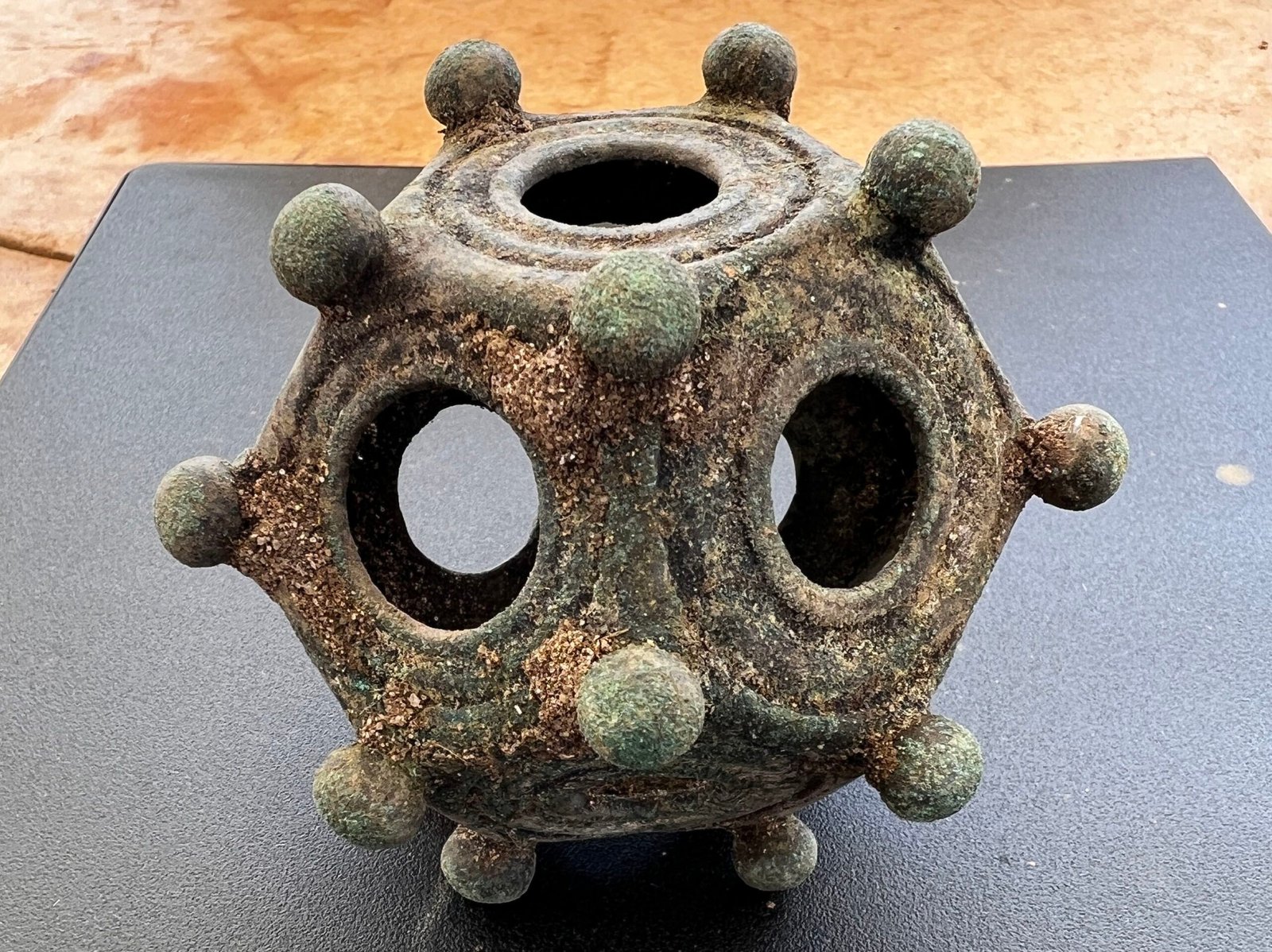
Imagine holding an object crafted nearly 2,000 years ago by skilled Roman hands. It is made of bronze, surprisingly intricate, and covered with twelve perfectly shaped pentagonal faces. Each face has a circular hole, but no two holes are exactly the same size. Small rounded knobs decorate every corner, giving it an appearance that is both elegant and mysterious.
You turn it over in your hands, searching for clues. Is it a scientific instrument? A religious object? A toy? A weapon? A tool for craftsmen? A symbol of status?
No one knows.
For more than three centuries, archaeologists, historians, engineers, and enthusiasts have debated the purpose of these extraordinary objects. Hundreds have been discovered across Europe, yet not a single ancient Roman text clearly explains what they were for. No paintings depict them. No sculptures show people using them. No inscriptions identify their purpose.
These curious objects are known today as the Roman dodecahedrons, and they remain one of archaeology’s greatest unsolved mysteries.
A Shape Unlike Anything Else
A dodecahedron is a three-dimensional geometric shape with twelve flat pentagonal faces. The word comes from Greek, meaning “twelve faces.”
The Roman dodecahedrons are hollow bronze objects, usually about the size of a baseball, although their dimensions vary considerably. Most measure between 4 and 11 centimeters (roughly 1.5 to 4.5 inches) across.
Each of the twelve pentagonal faces contains a circular hole. The diameter of these holes differs from one face to another, creating a unique pattern on every artifact. At each of the twenty corners sits a small rounded knob or sphere, carefully cast as part of the object.
Many examples show remarkable craftsmanship. Their surfaces are smooth, their symmetry impressive, and their construction suggests experienced metalworkers using sophisticated casting techniques.
The effort required to produce these objects indicates they were important enough to justify skilled labor and valuable bronze.
Yet their purpose remains unknown.
The Discovery of a Mystery
The first Roman dodecahedron entered the historical record in the eighteenth century.
Since then, archaeologists have uncovered more than 130 examples, and new discoveries continue to appear occasionally through archaeological excavations and accidental finds.
Unlike many famous Roman artifacts, these objects are not concentrated around the city of Rome or throughout the Mediterranean world.
Instead, nearly all known examples come from the northwestern provinces of the Roman Empire.
They have been discovered in modern-day France, Belgium, Luxembourg, Germany, the Netherlands, Switzerland, Austria, and parts of the United Kingdom.
This unusual geographical pattern is one of the first clues—and one of the greatest puzzles.
If the objects served an essential function throughout the Roman Empire, why are they almost entirely absent from Italy, Spain, Greece, North Africa, and the eastern provinces?
The distribution suggests they may have been associated with local traditions or specialized activities rather than everyday Roman life.
Life on Rome’s Northern Frontier
To understand these artifacts, it helps to imagine the world in which they existed.
The Roman Empire reached its greatest size during the second century AD, stretching from Britain to the Middle East.
Its northern frontier crossed forests, rivers, and rugged landscapes inhabited by Celtic and Germanic peoples. Roman soldiers guarded forts along the frontier, merchants traded goods across provinces, farmers cultivated fertile land, and towns flourished under Roman administration.
The dodecahedrons appear almost exclusively within this frontier region.
Some have been found in military camps.
Others come from settlements, villas, graves, or hoards buried underground.
This wide variety of archaeological contexts complicates the search for their purpose.
If they belonged only to soldiers, why are they found in civilian communities?
If they were household tools, why do some appear in graves?
If they had religious significance, why do they occur in so many different settings?
Each discovery raises as many questions as it answers.
Beautifully Made but Surprisingly Varied
Although Roman dodecahedrons share the same general design, no two are exactly alike.
Some are carefully decorated with engraved lines or concentric circles.
Others are relatively plain.
Hole sizes differ greatly.
Overall dimensions vary.
The spacing between knobs changes.
The bronze alloys used in casting are not identical.
This variation suggests they were not mass-produced according to strict government standards.
Instead, local craftsmen may have created them individually, perhaps for customers with particular needs or preferences.
If so, whatever purpose they served allowed considerable flexibility in design.
A Mystery Hidden in Silence
Perhaps the most frustrating aspect of the Roman dodecahedrons is the complete silence of written history.
The Romans left behind an enormous amount of literature.
They wrote books on engineering, agriculture, architecture, medicine, surveying, astronomy, religion, military tactics, and daily life.
Many ordinary objects are described in remarkable detail.
Yet no surviving Roman text clearly mentions bronze dodecahedrons matching these mysterious artifacts.
This absence has puzzled historians for generations.
It is possible that references once existed but were lost over time.
Ancient libraries disappeared through war, decay, and changing political circumstances. Only a small fraction of Roman literature survives today.
Even so, considering how distinctive these objects are, their silence in surviving records remains remarkable.
Were They Religious Objects?
One of the oldest theories suggests that the dodecahedrons had a religious purpose.
Religion played a central role in Roman society. Sacred objects were used during rituals, offerings, festivals, and ceremonies honoring numerous gods.
The dodecahedrons’ symmetrical design and impressive appearance could certainly fit within a ceremonial context.
Some examples have been discovered near temples or within archaeological settings that may have had ritual significance.
However, there is no direct evidence connecting them with any known Roman religious practice.
No inscriptions invoke gods.
No statues depict priests holding them.
No temple inventories mention them.
Without stronger evidence, the religious theory remains possible but unproven.
Could They Have Been Measuring Instruments?
Another popular idea is that Roman dodecahedrons functioned as measuring devices.
The different-sized holes immediately encourage this interpretation.
Some researchers have proposed that users looked through pairs of holes to estimate distances to objects of known size.
By aligning two holes, the device could theoretically create a fixed viewing angle, allowing calculations based on geometry.
The Romans possessed advanced knowledge of surveying and engineering.
They built roads, bridges, aqueducts, and monumental buildings requiring extraordinary precision.
Simple optical measuring tools were certainly within their technological capabilities.
Experimental archaeologists have demonstrated that dodecahedrons can indeed be used to estimate distances under certain conditions.
Yet problems remain.
No standardized hole sizes exist.
Different dodecahedrons produce different viewing angles.
No accompanying scales or markings appear on the artifacts.
If they were official surveying instruments, one might expect much greater consistency.
The measuring theory remains intriguing but incomplete.
A Tool for Craftsmen?
Some scholars believe the dodecahedrons may have been practical tools used by artisans.
The varying hole diameters could have helped measure rods, pipes, or wires.
Others suggest they served as gauges for determining object sizes during manufacturing.
Because Roman craftsmen produced complex metalwork, textiles, leather goods, and construction materials, specialized measuring tools certainly existed.
However, heavy bronze dodecahedrons seem unusually elaborate for ordinary workshop equipment.
Moreover, no examples have been found alongside obvious manufacturing setups in a way that clearly identifies their use.
The Candle Holder Theory
One of the more recent ideas emerged after experiments demonstrated that candles could be inserted through the holes.
Wax drips discovered inside a few dodecahedrons encouraged speculation that they functioned as decorative candle holders.
Placed over a candle, the bronze object would create fascinating patterns of light shining through its various openings.
The rounded knobs would also stabilize the object when resting on a flat surface.
While visually appealing, this explanation faces important challenges.
Most archaeologists believe the wax likely accumulated long after the objects were originally made. Ancient artifacts often acquired secondary uses over centuries.
Just because an object can hold a candle today does not necessarily mean that was its original purpose.
A Device for Knitting Gloves?
One of the most unexpected theories gained widespread public attention in recent years.
Some modern craftspeople demonstrated that woolen gloves with individual fingers can be knitted using bronze dodecahedrons as measuring guides.
The various hole sizes conveniently correspond to different finger widths.
This idea is certainly imaginative.
Romans living in northern Europe experienced cold winters, and knitted or woven clothing was important.
However, there is no archaeological evidence that the dodecahedrons were associated with textile production.
No Roman texts connect them with knitting.
Moreover, knitting as it is practiced today developed much later than the Roman period, although earlier forms of looped textile techniques certainly existed.
Most specialists therefore remain cautious about accepting this explanation.
Military Equipment?
Because several dodecahedrons have been discovered near Roman forts, some researchers have suggested a military connection.
Could they have helped soldiers estimate enemy distances?
Were they components of signaling equipment?
Did they belong to artillery crews?
Perhaps they served as symbols of rank or specialized training.
Roman armies were highly organized and used many specialized instruments.
Yet again, evidence is lacking.
No military manuals describe them.
No surviving depictions of Roman soldiers include such objects.
Their relatively limited geographical distribution also makes an empire-wide military function less likely.
Objects of Prestige
Another possibility is that Roman dodecahedrons served primarily as luxury items.
Bronze was valuable.
Producing these objects required considerable skill.
Owning one may have signaled wealth, education, or social status.
Throughout history, many societies have created objects valued more for symbolism than practical function.
Beautifully crafted artifacts often communicated identity, prestige, or cultural affiliation.
Some dodecahedrons may indeed have held symbolic meaning for local elites.
However, this explanation still leaves unanswered why they were designed with such specific geometric features.
The Importance of Context
Archaeologists often solve mysteries not by studying objects alone but by examining where they are found.
The surrounding soil, nearby buildings, associated artifacts, and burial conditions all provide valuable clues.
Unfortunately, many Roman dodecahedrons were discovered centuries ago under poorly documented circumstances.
Some were found by farmers.
Others appeared during construction work.
Many entered private collections before modern archaeological methods existed.
As a result, crucial contextual information was lost forever.
Every undocumented discovery makes the mystery a little harder to solve.
Experimental Archaeology
One of the most exciting approaches to this puzzle is experimental archaeology.
Rather than relying only on speculation, researchers create accurate replicas of Roman dodecahedrons and test different proposed uses.
They evaluate whether the objects function effectively as measuring devices, candle holders, surveying tools, knitting aids, astronomical instruments, or mechanical gauges.
This hands-on approach helps eliminate ideas that simply do not work in practice.
Some theories perform surprisingly well.
Others quickly reveal serious flaws.
Experimental archaeology cannot prove an object’s original purpose, but it helps narrow the range of realistic possibilities.
Why the Mystery Persists
People often wonder why experts cannot simply determine what the objects were for.
The answer lies in how archaeology works.
Most artifacts become understandable because multiple forms of evidence support one another.
Written records describe them.
Artistic depictions illustrate their use.
Examples appear in recognizable settings.
Associated tools provide context.
Wear patterns reveal repeated activities.
For Roman dodecahedrons, nearly all of these sources of evidence are missing or ambiguous.
Without clear documentation, researchers must rely on careful interpretation rather than certainty.
Science sometimes advances by acknowledging what remains unknown.
Could There Be More Than One Answer?
An increasingly accepted possibility is that there may never have been a single universal purpose.
Different communities may have used similar objects in different ways.
A dodecahedron originally created for one function could later have been reused for another.
This would explain the diversity of archaeological contexts and the variation in design.
Many objects throughout history have had multiple lives.
A ceremonial vessel can become a household container.
A military tool can become a family heirloom.
An expensive object can pass through generations, acquiring new meanings along the way.
The Roman dodecahedrons may have followed similarly complex histories.
What New Discoveries Could Reveal
The mystery is not impossible to solve.
Future discoveries may transform our understanding overnight.
An exceptionally well-preserved archaeological site could reveal a dodecahedron alongside unmistakable evidence of its use.
A newly discovered Roman manuscript might describe the object directly.
Advanced scientific techniques could identify microscopic traces of materials once handled by the artifacts.
Residue analysis, high-resolution imaging, metallurgical studies, and three-dimensional scanning continue to improve each year.
As archaeological science advances, even familiar artifacts can yield surprising new information.
Why People Love Unsolved Mysteries
The Roman dodecahedrons capture our imagination because they remind us that history is never completely known.
The Roman Empire is one of the best-studied civilizations in the world.
Millions of artifacts have been excavated.
Thousands of ancient texts survive.
Magnificent buildings still stand.
Yet these small bronze objects continue to resist explanation.
They challenge the comforting belief that science already has every answer.
Instead, they reveal an important truth: archaeology is an ongoing investigation, not a completed story.
Every excavation has the potential to rewrite history.
A Puzzle That Connects Past and Present
There is something deeply human about the Roman dodecahedrons.
Nearly two thousand years ago, someone carefully designed them, shaped molten bronze into intricate forms, polished their surfaces, and carried them through daily life. Whoever owned these objects almost certainly understood exactly what they were for. To them, there was no mystery at all.
Today, those ordinary explanations have vanished.
What remains is a silent puzzle that has crossed twenty centuries.
The Roman dodecahedrons remind us that history is not merely a collection of dates and famous names. It is also made of forgotten tools, lost traditions, and unanswered questions. They encourage humility, curiosity, and patience—qualities at the heart of both archaeology and science.
Perhaps one day a remarkable discovery will finally reveal their true purpose. Until then, these elegant bronze objects continue to fascinate scholars and the public alike, standing as one of the Roman world’s most enduring enigmas. They are proof that even in one of history’s most extensively studied civilizations, some secrets remain hidden, waiting for the moment when the past is finally ready to speak.